Kim Wan Kyu, Marcotte Edward M
Center for Systems and Synthetic Biology, Institute for Cellular and Molecular Biology, University of Texas at Austin, Austin, Texas, United States of America.
PLoS Comput Biol. 2008 Nov;4(11):e1000232. doi: 10.1371/journal.pcbi.1000232. Epub 2008 Nov 28.
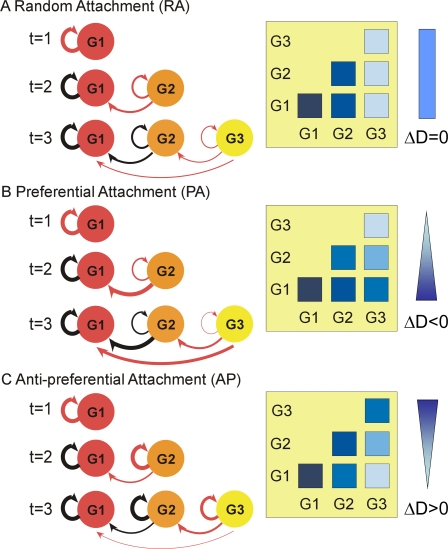
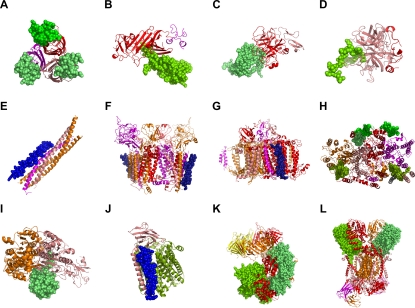
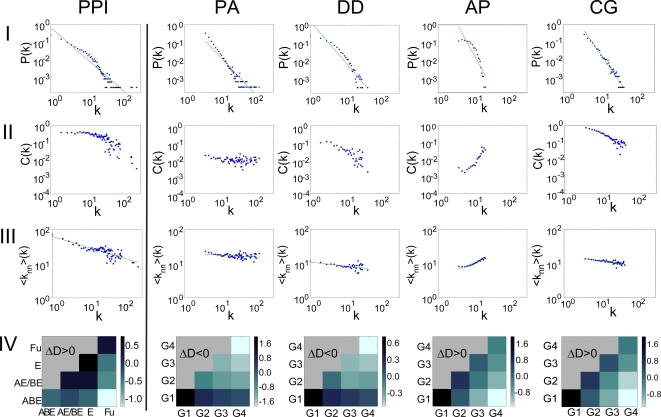
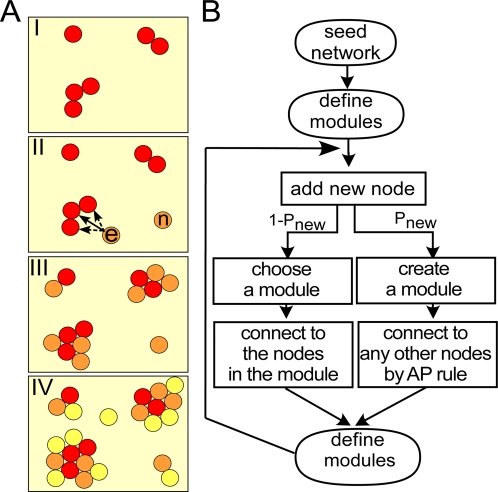
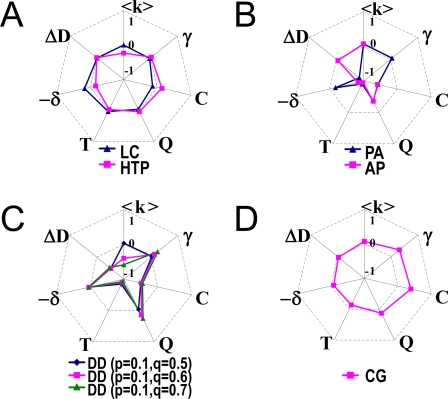
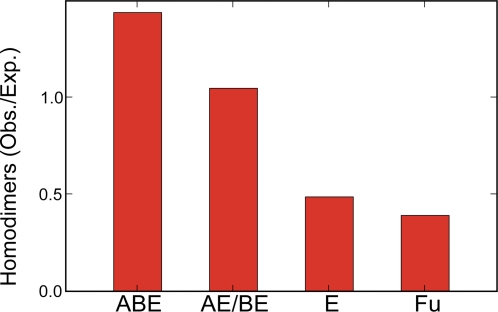
Proteins interact in complex protein-protein interaction (PPI) networks whose topological properties-such as scale-free topology, hierarchical modularity, and dissortativity-have suggested models of network evolution. Currently preferred models invoke preferential attachment or gene duplication and divergence to produce networks whose topology matches that observed for real PPIs, thus supporting these as likely models for network evolution. Here, we show that the interaction density and homodimeric frequency are highly protein age-dependent in real PPI networks in a manner which does not agree with these canonical models. In light of these results, we propose an alternative stochastic model, which adds each protein sequentially to a growing network in a manner analogous to protein crystal growth (CG) in solution. The key ideas are (1) interaction probability increases with availability of unoccupied interaction surface, thus following an anti-preferential attachment rule, (2) as a network grows, highly connected sub-networks emerge into protein modules or complexes, and (3) once a new protein is committed to a module, further connections tend to be localized within that module. The CG model produces PPI networks consistent in both topology and age distributions with real PPI networks and is well supported by the spatial arrangement of protein complexes of known 3-D structure, suggesting a plausible physical mechanism for network evolution.
蛋白质在复杂的蛋白质-蛋白质相互作用(PPI)网络中相互作用,其拓扑特性,如无标度拓扑、层次模块化和异配性,为网络进化模型提供了线索。目前较受欢迎的模型采用优先连接或基因复制与分化来生成拓扑结构与真实PPI网络相匹配的网络,从而支持这些模型作为网络进化的可能模型。在此,我们表明,在真实的PPI网络中,相互作用密度和同二聚体频率高度依赖于蛋白质年龄,其方式与这些经典模型不一致。鉴于这些结果,我们提出了一种替代的随机模型,该模型以类似于溶液中蛋白质晶体生长(CG)的方式,将每个蛋白质依次添加到一个不断增长的网络中。关键思想如下:(1)相互作用概率随着未占据相互作用表面的可用性增加而增加,因此遵循反优先连接规则;(2)随着网络的增长,高度连接的子网会形成蛋白质模块或复合物;(3)一旦一个新蛋白质进入一个模块,进一步的连接往往局限于该模块内。CG模型产生的PPI网络在拓扑结构和年龄分布上均与真实的PPI网络一致,并且得到了已知三维结构的蛋白质复合物空间排列的有力支持,这表明了一种合理的网络进化物理机制。