Boulenger Véronique, Hauk Olaf, Pulvermüller Friedemann
Medical Research Council, Cognition and Brain Sciences Unit, 15 Chaucer Road, Cambridge CB2 7EF, UK.
Cereb Cortex. 2009 Aug;19(8):1905-14. doi: 10.1093/cercor/bhn217. Epub 2008 Dec 9.
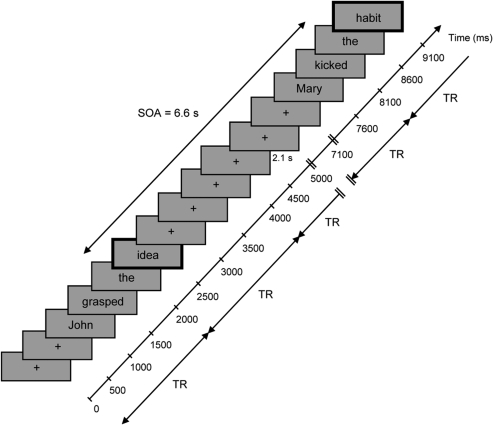
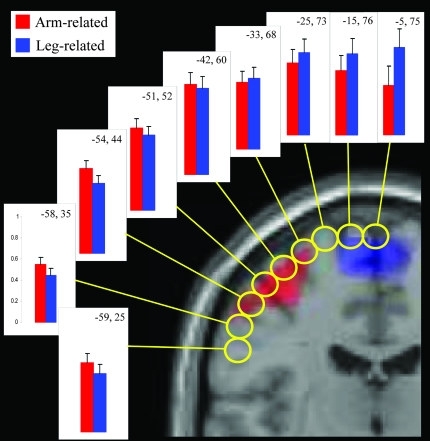
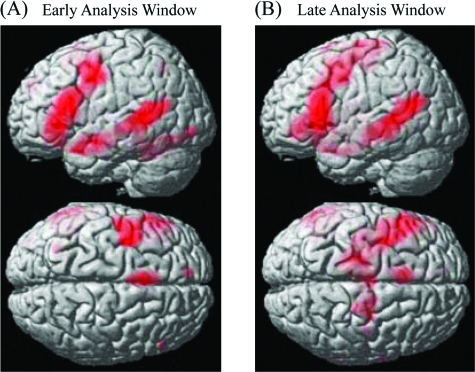
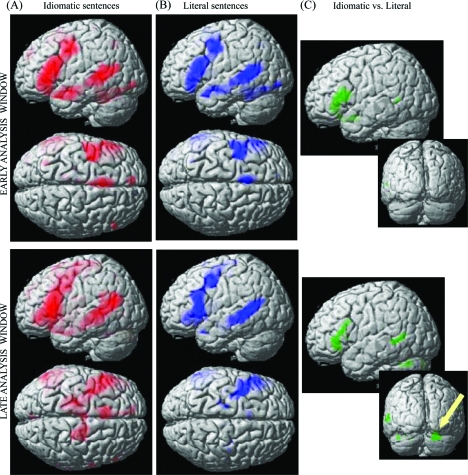
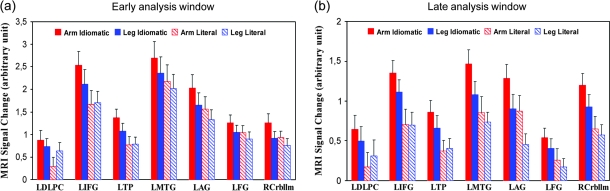
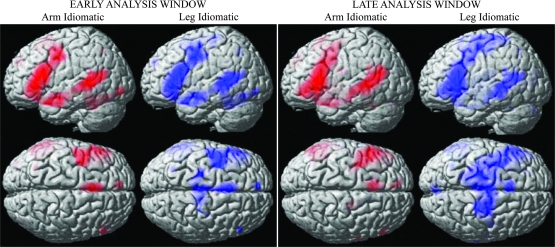
Single words and sentences referring to bodily actions activate the motor cortex. However, this semantic grounding of concrete language does not address the critical question whether the sensory-motor system contributes to the processing of abstract meaning and thought. We examined functional magnetic resonance imaging activation to idioms and literal sentences including arm- and leg-related action words. A common left fronto-temporal network was engaged in sentence reading, with idioms yielding relatively stronger activity in (pre)frontal and middle temporal cortex. Crucially, somatotopic activation along the motor strip, in central and precentral cortex, was elicited by idiomatic and literal sentences, reflecting the body part reference of the words embedded in the sentences. Semantic somatotopy was most pronounced after sentence ending, thus reflecting sentence-level processing rather than that of single words. These results indicate that semantic representations grounded in the sensory-motor system play a role in the composition of sentence-level meaning, even in the case of idioms.
指代身体动作的单个单词和句子会激活运动皮层。然而,这种具体语言的语义基础并未解决一个关键问题,即感觉运动系统是否有助于抽象意义和思维的处理。我们研究了对包含与手臂和腿部相关动作词汇的习语和字面句子的功能磁共振成像激活情况。一个常见的左额颞叶网络参与句子阅读,习语在额叶(前)和颞中皮层产生相对更强的活动。至关重要的是,习语和字面句子会引发中央和中央前皮层沿运动带的躯体定位激活,反映了句子中所嵌入单词的身体部位指代。语义躯体定位在句子结束后最为明显,因此反映的是句子层面的处理而非单个单词的处理。这些结果表明,基于感觉运动系统的语义表征在句子层面意义的构成中发挥作用,即使在习语的情况下也是如此。