Dandona R, Kumar G A, Ameer M A, Ahmed G M, Dandona L
George Institute for International Health - India, Hyderabad, India.
Inj Prev. 2008 Dec;14(6):354-9. doi: 10.1136/ip.2008.019620.
The scale of road traffic injuries (RTIs) in India is uncertain because of limitations in the availability and reliability of incidence data.
To report these data for Hyderabad city in southern India.
In a cross-sectional population-based survey, 10 459 participants aged 5-49 years (94.3% participation), selected using three-stage systematic cluster sampling, were interviewed. Participants recalled RTIs in the preceding 3 months and RTI-related death and disability in the household in the preceding 3 years. RTI was defined as an injury resulting from a road traffic crash irrespective of the severity.
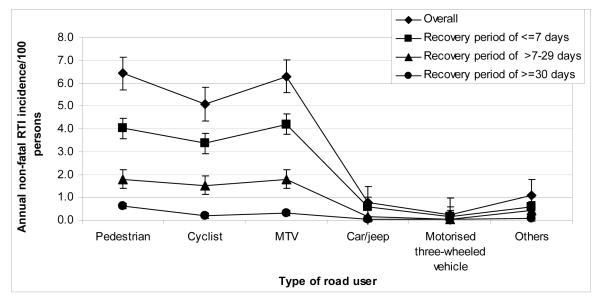
The age/sex-adjusted annual incidence of non-fatal RTI requiring a recovery period of < or =7, 8-29, and > or =30 days was 13% (95% CI 12.6% to 13.4%), 5.8% (95% CI 5.5% to 6.0%), and 1.2% (95% CI 1.1% to 1.4%), respectively. The overall adjusted rate for non-fatal RTI was 20.7% (95% CI 20.0% to 21.3%). The relative risk of RTI requiring a recovery period of >7 days was significantly higher in the third per capita monthly income quartile (1.24 (95% CI 1.12 to 1.37); p<0.05). The incidence of non-fatal RTI was highest in pedestrians, motorized two-wheeled vehicle users, and cyclists: 6.4, 6.3, and 5.1/100 persons/year, respectively. Annual RTI mortality and disability rates were 38.2 (95% CI 17.5 to 58.8) and 35.1 (95% CI 12.4 to 57.7) per 100,000 population, respectively.
There is a high burden of RTI in this urban population. With the recent attention focused on RTI by the Government of India, these findings may assist in planning appropriate initiatives to reduce the RTI burden.
由于发病率数据的可得性和可靠性存在局限,印度道路交通伤害(RTIs)的规模尚不确定。
报告印度南部海得拉巴市的这些数据。
在一项基于人群的横断面调查中,采用三阶段系统整群抽样选取了10459名年龄在5至49岁的参与者(参与率为94.3%)并进行访谈。参与者回忆前3个月内的道路交通伤害以及前3年内家庭中与道路交通伤害相关的死亡和残疾情况。道路交通伤害被定义为不论严重程度如何,由道路交通事故导致的损伤。
需要<或=7天、8至29天以及>或=30天恢复期的非致命道路交通伤害的年龄/性别调整年发病率分别为13%(95%可信区间12.6%至13.4%)、5.8%(95%可信区间5.5%至6.0%)和1.2%(95%可信区间1.1%至1.4%)。非致命道路交通伤害的总体调整率为20.7%(95%可信区间20.0%至21.3%)。在人均月收入第三个四分位数组中,需要>7天恢复期的道路交通伤害的相对风险显著更高(1.24(95%可信区间1.12至1.37);p<0.05)。非致命道路交通伤害的发病率在行人、电动两轮车使用者和骑自行车者中最高:分别为6.4、6.3和5.1/100人/年。道路交通伤害的年死亡率和残疾率分别为每10万人口38.2(95%可信区间17.5至58.8)和35.1(95%可信区间12.4至57.7)。
在这个城市人群中道路交通伤害负担很重。鉴于印度政府最近对道路交通伤害的关注,这些发现可能有助于规划适当的举措以减轻道路交通伤害负担。