Inaoka Yoshihiko, Yazawa Takashi, Mizutani Tetsuya, Kokame Koichi, Kangawa Kenji, Uesaka Miki, Umezawa Akihiro, Miyamoto Kaoru
Department of Biochemistry, Faculty of Medical Sciences, University of Fukui, Fukui, Japan.
Reprod Biol Endocrinol. 2008 Dec 16;6:62. doi: 10.1186/1477-7827-6-62.
P450 oxidoreductase (POR) catalyzes electron transfer to microsomal P450 enzymes. Its deficiency causes Antley-Bixler syndrome (ABS), and about half the patients with ABS have ambiguous genitalia and/or impaired steroidogenesis. POR mRNA expression is up-regulated when mesenchymal stem cells (MSCs) differentiate into steroidogenic cells, suggesting that the regulation of POR gene expression is important for steroidogenesis. In this context we examined the regulation of POR expression in ovarian granulosa cells by gonadotropins, and its possible role in steroidogenesis.
Changes in gene expression in MSCs during differentiation into steroidogenic cells were examined by DNA microarray analysis. Changes in mRNA and protein expression of POR in the rat ovary or in granulosa cells induced by gonadotropin treatment were examined by reverse transcription-polymerase chain reaction and western blotting. Effects of transient expression of wild-type or mutant (R457H or V492E) POR proteins on the production of estrone in COS-7 cells were examined in vitro. Effects of POR knockdown were also examined in estrogen producing cell-line, KGN cells.
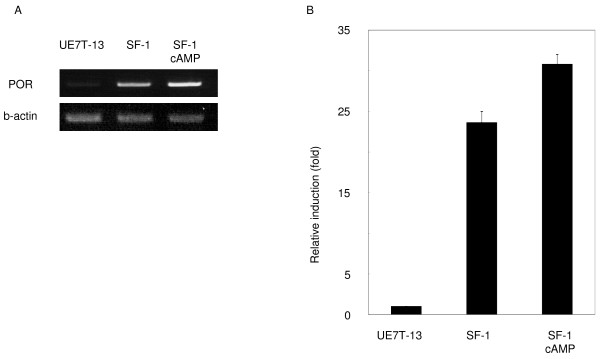
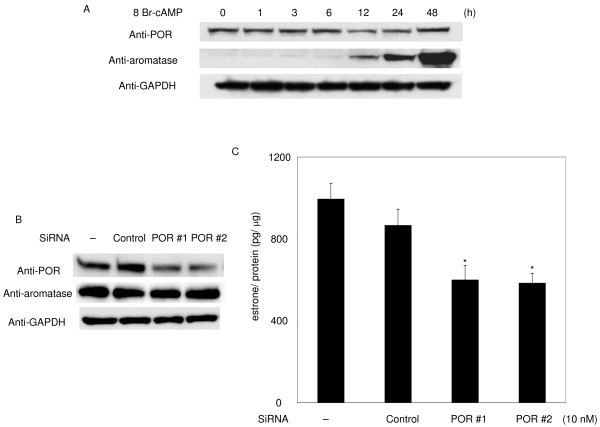
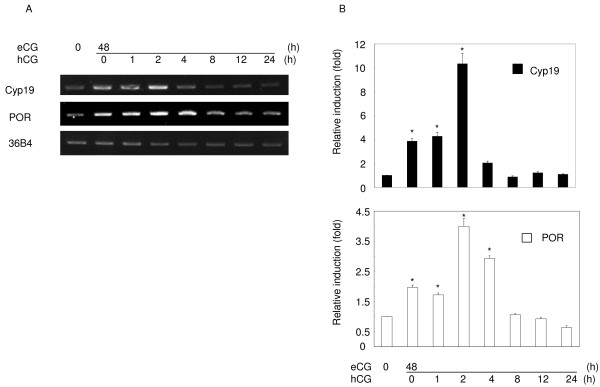
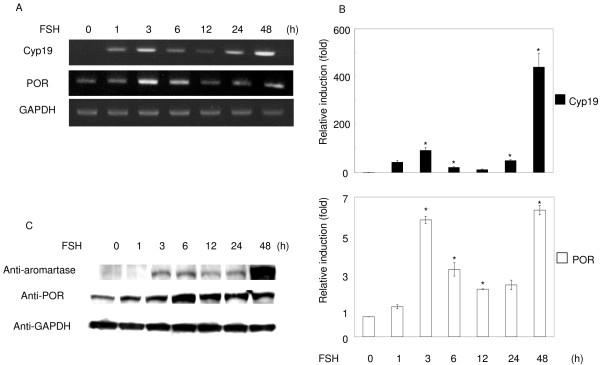
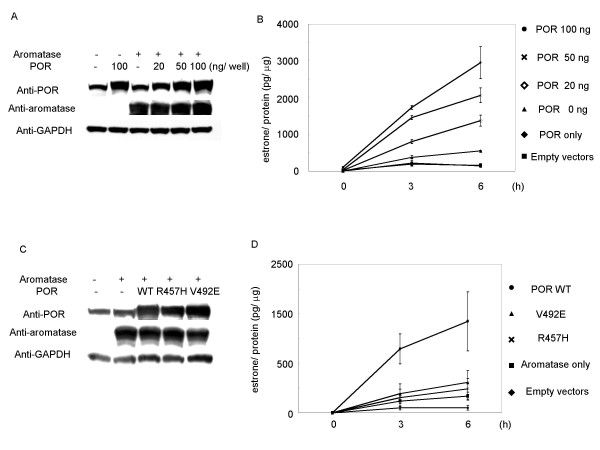
POR mRNA was induced in MSCs following transduction with the SF-1 retrovirus, and was further increased by cAMP treatment. Expression of POR mRNA, as well as Cyp19 mRNA, in the rat ovary were induced by equine chorionic gonadotropin and human chorionic gonadotropin. POR mRNA and protein were also induced by follicle stimulating hormone in primary cultured rat granulosa cells, and the induction pattern was similar to that for aromatase. Transient expression of POR in COS-7 cells, which expressed a constant amount of aromatase protein, greatly increased the rate of conversion of androstenedione to estrone, in a dose-dependent manner. The expression of mutant POR proteins (R457H or V492E), such as those found in ABS patients, had much less effect on aromatase activity than expression of wild-type POR proteins. Knockdown of endogenous POR protein in KGN human granulosa cells led to reduced estrone production, indicating that endogenous POR affected aromatase activity.
We demonstrated that the expression of POR, together with that of aromatase, was regulated by gonadotropins, and that its induction could up-regulate aromatase activity in the ovary, resulting in a coordinated increase in estrogen production.
细胞色素P450氧化还原酶(POR)催化电子传递至微粒体细胞色素P450酶。其缺乏会导致安特利-比克斯勒综合征(ABS),约一半的ABS患者存在生殖器模糊和/或类固醇生成受损。间充质干细胞(MSC)分化为类固醇生成细胞时,POR mRNA表达上调,提示POR基因表达的调控对类固醇生成很重要。在此背景下,我们研究了促性腺激素对卵巢颗粒细胞中POR表达的调控及其在类固醇生成中的可能作用。
通过DNA微阵列分析检测MSC分化为类固醇生成细胞过程中的基因表达变化。采用逆转录-聚合酶链反应和蛋白质免疫印迹法检测促性腺激素处理诱导的大鼠卵巢或颗粒细胞中POR的mRNA和蛋白质表达变化。在体外检测野生型或突变型(R457H或V492E)POR蛋白瞬时表达对COS-7细胞中雌酮生成的影响。在雌激素产生细胞系KGN细胞中也检测了POR基因敲低的影响。
用SF-1逆转录病毒转导后,MSC中POR mRNA被诱导,cAMP处理后进一步增加。马绒毛膜促性腺激素和人绒毛膜促性腺激素可诱导大鼠卵巢中POR mRNA以及Cyp19 mRNA的表达。促卵泡激素也可诱导原代培养的大鼠颗粒细胞中POR mRNA和蛋白质表达,其诱导模式与芳香化酶相似。在表达恒定数量芳香化酶蛋白的COS-7细胞中瞬时表达POR,可使雄烯二酮向雌酮的转化速率以剂量依赖方式大幅增加。ABS患者中发现的突变型POR蛋白(R457H或V492E)的表达对芳香化酶活性的影响远小于野生型POR蛋白的表达。敲低KGN人颗粒细胞中的内源性POR蛋白会导致雌酮生成减少,表明内源性POR影响芳香化酶活性。
我们证明,POR的表达与芳香化酶的表达一样,受促性腺激素调控,其诱导可上调卵巢中芳香化酶活性,从而导致雌激素生成协同增加。