Carmona-Fontaine Carlos, Matthews Helen K, Kuriyama Sei, Moreno Mauricio, Dunn Graham A, Parsons Maddy, Stern Claudio D, Mayor Roberto
Department of Anatomy and Developmental Biology, University College London, London WC1E 6BT, UK.
Nature. 2008 Dec 18;456(7224):957-61. doi: 10.1038/nature07441. Epub 2008 Dec 10.
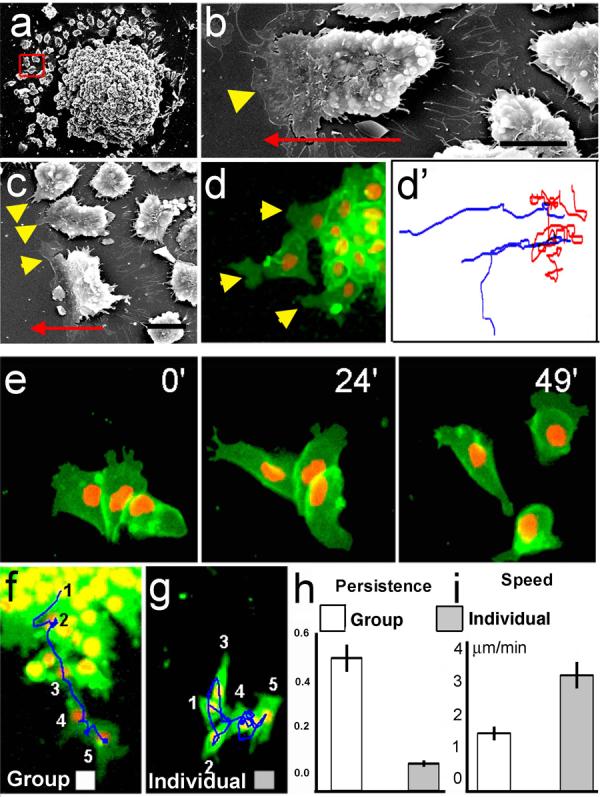
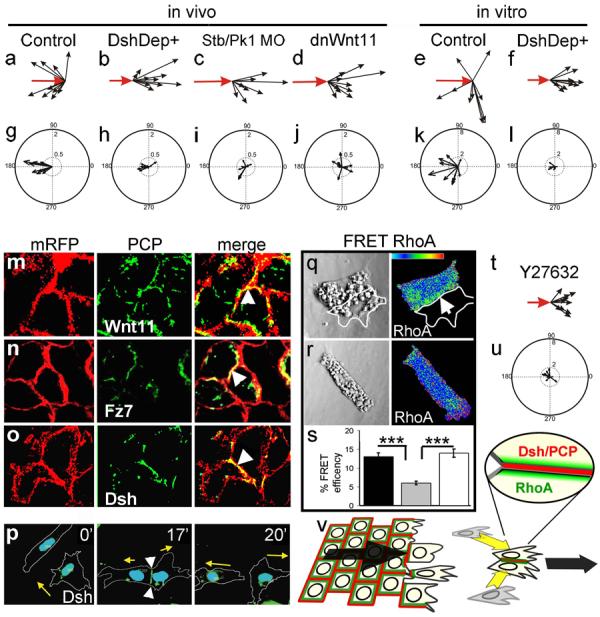
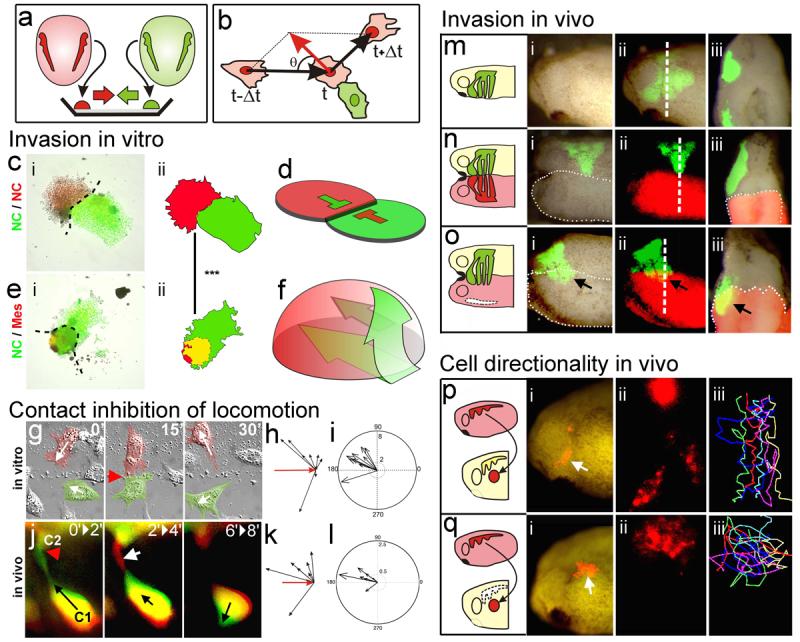
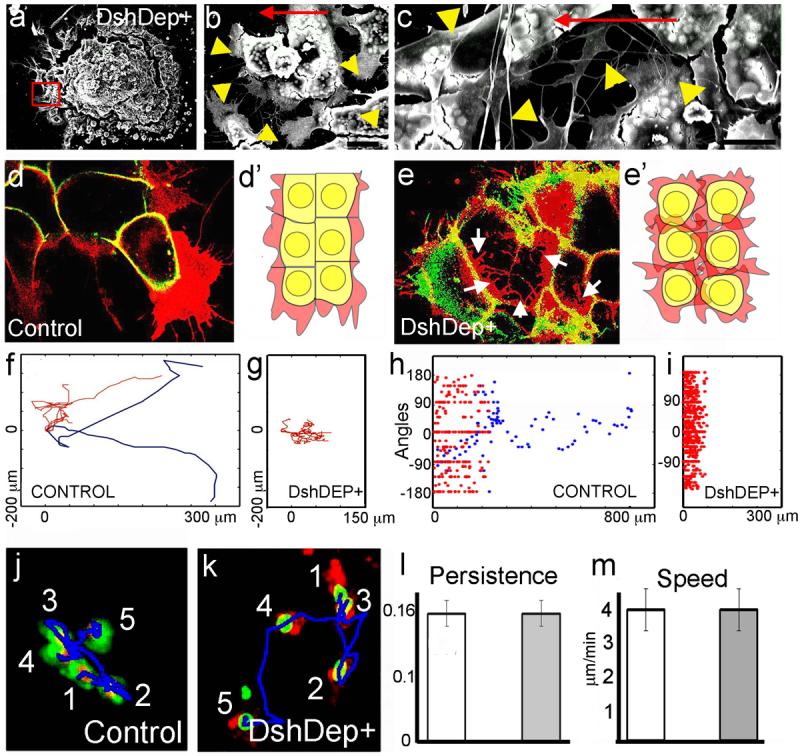
Contact inhibition of locomotion was discovered by Abercrombie more than 50 years ago and describes the behaviour of fibroblast cells confronting each other in vitro, where they retract their protrusions and change direction on contact. Its failure was suggested to contribute to malignant invasion. However, the molecular basis of contact inhibition of locomotion and whether it also occurs in vivo are still unknown. Here we show that neural crest cells, a highly migratory and multipotent embryonic cell population, whose behaviour has been likened to malignant invasion, demonstrate contact inhibition of locomotion both in vivo and in vitro, and that this accounts for their directional migration. When two migrating neural crest cells meet, they stop, collapse their protrusions and change direction. In contrast, when a neural crest cell meets another cell type, it fails to display contact inhibition of locomotion; instead, it invades the other tissue, in the same manner as metastatic cancer cells. We show that inhibition of non-canonical Wnt signalling abolishes both contact inhibition of locomotion and the directionality of neural crest migration. Wnt-signalling members localize at the site of cell contact, leading to activation of RhoA in this region. These results provide the first example of contact inhibition of locomotion in vivo, provide an explanation for coherent directional migration of groups of cells and establish a previously unknown role for non-canonical Wnt signalling.
运动接触抑制是50多年前由阿伯克龙比发现的,它描述了成纤维细胞在体外相互对峙时的行为,即它们在接触时缩回突起并改变方向。有人认为其功能失调会导致恶性侵袭。然而,运动接触抑制的分子基础以及它是否也发生在体内仍然未知。在这里,我们表明神经嵴细胞,一种高度迁移且多能的胚胎细胞群体,其行为被比作恶性侵袭,在体内和体外都表现出运动接触抑制,并且这解释了它们的定向迁移。当两个迁移的神经嵴细胞相遇时,它们会停止,缩回突起并改变方向。相反,当一个神经嵴细胞遇到另一种细胞类型时,它不会表现出运动接触抑制;相反,它会像转移性癌细胞一样侵入另一个组织。我们表明,抑制非经典Wnt信号传导会消除运动接触抑制和神经嵴迁移的方向性。Wnt信号成员定位于细胞接触部位,导致该区域的RhoA激活。这些结果提供了体内运动接触抑制的首个例子,为细胞群体的连贯定向迁移提供了解释,并确立了非经典Wnt信号传导以前未知的作用。