Hernández-Zavala Araceli, Valenzuela Olga L, Matousek Tomás, Drobná Zuzana, Dĕdina Jirí, García-Vargas Gonzalo G, Thomas David J, Del Razo Luz M, Stýblo Miroslav
Center for Environmental Medicine, Asthma, and Lung Biology, University of North Carolina at Chapel Hill, Chapel Hill, NC 27599, USA.
Environ Health Perspect. 2008 Dec;116(12):1656-60. doi: 10.1289/ehp.11503. Epub 2008 Jul 18.
The concentration of arsenic in urine has been used as a marker of exposure to inorganic As (iAs). Relative proportions of urinary metabolites of iAs have been identified as potential biomarkers of susceptibility to iAs toxicity. However, the adverse effects of iAs exposure are ultimately determined by the concentrations of iAs metabolites in target tissues.
In this study we examined the feasibility of analyzing As species in cells that originate in the urinary bladder, a target organ for As-induced cancer in humans.
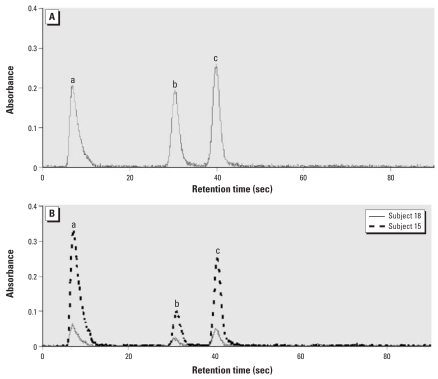
Exfoliated bladder epithelial cells (BECs) were collected from urine of 21 residents of Zimapan, Mexico, who were exposed to iAs in drinking water. We determined concentrations of iAs, methyl-As (MAs), and dimethyl-As (DMAs) in urine using conventional hydride generation-cryotrapping-atomic absorption spectrometry (HG-CT-AAS). We used an optimized HG-CT-AAS technique with detection limits of 12-17 pg As for analysis of As species in BECs.
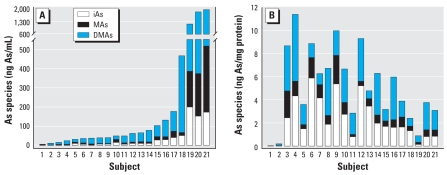
All urine samples and 20 of 21 BEC samples contained detectable concentrations of iAs, MAs, and DMAs. Sums of concentrations of these As species in BECs ranged from 0.18 to 11.4 ng As/mg protein and in urine from 4.8 to 1,947 ng As/mL. We found no correlations between the concentrations or ratios of As species in BECs and in urine.
These results suggest that urinary levels of iAs metabolites do not necessarily reflect levels of these metabolites in the bladder epithelium. Thus, analysis of As species in BECs may provide a more effective tool for risk assessment of bladder cancer and other urothelial diseases associated with exposures to iAs.
尿中砷的浓度已被用作无机砷(iAs)暴露的标志物。iAs尿代谢物的相对比例已被确定为对iAs毒性易感性的潜在生物标志物。然而,iAs暴露的不良影响最终由靶组织中iAs代谢物的浓度决定。
在本研究中,我们检测了分析源自膀胱(人类As诱导癌症的靶器官)的细胞中砷形态的可行性。
从墨西哥锡马潘的21名居民的尿液中收集脱落的膀胱上皮细胞(BEC),这些居民在饮用水中接触iAs。我们使用传统的氢化物发生-冷阱捕集-原子吸收光谱法(HG-CT-AAS)测定尿液中iAs、甲基砷(MAs)和二甲基砷(DMAs)的浓度。我们使用一种优化的HG-CT-AAS技术,其检测限为12-17 pg As,用于分析BEC中的砷形态。
所有尿液样本和21个BEC样本中的20个都含有可检测浓度的iAs、MAs和DMAs。这些砷形态在BEC中的浓度总和范围为0.18至11.4 ng As/mg蛋白质,在尿液中为4.8至1947 ng As/mL。我们发现BEC和尿液中砷形态的浓度或比例之间没有相关性。
这些结果表明,iAs代谢物的尿水平不一定反映膀胱上皮中这些代谢物的水平。因此,分析BEC中的砷形态可能为膀胱癌和其他与iAs暴露相关的尿路上皮疾病的风险评估提供更有效的工具。