Tanomaru-Filho Mario, da Silva Guilherme Ferreira, Duarte Marco Antonio Húngaro, Gonçalves Marcelo, Tanomaru Juliane Maria Guerreiro
Department of Restorative Dentistry, Dental School of Araraquara, São Paulo State University, Araraquara, SP, Brazil.
J Appl Oral Sci. 2008 Nov-Dec;16(6):376-9. doi: 10.1590/s1678-77572008000600004.
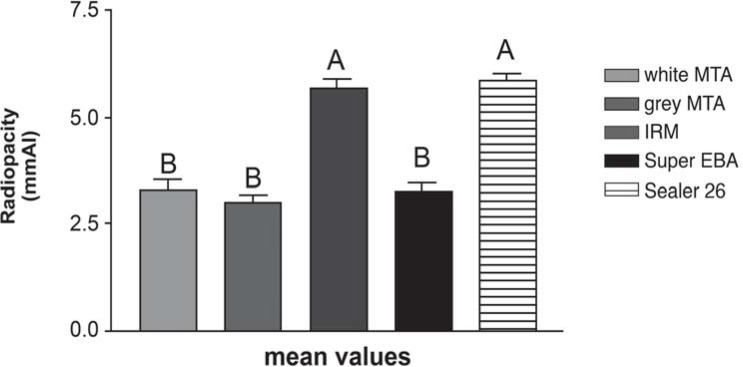
The purpose of this study was to evaluate the radiopacity of 5 root-end filling materials (white MTA-Angelus, grey MTA-Angelus, IRM, Super EBA and Sealer 26). Five specimens (10 mm diameter X 1 mm thickness) were made from each material and radiographed next to an aluminum stepwedge varying in thickness from 2 to 16 mm. Radiographs were digitized and the radiopacity of the materials was compared to that of the aluminum stepwedge using VIXWIN 2000 software in millimeters of aluminum (mm Al). Data were analyzed statistically by ANOVA and Tukey's test at 5% significance level. Radiopacity values varied from 3 mm Al to 5.9 mm Al. Sealer 26 and IRM presented the highest radiopacity values (p<0.05), while white/grey MTA and Super EBA presented the lowest radiopacity values (p<0.05). The tested root-end filling materials presented different radiopacities, white/grey MTA and Super EBA being the least radiopaque materials.
本研究的目的是评估5种根充材料(白色MTA-Angelus、灰色MTA-Angelus、IRM、Super EBA和Sealer 26)的射线不透性。每种材料制作5个样本(直径10毫米×厚度1毫米),并在厚度从2毫米到16毫米不等的铝阶梯楔旁边进行射线照相。将射线照片数字化,并使用VIXWIN 2000软件以铝的毫米数(mm Al)将材料的射线不透性与铝阶梯楔的射线不透性进行比较。数据采用方差分析和Tukey检验进行统计学分析,显著性水平为5%。射线不透性值在3 mm Al至5.9 mm Al之间变化。Sealer 26和IRM呈现出最高的射线不透性值(p<0.05),而白色/灰色MTA和Super EBA呈现出最低的射线不透性值(p<0.05)。所测试的根充材料呈现出不同的射线不透性,白色/灰色MTA和Super EBA是射线不透性最低的材料。