Dorileo Maura Cristiane Gonçales Orçati, Pedro Fábio Luis Miranda, Bandeca Matheus Coelho, Guedes Orlando Aguirre, Villa Ricardo Dalla, Borges Alvaro Henrique
Departament of Endodontics, Faculty of Dentistry, University of Cuiabá, Cuiaba, Mato grosso, Brazil.
Departament of Prosthodontic Dentistry, Faculty of Dentistry, CEUMA University, São Luis, Maranhão, Brazil.
Restor Dent Endod. 2014 Aug;39(3):201-9. doi: 10.5395/rde.2014.39.3.201. Epub 2014 Jun 30.
This study evaluated the solubility, dimensional alteration, pH, electrical conductivity, and radiopacity of root perforation sealer materials.
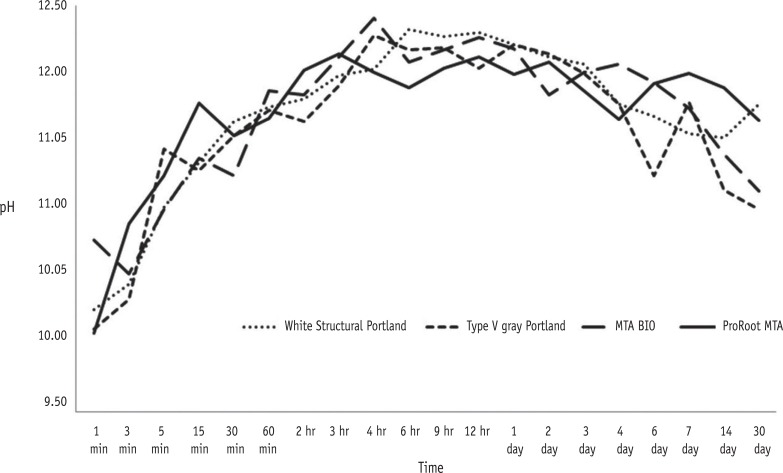
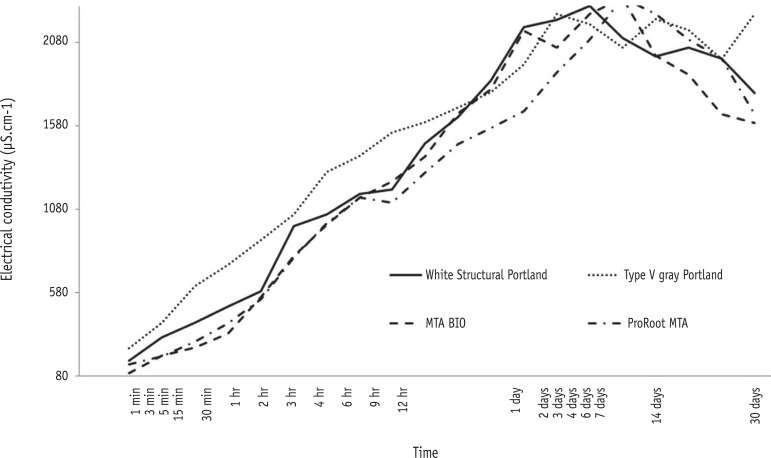
For the pH test, the samples were immersed in distilled water for different periods of time. Then, the samples were retained in plastic recipients, and the electrical conductivity of the solution was measured. The solubility, dimensional alteration, and radiopacity properties were evaluated according to Specification No. 57 of the American National Standards Institute/American Dental Association (ANSI/ADA). Statistical analyses were carried out using analysis of variance (ANOVA) and Tukey's test at a significance level of 5%. When the sample distribution was not normal, a nonparametric ANOVA was performed with a Kruskal-Wallis test (α = 0.05).
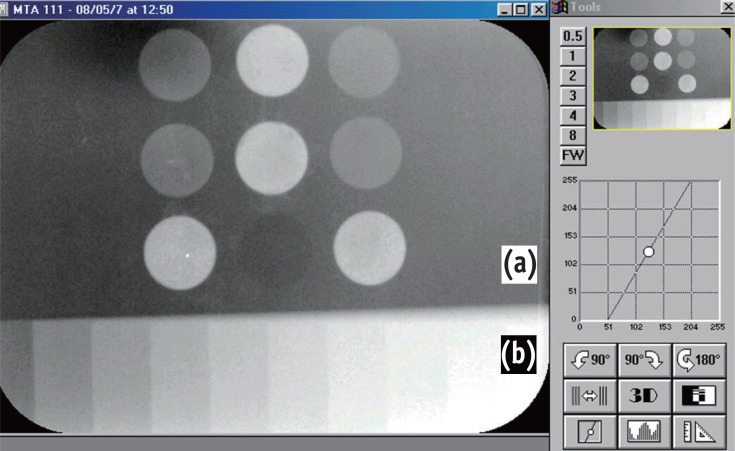
The results showed that white structural Portland cement (PC) had the highest solubility, while mineral trioxide aggregate (MTA)-based cements, ProRoot MTA (Dentsply-Tulsa Dental) and MTA BIO (Ângelus Ind. Prod.), had the lowest values. MTA BIO showed the lowest dimensional alteration values and white PC presented the highest values. No differences among the tested materials were observed in the the pH and electrical conductivity analyses. Only the MTA-based cements met the ANSI/ADA recommendations regarding radiopacity, overcoming the three steps of the aluminum step wedge.
On the basis of these results, we concluded that the values of solubility and dimensional alteration of the materials were in accordance with the ANSI/ADA specifications. PCs did not fulfill the ANSI/ADA requirements regarding radiopacity. No differences were observed among the materials with respect to the pH and electrical conductivity analyses.
本研究评估了根管穿孔封闭剂材料的溶解度、尺寸变化、pH值、电导率和射线不透性。
对于pH测试,将样本在蒸馏水中浸泡不同时间。然后,将样本保存在塑料容器中,并测量溶液的电导率。根据美国国家标准学会/美国牙科协会(ANSI/ADA)第57号规范评估溶解度、尺寸变化和射线不透性特性。使用方差分析(ANOVA)和Tukey检验进行统计分析,显著性水平为5%。当样本分布不呈正态时,采用Kruskal-Wallis检验进行非参数方差分析(α = 0.05)。
结果显示,白色结构波特兰水泥(PC)的溶解度最高,而基于三氧化矿物凝聚体(MTA)的水泥,即ProRoot MTA(登士柏-塔尔萨牙科)和MTA BIO(安热卢斯工业产品公司),溶解度最低。MTA BIO的尺寸变化值最低而白色PC的尺寸变化值最高。在pH和电导率分析中,未观察到受试材料之间存在差异。只有基于MTA的水泥符合ANSI/ADA关于射线不透性的建议,能穿透铝阶梯楔的三个阶梯。
基于这些结果,我们得出结论,材料的溶解度和尺寸变化值符合ANSI/ADA规范。PC不符合ANSI/ADA关于射线不透性的要求。在pH和电导率分析方面,未观察到材料之间存在差异。