Standley Paul R, Meltzer Kate
Department of Basic Medical Sciences, University of Arizona College of Medicine-Phoenix in partnership with Arizona State University, Phoenix, AZ 85004-2157, USA.
J Bodyw Mov Ther. 2008 Jul;12(3):201-3. doi: 10.1016/j.jbmt.2008.05.006. Epub 2008 Jun 30.
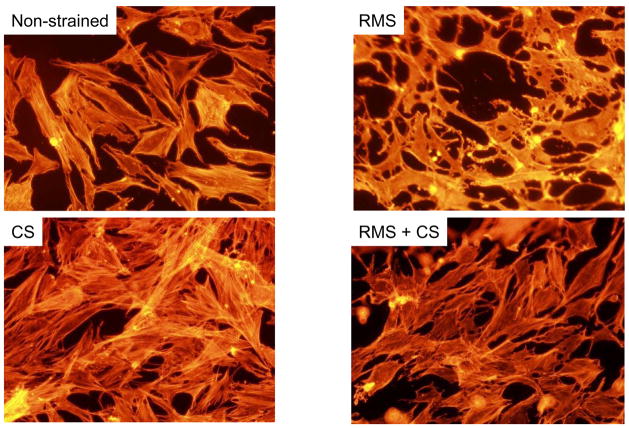
Despite positive clinical outcomes documented post-treatment with a variety of manual medicine treatments (MMT), the underlying cellular mechanisms responsible remain elusive. We have developed an in vitro human fibroblast cell system used to model various biomechanical strains that human fibroblasts might undergo in response to repetitive motion strain (RMS) and MMT. Our data utilizing this system suggest that RMS induces disruption of cell-cell and cell-matrix contacts, which appear are reversed when a modeled MMT is also added to the treatment protocol. Similarly, while RMS induces secretion of several inflammatory cytokines, modeled MMT attenuates this secretory response. In terms of strain direction, fibroblasts strained equiradially exhibit unique cytokine secretory profiles vs. those strained heterobiaxially. Taken together, these data suggest that this cell model may prove useful in identifying the cellular mechanisms by which various fascial strains used clinically to treat somatic dysfunctions yield positive clinical outcomes such as reduced pain, reduced analgesic use and improved range of motion.
尽管有文献记录了多种手法医学治疗(MMT)后积极的临床结果,但其中潜在的细胞机制仍不清楚。我们开发了一种体外人成纤维细胞系统,用于模拟人成纤维细胞可能因重复性运动应变(RMS)和MMT而经历的各种生物力学应变。我们利用该系统的数据表明,RMS会导致细胞间和细胞与基质接触的破坏,而当在治疗方案中加入模拟的MMT时,这种破坏似乎会得到逆转。同样,虽然RMS会诱导几种炎性细胞因子的分泌,但模拟的MMT会减弱这种分泌反应。在应变方向方面,与双轴应变的成纤维细胞相比,等半径应变的成纤维细胞表现出独特的细胞因子分泌谱。综上所述,这些数据表明,该细胞模型可能有助于识别临床上用于治疗躯体功能障碍的各种筋膜应变产生诸如疼痛减轻、镇痛药使用减少和运动范围改善等积极临床结果的细胞机制。