Soto-Ramírez Nelís, Karmaus Wilfried
Epidemiology and Biostatistics Department, Arnold School of Public Health, University of South Carolina, 800 Sumter St, Columbia, SC, USA.
Int Breastfeed J. 2008 Dec 16;3:29. doi: 10.1186/1746-4358-3-29.
Various studies have identified risk factors associated with decreased breastfeeding duration. The aim of this study was to investigate whether there is an association between oral contraceptive (OC) use before pregnancy and breastfeeding duration.
In 1994/95, as part of a 3-year epidemiologic follow-up study of school children, reproductive interviews were conducted with their mothers. The study population consists of 663 women residing in Hesse, Central Germany; 575 provided information on their reproductive history. The interview included retrospective ascertainment of OC use, its timing before pregnancy, and duration of breastfeeding. To estimate its effect on duration of breastfeeding, survival analysis was applied controlling for maternal age, socio-demographic characteristics, smoking during pregnancy, age at menarche, planning of the pregnancy and birth order. Hazard ratios and median breastfeeding duration were estimated.
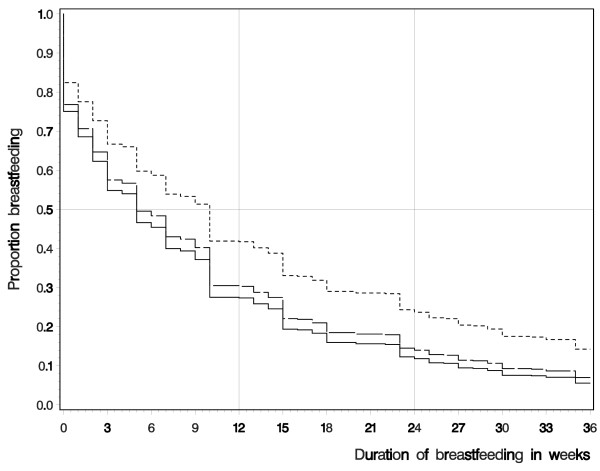
The mean age of the women at delivery was 27.3 years. Among participants, 34.9% had high school education or less, 10.4% had more than 2 children, and 30.1% smoked during pregnancy. In total, oral contraceptive use in the 12 months before conception was reported by 40.4% of the women, within 3 months of conception by 18.4%. 81.4% (468/575) of women initiated breastfeeding. Compared to those who did not use OC in the 12 months preceding pregnancy, mothers who used OC during the 3 months before conception had a shorter duration of breastfeeding (HR = 1.29; 95% CI: 1.03, 1.61), as did mothers who stopped OC use 4-12 months before conception (HR = 1.27, 95% CI: 1.02, 1.58). Smoking during pregnancy and lower education were also significantly associated with shorter duration of breastfeeding.
The results suggest that OC use during the 12 months prior to conception may affect breastfeeding duration. These findings may be due to the endocrine disrupting effect of OC. Alternatively, both OC use and shorter duration of breastfeeding may represent lifestyle-related conditions.
多项研究已确定了与母乳喂养持续时间缩短相关的风险因素。本研究的目的是调查怀孕前使用口服避孕药(OC)与母乳喂养持续时间之间是否存在关联。
1994/1995年,作为对学龄儿童进行的为期3年的流行病学随访研究的一部分,对他们的母亲进行了生殖方面的访谈。研究人群包括居住在德国中部黑森州的663名妇女;575名提供了她们的生殖史信息。访谈包括对OC使用情况、怀孕前使用时间以及母乳喂养持续时间的回顾性确定。为了评估其对母乳喂养持续时间的影响,采用生存分析,并对产妇年龄、社会人口学特征、孕期吸烟情况、初潮年龄、怀孕计划和生育顺序进行了控制。估计了风险比和母乳喂养的中位数持续时间。
产妇的平均年龄为27.3岁。在参与者中,34.9%的人受过高中及以下教育,10.4%的人有两个以上孩子,30.1%的人在孕期吸烟。共有40.4%的妇女报告在受孕前12个月使用过口服避孕药,18.4%的妇女在受孕后3个月内使用过。81.4%(468/575)的妇女开始进行母乳喂养。与在怀孕前12个月未使用OC的母亲相比,在受孕前3个月使用OC的母亲母乳喂养持续时间较短(风险比=1.29;95%置信区间:1.03,1.61),在受孕前4至12个月停用OC的母亲也是如此(风险比=1.27,95%置信区间:1.02,1.58)。孕期吸烟和低学历也与较短的母乳喂养持续时间显著相关。
结果表明,受孕前12个月内使用OC可能会影响母乳喂养持续时间。这些发现可能是由于OC的内分泌干扰作用。或者,使用OC和较短的母乳喂养持续时间都可能代表与生活方式相关的情况。