Cyders Melissa A, Smith Gregory T
Department of Psychology, University of Kentucky, 111-K Kastle Hall, Lexington, KY 40506-0044, United States.
Pers Individ Dif. 2008 Oct;45(6):503-508. doi: 10.1016/j.paid.2008.06.002.
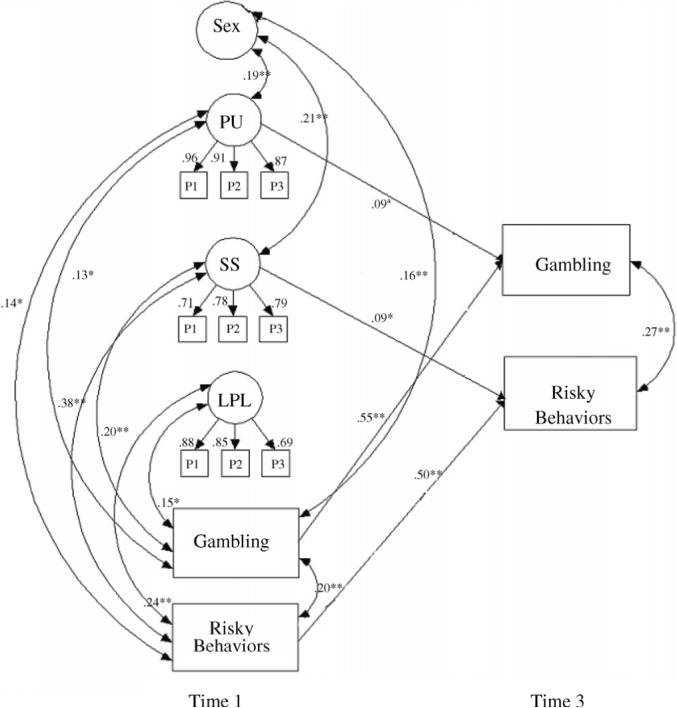
The current study clarifies the role of personality for increased gambling behaviors. The authors compared five traits, each involving a different disposition to rash action, predicting increased gambling behavior across the transition into college life. The authors sampled 418 college students (75% female; median age 18.0 years) across their freshman year. Participants completed the UPPS-P scale and measures to assess gambling and risky behavior participation. SEM analyses showed that although the disposition to engage in rash action when in an unusually positive mood (positive urgency), lack of planning, and sensation seeking all related to both gambling behavior and general risky behavior (e.g., mountain climbing) cross-sectionally, only positive urgency predicted longitudinal increases in gambling behavior and only sensation seeking predicted longitudinal increases in general risky behaviors. Beginning college students high in positive urgency are at increased risk to increase their gambling behavior in college.
当前的研究阐明了人格特质在赌博行为增加方面所起的作用。作者比较了五种特质,每种特质都涉及不同的冲动行事倾向,这些特质能够预测在进入大学生活的过渡阶段赌博行为会增加。作者在大一学生中抽取了418名大学生样本(75%为女性;年龄中位数为18.0岁)。参与者完成了UPPS-P量表以及评估赌博和危险行为参与情况的测量。结构方程模型分析表明,尽管处于异常积极情绪时冲动行事的倾向(积极紧迫性)、缺乏计划以及寻求刺激在横截面上均与赌博行为和一般危险行为(如爬山)有关,但只有积极紧迫性能够预测赌博行为的纵向增加,只有寻求刺激能够预测一般危险行为的纵向增加。积极紧迫性高的大一学生在大学期间增加赌博行为的风险更高。