Yang Yuchen, Wang Yu-Ping, Li Kuo-Bin
Institute of Molecular and Cell Biology, 61 Biopolis Drive, 138673, Singapore.
BMC Bioinformatics. 2008 Dec 12;9 Suppl 12(Suppl 12):S4. doi: 10.1186/1471-2105-9-S12-S4.
MicroRNAs (miRNAs) are a set of small non-coding RNAs serving as important negative gene regulators. In animals, miRNAs turn down protein translation by binding to the 3' UTR regions of target genes with imperfect complementary pairing. The identification of microRNA targets has become one of the major challenges of miRNA research. Bioinformatics investigations on miRNA target have resulted in a number of target prediction tools. Although these tools are capable of predicting hundreds of targets for a given miRNA, many of them suffer from high false positive rates, indicating the need for a post-processing filter for the predicted targets. Once trained with experimentally validated true and false targets, machine learning methods appear to be ideal approaches to distinguish the true targets from the false ones.
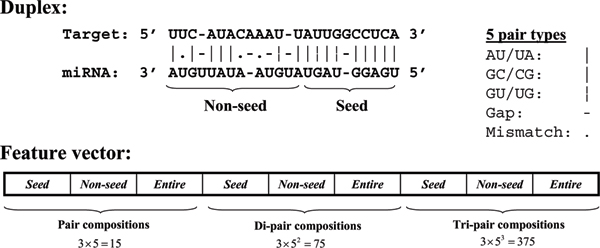
We present a miRNA target filtering system named MiRTif (miRNA:target interaction filter). The system is a support vector machine (SVM) classifier trained with 195 positive and 38 negative miRNA:target interaction pairs, all experimentally validated. Each miRNA:target interaction pair is divided into a seed and a non-seed region. The encoded feature vector contains various k-gram frequencies in the seed, the non-seed and the entire regions. Informative features are selected based on their discriminating abilities. Prediction accuracies are assessed using 10-fold cross-validation experiments. Our system achieves AUC (area under the ROC curve) of 0.86, sensitivity of 83.59%, and specificity of 73.68%. More importantly, the system correctly predicts majority of the false positive miRNA:target interactions (28 out of 38). The possibility of over-fitting due to the relatively small negative sample set has also been investigated using a set of non-validated and randomly selected targets (from miRBase).
MiRTif is designed as a post-processing filter that takes miRNA:target interactions predicted by other target prediction softwares such as TargetScanS, PicTar and miRanda as inputs, and determines how likely the given interaction is a real or a pseudo one. MiRTif can be accessed from http://bsal.ym.edu.tw/mirtif.
微小RNA(miRNA)是一类小的非编码RNA,作为重要的负性基因调节因子。在动物中,miRNA通过与靶基因的3'非翻译区(UTR)进行不完全互补配对来下调蛋白质翻译。鉴定miRNA靶标已成为miRNA研究的主要挑战之一。对miRNA靶标的生物信息学研究已产生了许多靶标预测工具。尽管这些工具能够为给定的miRNA预测数百个靶标,但其中许多工具的假阳性率很高,这表明需要对预测的靶标进行后处理筛选。一旦用经过实验验证的真、假靶标进行训练,机器学习方法似乎是区分真靶标和假靶标的理想方法。
我们提出了一种名为MiRTif(miRNA:靶标相互作用筛选器)的miRNA靶标筛选系统。该系统是一个支持向量机(SVM)分类器,用195个正性和38个负性miRNA:靶标相互作用对进行训练,所有这些相互作用对均经过实验验证。每个miRNA:靶标相互作用对被分为种子区域和非种子区域。编码的特征向量包含种子区域、非种子区域和整个区域中各种k-mer频率。根据其区分能力选择信息性特征。使用10折交叉验证实验评估预测准确性。我们的系统实现了0.86的ROC曲线下面积(AUC)、83.59%的灵敏度和73.68%的特异性。更重要的是,该系统正确预测了大多数假阳性miRNA:靶标相互作用(38个中的28个)。还使用一组未经验证的随机选择的靶标(来自miRBase)研究了由于相对较小的负样本集导致过拟合的可能性。
MiRTif被设计为一种后处理筛选器,它将其他靶标预测软件(如TargetScanS、PicTar和miRanda)预测的miRNA:靶标相互作用作为输入,并确定给定的相互作用是真实的还是假的可能性。可从http://bsal.ym.edu.tw/mirtif访问MiRTif。