Erdling André, Bondesson Susanne, Pettersson Thomas, Edvinsson Lars
Department of Medicine, Centralsjukhuset, SE-291 85 Kristianstad, Sweden.
BMC Cardiovasc Disord. 2008 Dec 18;8:39. doi: 10.1186/1471-2261-8-39.
Enhanced external counter pulsation (EECP) is a non-invasive treatment option for patients with refractory angina pectoris ineligible to further traditional treatment. The aim of this study was to evaluate the effect of EECP on patients at a Scandinavian medical centre and to investigate if outcome can be predicted by analysing baseline factors.
86 consecutive patients (70 male, 16 female) were treated with EECP and followed for two years post treatment. Canadian cardiovascular society (CCS) class was analysed, and medication and adverse clinical events were researched prior to EECP, at the end of the treatment, and at six, 12 and 24 months thereafter. Patients responding to therapy by improving at least one CCS class were compared with those who failed to respond. Any differences in background factors were recorded and analysed.
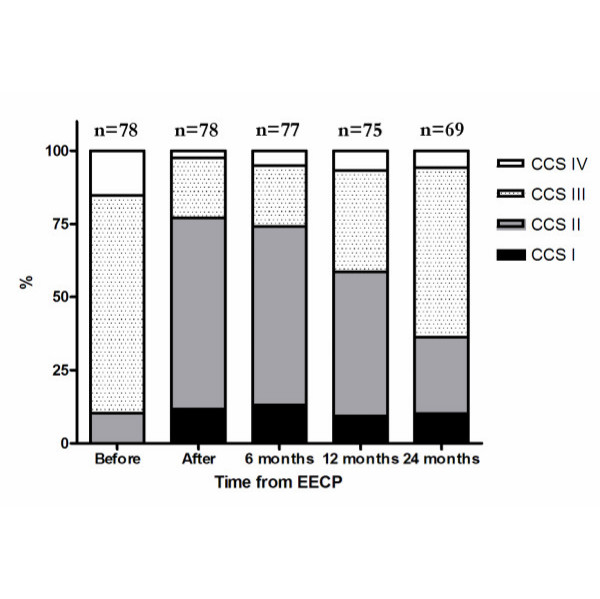
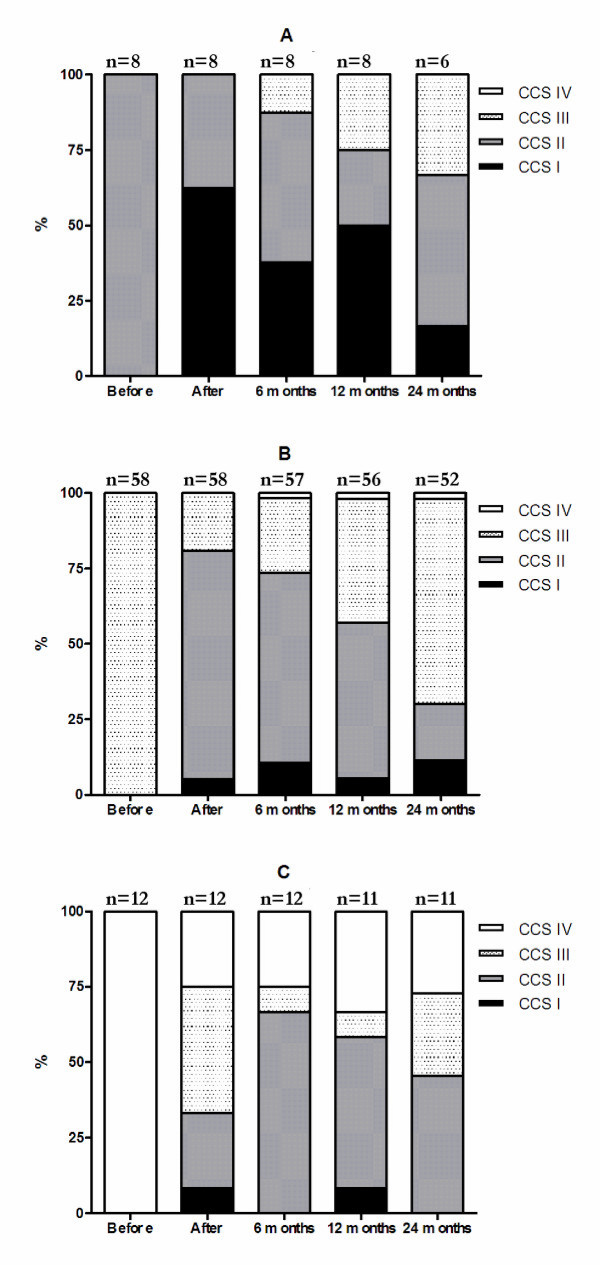
79% of the patients responded to therapy by improving at least one CCS class. In general, the CCS class improved by one class after EECP treatment (3.05 before versus 2.14 after treatment). A total of 61.5% of the initial responders showed sustained improvement at the 12 month follow-up while 29% presented sustained improvement after 24 months. Treatment was most effective among patients suffering from CCS class III-IV angina pectoris, while patients suffering from CCS class II angina pectoris improved transiently but failed to show sustained improvement after the 12 month follow-up. Diabetes mellitus and calcium channel antagonists were more common among the non-responders (p < 0.05).
This study confirms the safety and efficiency of EECP as a treatment option for patients suffering from refractory angina pectoris. The therapy is most beneficial in patients suffering from severe angina (CCS III-IV) while sustained response to therapy could not be verified among patients suffering from CCS class II angina pectoris.
增强型体外反搏(EECP)是一种用于无法接受进一步传统治疗的顽固性心绞痛患者的非侵入性治疗选择。本研究的目的是评估EECP在一家斯堪的纳维亚医疗中心对患者的疗效,并通过分析基线因素来研究是否可以预测治疗结果。
连续86例患者(70例男性,16例女性)接受EECP治疗,并在治疗后随访两年。分析加拿大心血管学会(CCS)分级,研究EECP治疗前、治疗结束时以及此后6个月、12个月和24个月的用药情况和不良临床事件。将至少改善一个CCS分级从而对治疗有反应的患者与无反应的患者进行比较。记录并分析背景因素的任何差异。
79%的患者通过至少改善一个CCS分级对治疗有反应。总体而言,EECP治疗后CCS分级改善了一级(治疗前为3.05级,治疗后为2.14级)。共有61.5%的初始有反应者在12个月随访时显示持续改善,而29%在24个月后显示持续改善。治疗在患有CCS III-IV级心绞痛的患者中最有效,而患有CCS II级心绞痛的患者改善短暂,但在12个月随访后未显示持续改善。糖尿病和钙通道拮抗剂在无反应者中更常见(p<0.05)。
本研究证实了EECP作为顽固性心绞痛患者治疗选择的安全性和有效性。该疗法对患有严重心绞痛(CCS III-IV级)的患者最有益,而在患有CCS II级心绞痛的患者中无法证实对治疗的持续反应。