Compte Marta, Cuesta Angel M, Sánchez-Martín David, Alonso-Camino Vanesa, Vicario José Luís, Sanz Laura, Alvarez-Vallina Luís
Hospital Universitario Puerta de Hierro, Madrid, Spain.
Stem Cells. 2009 Mar;27(3):753-60. doi: 10.1634/stemcells.2008-0831.
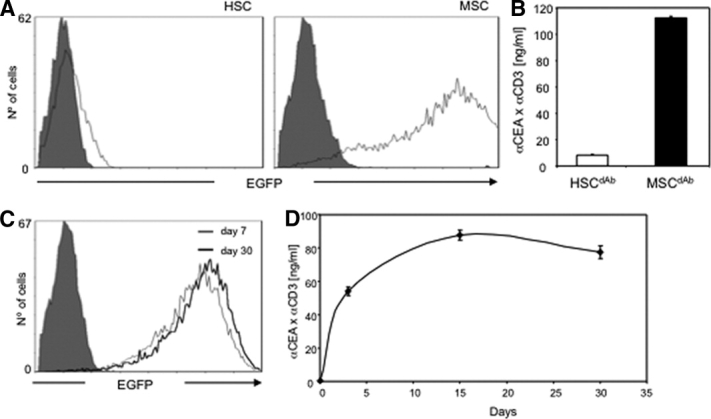
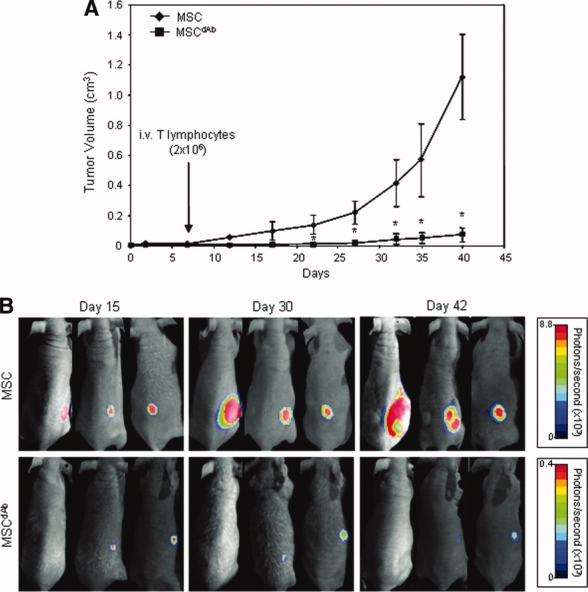
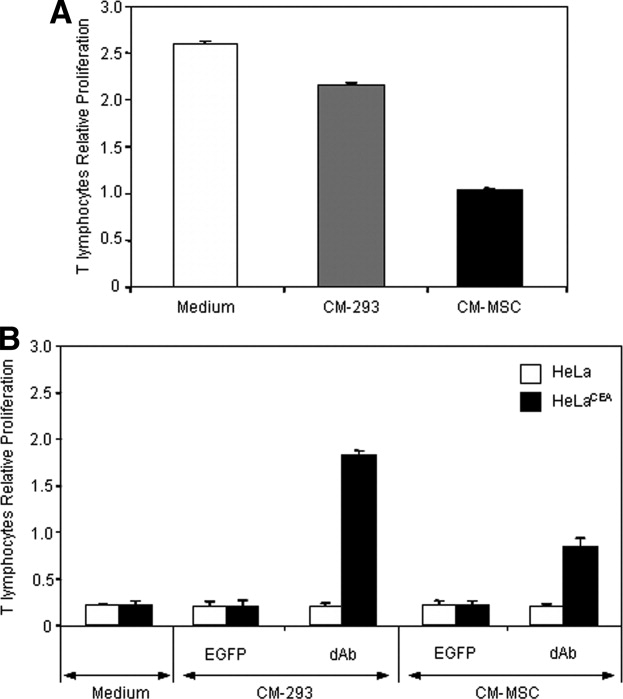
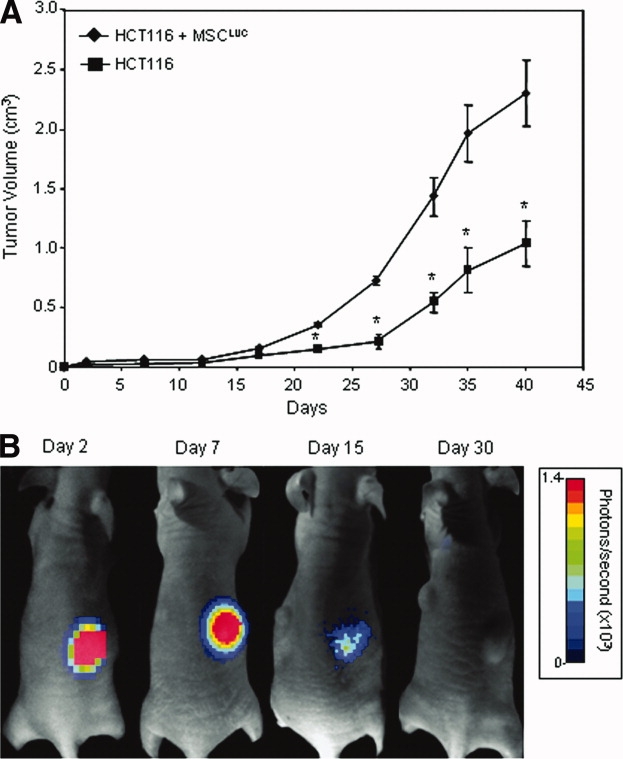
Mesenchymal stem cells (MSCs) are appealing as gene therapy cell vehicles given their ease of expansion and transduction. However, MSCs exhibit immunomodulatory and proangiogenic properties that may pose a risk in their use in anticancer therapy. For this reason, we looked for a strategy to confine MSCs to a determined location, compatible with a clinical application. Human MSCs genetically modified to express luciferase (MSC(luc)), seeded in a synthetic extracellular matrix (sECM) scaffold (sentinel scaffold) and injected subcutaneously in immunodeficient mice, persisted for more than 40 days, as assessed by bioluminescence imaging in vivo. MSCs modified to express a bispecific alpha-carcinoembryonic antigen (alphaCEA)/alphaCD3 diabody (MSC(dAb)) and seeded in an sECM scaffold (therapeutic scaffolds) supported the release of functional diabody into the bloodstream at detectable levels for at least 6 weeks after implantation. Furthermore, when therapeutic scaffolds were implanted into CEA-positive human colon cancer xenograft-bearing mice and human T lymphocytes were subsequently transferred, circulating alphaCEA/alphaCD3 diabody activated T cells and promoted tumor cell lysis. Reduction of tumor growth in MSC(dAb)-treated mice was statistically significant compared with animals that only received MSC(luc). In summary, we report here for the first time that human MSCs genetically engineered to secrete a bispecific diabody, seeded in an sECM scaffold and implanted in a location distant from the primary tumor, induce an effective antitumor response and tumor regression.
间充质干细胞(MSCs)因其易于扩增和转导,作为基因治疗的细胞载体颇具吸引力。然而,MSCs具有免疫调节和促血管生成特性,这可能使其在抗癌治疗中的应用存在风险。因此,我们寻求一种将MSCs限制在特定位置的策略,以符合临床应用要求。将经基因改造表达荧光素酶的人MSCs(MSC(luc))接种于合成细胞外基质(sECM)支架(哨兵支架)中,并皮下注射到免疫缺陷小鼠体内,通过体内生物发光成像评估,其持续存在超过40天。经改造表达双特异性α-癌胚抗原(αCEA)/αCD3双抗体的MSCs(MSC(dAb))接种于sECM支架(治疗性支架)中,植入后至少6周内,能将功能性双抗体释放到血液中并可检测到。此外,当将治疗性支架植入携带CEA阳性人结肠癌异种移植瘤的小鼠体内,随后转移人T淋巴细胞时,循环中的αCEA/αCD3双抗体激活T细胞并促进肿瘤细胞裂解。与仅接受MSC(luc)的动物相比,接受MSC(dAb)治疗的小鼠肿瘤生长的减少具有统计学意义。总之,我们首次在此报告,经基因工程改造以分泌双特异性双抗体的人MSCs,接种于sECM支架并植入远离原发肿瘤的位置,可诱导有效的抗肿瘤反应和肿瘤消退。