Cancer Immunotherapy Unit (UNICA), Department of Immunology, Hospital Universitario 12 de Octubre, Madrid, Spain.
Immuno-Oncology and Immunotherapy Group, Instituto de Investigación Sanitaria 12 de Octubre (imas12), Madrid, Spain.
Front Immunol. 2020 Aug 13;11:1792. doi: 10.3389/fimmu.2020.01792. eCollection 2020.
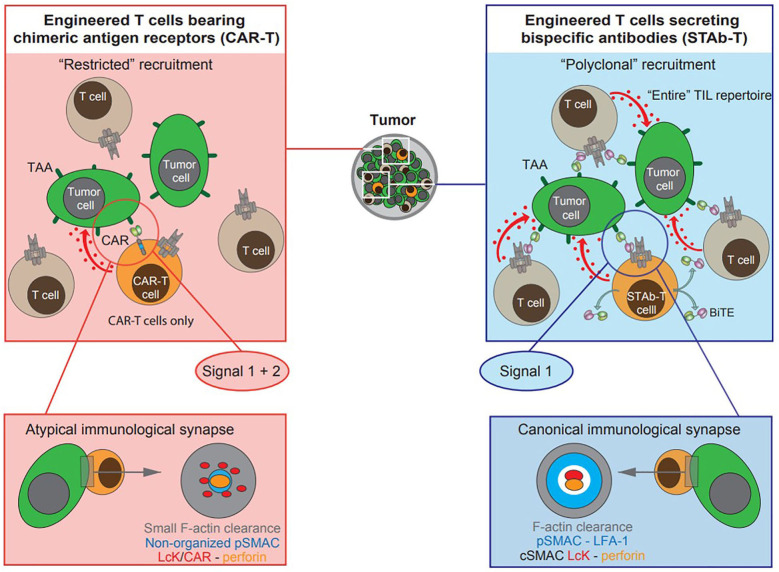
Immunotherapeutic approaches based on the redirection of T cell activity toward tumor cells are actively being investigated. The impressive clinical success of the continuously intravenously infused T cell-redirecting bispecific antibody (T-bsAb) blinatumomab (anti-CD19 x anti-CD3), and of engineered T cells expressing anti-CD19 chimeric antigen receptors (CAR-T cells) in hematological malignancies, has led to renewed interest in a novel cancer immunotherapy strategy that combines features of antibody- and cell-based therapies. This emerging approach is based on the endogenous secretion of T-bsAbs by engineered T cells (STAb-T cells). Adoptive transfer of genetically modified STAb-T cells has demonstrated potent anti-tumor activity in both solid tumor and hematologic preclinical xenograft models. We review here the potential benefits of the STAb-T strategy over similar approaches currently being used in clinic, and we discuss the potential combination of this promising strategy with the well-established CAR-T cell approach.
基于 T 细胞活性向肿瘤细胞重定向的免疫治疗方法正在积极研究中。不断静脉输注的 T 细胞重定向双特异性抗体(T-bsAb)blinatumomab(抗-CD19 x 抗-CD3)和表达抗-CD19 嵌合抗原受体(CAR-T 细胞)的工程 T 细胞在血液恶性肿瘤中的显著临床成功,重新激发了人们对一种新型癌症免疫治疗策略的兴趣,该策略结合了抗体和细胞治疗的特点。这种新兴方法基于工程 T 细胞(STAb-T 细胞)内源性分泌 T-bsAbs。基因修饰的 STAb-T 细胞过继转移已在实体瘤和血液学临床前异种移植模型中显示出强大的抗肿瘤活性。我们在此回顾了 STAb-T 策略相对于目前临床应用的类似方法的潜在优势,并讨论了将这种有前途的策略与成熟的 CAR-T 细胞方法相结合的可能性。