Sagatun Ase, Kolle Elin, Anderssen Sigmund A, Thoresen Magne, Søgaard Anne Johanne
Center for Child and Adolescent Mental Health, Eastern and Southern Norway, P,O, Box 4623 Nydalen, 0405 Oslo, Norway.
BMC Public Health. 2008 Dec 22;8:419. doi: 10.1186/1471-2458-8-419.
More research on factors associated with physical activity and the decline in participation during adolescence is needed. In this paper, we investigate the levels, change, and stability of physical activity during the late teens among ethnic Norwegians and ethnic minorities, and we examine the associations between physical activity and socio-demographic factors.
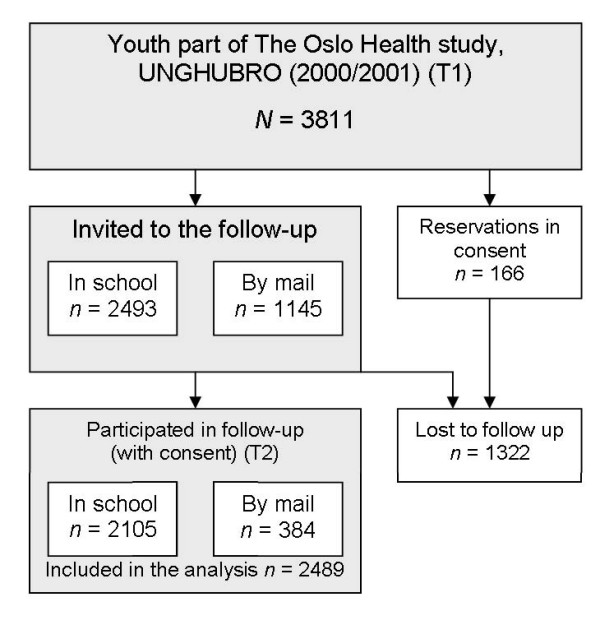
The baseline (T1) of this longitudinal study included 10th graders who participated in the youth part of the Oslo Health Study, which was carried out in schools in 2000-2001. The follow-up (T2) in 2003-2004 was conducted partly at school and partly by mail. A total of 2489 (1112 boys and 1377 girls) participated both at baseline and at follow-up. Physical activity level was measured by a question on weekly hours of physical activity outside of school. Socio-demographic variables were collected by questionnaire and from data obtained from Statistics Norway. Analysis of variance was used to study the level of and changes (T1 to T2) in physical activity, and the associations between physical activity and socio-demographic factors. Stability in physical activity was defined as the percentage of students reporting the same physical activity both times.
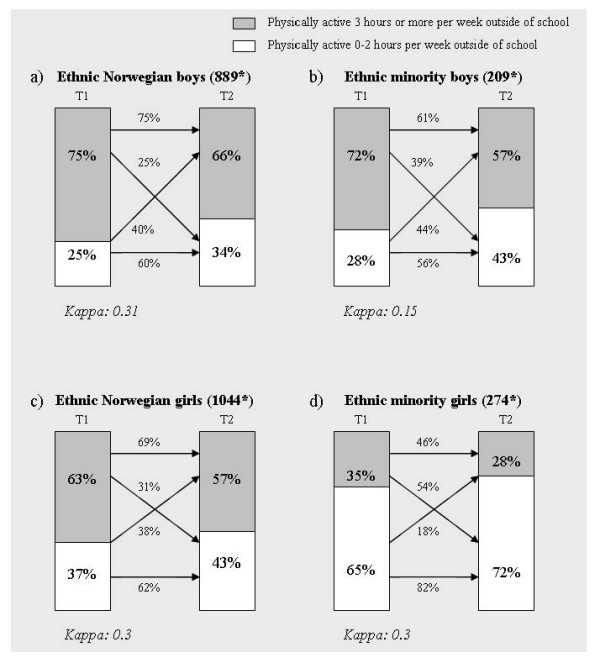
Boys were more active than girls at age 15 and 18 years, independent of ethnic background. Among girls, ethnic Norwegians were more active than ethnic minorities. Hours per week spent on physical activity declined in all groups during the follow-up period. Few associations were found between physical activity and socio-demographic factors in both cross-sectional and longitudinal data. Among the ethnic minority girls, 65% reported being physically active 0-2 hours per week at baseline, and 82% of these girls reported the same level at follow up.
The association between physical activity and ethnicity at age 15 years remained the same during the follow-up. Few associations were found between physical activity and socio-demographic variables. A large proportion of ethnic minority girls reported a persistently low physical activity level, and this low participation rate may need special attention.
需要对与青少年身体活动及参与度下降相关的因素开展更多研究。在本文中,我们调查了挪威族青少年和少数民族青少年在接近成年期时的身体活动水平、变化情况及稳定性,并研究了身体活动与社会人口学因素之间的关联。
这项纵向研究的基线期(T1)纳入了参与奥斯陆健康研究青少年部分的十年级学生,该研究于2000 - 2001年在学校开展。2003 - 2004年的随访期(T2)部分在学校进行,部分通过邮寄方式。共有2489名学生(1112名男生和1377名女生)参与了基线期和随访期的研究。身体活动水平通过一个关于校外每周体育活动时长的问题来衡量。社会人口学变量通过问卷收集,并取自挪威统计局的数据。方差分析用于研究身体活动水平及(从T1到T2的)变化情况,以及身体活动与社会人口学因素之间的关联。身体活动的稳定性定义为两次报告相同身体活动水平的学生比例。
在15岁和18岁时,男孩比女孩更活跃,与种族背景无关。在女孩中,挪威族比少数民族更活跃。随访期间所有组每周用于体育活动的时长均有所下降。在横断面和纵向数据中,身体活动与社会人口学因素之间几乎没有关联。在少数民族女孩中,65%在基线期报告每周体育活动0 - 2小时,其中82%的女孩在随访期报告相同水平。
随访期间,15岁时身体活动与种族之间的关联保持不变。身体活动与社会人口学变量之间几乎没有关联。很大一部分少数民族女孩报告身体活动水平持续较低,这种低参与率可能需要特别关注。