Centers for Disease Control and Prevention, Atlanta, Georgia, USA.
Cost Eff Resour Alloc. 2009 Jan 8;7:1. doi: 10.1186/1478-7547-7-1.
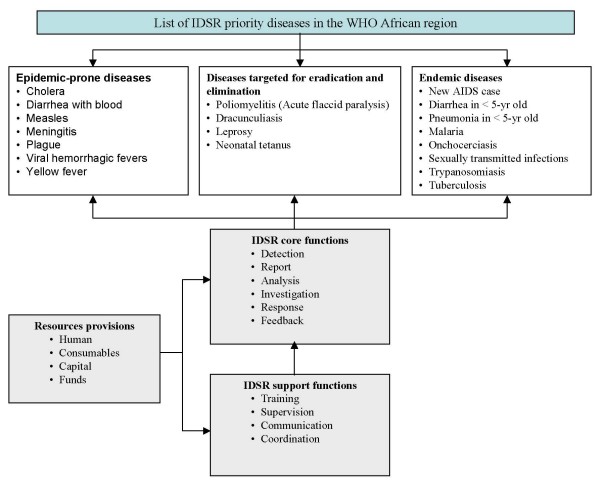
Communicable diseases are the leading causes of illness, deaths, and disability in sub-Saharan Africa. To address these threats, countries within the World Health Organization (WHO) African region adopted a regional strategy called Integrated Disease Surveillance and Response (IDSR). This strategy calls for streamlining resources, tools, and approaches to better detect and respond to the region's priority communicable disease. The purpose of this study was to analyze the incremental costs of establishing and subsequently operating activities for detection and response to the priority diseases under the IDSR.
We collected cost data for IDSR activities at central, regional, district, and primary health care center levels from Burkina Faso, Eritrea, and Mali, countries where IDSR is being fully implemented. These cost data included personnel, transportation items, office consumable goods, media campaigns, laboratory and response materials and supplies, and annual depreciation of buildings, equipment, and vehicles.
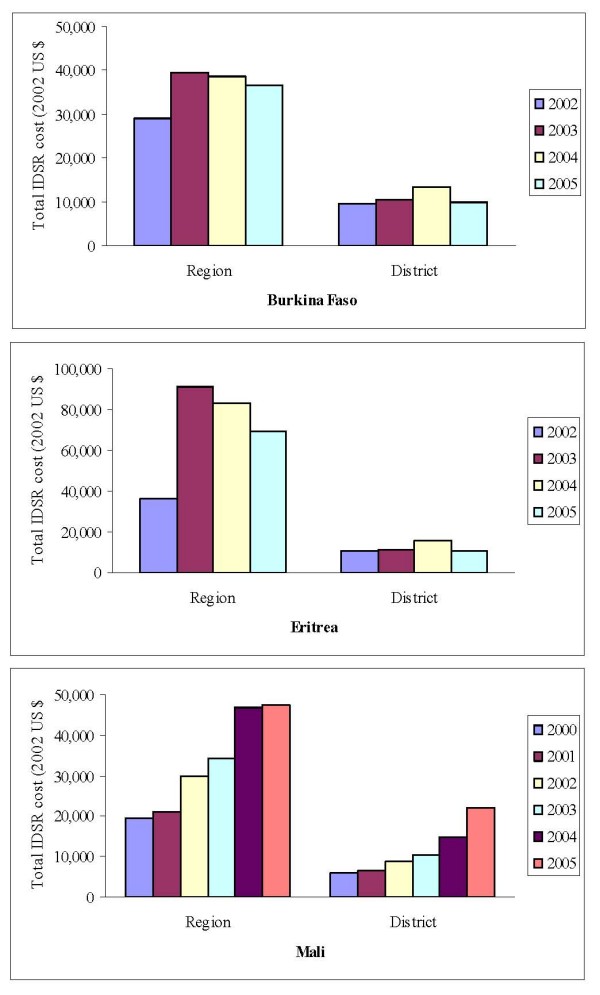
Over the period studied (2002-2005), the average cost to implement the IDSR program in Eritrea was $0.16 per capita, $0.04 in Burkina Faso and $0.02 in Mali. In each country, the mean annual cost of IDSR was dependent on the health structure level, ranging from $35,899 to $69,920 at the region level, $10,790 to $13,941 at the district level, and $1,181 to $1,240 at the primary health care center level. The proportions spent on each IDSR activity varied due to demand for special items (e.g., equipment, supplies, drugs and vaccines), service availability, distance, and the epidemiological profile of the country.
This study demonstrates that the IDSR strategy can be considered a low cost public health system although the benefits have yet to be quantified. These data can also be used in future studies of the cost-effectiveness of IDSR.
传染病是撒哈拉以南非洲地区疾病、死亡和残疾的主要原因。为了应对这些威胁,世界卫生组织(WHO)非洲区域内的国家通过了一项名为综合疾病监测和应对(IDSR)的区域战略。该战略呼吁整合资源、工具和方法,以更好地发现和应对该区域的优先传染病。本研究旨在分析在 IDSR 下为发现和应对优先疾病而建立和随后开展活动的增量成本。
我们从布基纳法索、厄立特里亚和马里收集了 IDSR 活动的成本数据,这些国家正在全面实施 IDSR。这些成本数据包括人员、交通项目、办公用品、媒体宣传、实验室和应对材料和用品以及建筑物、设备和车辆的年度折旧。
在所研究的期间(2002-2005 年),厄立特里亚实施 IDSR 方案的平均成本为每人 0.16 美元,布基纳法索为 0.04 美元,马里为 0.02 美元。在每个国家,IDSR 的年平均成本取决于卫生结构级别,从地区一级的 35899 美元到 69920 美元,到地区一级的 10790 美元到 13941 美元,再到初级保健中心一级的 1181 美元到 1240 美元。由于对特殊物品(如设备、用品、药品和疫苗)的需求、服务可用性、距离和国家的流行病学特征,用于每项 IDSR 活动的比例有所不同。
尽管效益尚未量化,但本研究表明,IDSR 战略可以被视为一种低成本的公共卫生系统。这些数据还可用于未来 IDSR 成本效益的研究。