World Health Organization Country Office, Mogadishu, Somalia.
Health Information Strengthening Project, Dar es Salaam, Tanzania.
Front Public Health. 2023 Sep 7;11:1204165. doi: 10.3389/fpubh.2023.1204165. eCollection 2023.
In 2021, a regional strategy for integrated disease surveillance was adopted by member states of the World Health Organization Eastern Mediterranean Region. But before then, member states including Somalia had made progress in integration of their disease surveillance systems. We report on the progress and experiences of implementing an integrated disease surveillance and response system in Somalia between 2016 and 2023.
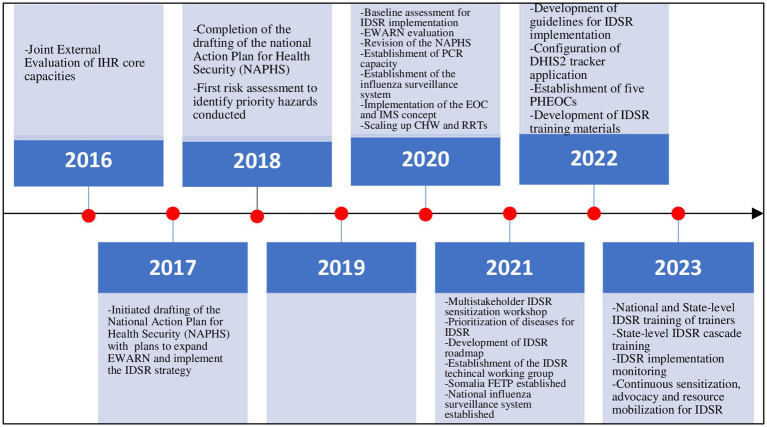
We reviewed 20 operational documents and identified key integrated disease surveillance and response system (IDSRS) actions/processes implemented between 2016 and 2023. We verified these through an anonymized online survey. The survey respondents also assessed Somalia's IDSRS implementation progress using a standard IDS monitoring framework Finally, we interviewed 8 key informants to explore factors to which the current IDSRS implementation progress is attributed.
Between 2016 and 2023, 7 key IDSRS actions/processes were implemented including: establishment of high-level commitment; development of a 3-year operational plan; development of a coordination mechanism; configuring the District Health Information Software to support implementation among others. IDSRS implementation progress ranged from 15% for financing to 78% for tools. Reasons for the progress were summarized under 6 thematic areas; understanding frustrations with the current surveillance system; the opportunity occasioned by COVID-19; mainstreaming IDSRS in strategic documents; establishment of an oversight mechanism; staggering implementation of key activities over a reasonable length of time and being flexible about pre-determined timelines.
From 2016 to 2023, Somalia registered significant progress towards implementation of IDSRS. The 15 years of EWARN implementation in Somalia (since 2008) provided a strong foundation for IDSRS implementation. If implemented comprehensively, IDSRS will accelerate country progress toward establishment of IHR core capacities. Sustainable funding is the major challenge towards IDSRS implementation in Somalia. Government and its partners need to exploit feasible options for sustainable investment in integrated disease surveillance and response.
2021 年,世界卫生组织东地中海区域成员国通过了一项综合疾病监测区域战略。但在此之前,包括索马里在内的成员国在整合其疾病监测系统方面已经取得了进展。我们报告了 2016 年至 2023 年期间在索马里实施综合疾病监测和应对系统的进展和经验。
我们审查了 20 份业务文件,并确定了 2016 年至 2023 年期间实施的综合疾病监测和应对系统(IDSRS)的主要行动/进程。我们通过匿名在线调查对此进行了核实。调查对象还使用标准 IDS 监测框架评估了索马里 IDSRS 的实施进展。最后,我们采访了 8 名主要知情者,以探讨当前 IDSRS 实施进展的归因因素。
2016 年至 2023 年期间,实施了 7 项关键的 IDSRS 行动/进程,包括:建立高层承诺;制定三年期业务计划;建立协调机制;配置地区卫生信息软件以支持实施等。IDSRS 的实施进展从融资的 15%到工具的 78%不等。进展的原因归纳为 6 个主题领域;理解对当前监测系统的不满;COVID-19 带来的机会;将 IDSRS 纳入战略文件;建立监督机制;在合理的时间跨度内分阶段实施关键活动以及灵活对待预定的时间表。
2016 年至 2023 年期间,索马里在实施 IDSRS 方面取得了显著进展。自 2008 年以来,EWARN 在索马里实施了 15 年(自 2008 年以来),为 IDSRS 的实施奠定了坚实的基础。如果全面实施,IDSRS 将加速该国在建立国际卫生条例核心能力方面的进展。可持续供资是索马里实施 IDSRS 的主要挑战。政府及其合作伙伴需要探索可持续投资综合疾病监测和应对的可行方案。