Zhang Lingyun, Tong Matthew H, Marks Tim K, Shan Honghao, Cottrell Garrison W
Department of Computer Science and Engineering, UCSD, La Jolla, CA, USA.
J Vis. 2008 Dec 16;8(7):32.1-20. doi: 10.1167/8.7.32.
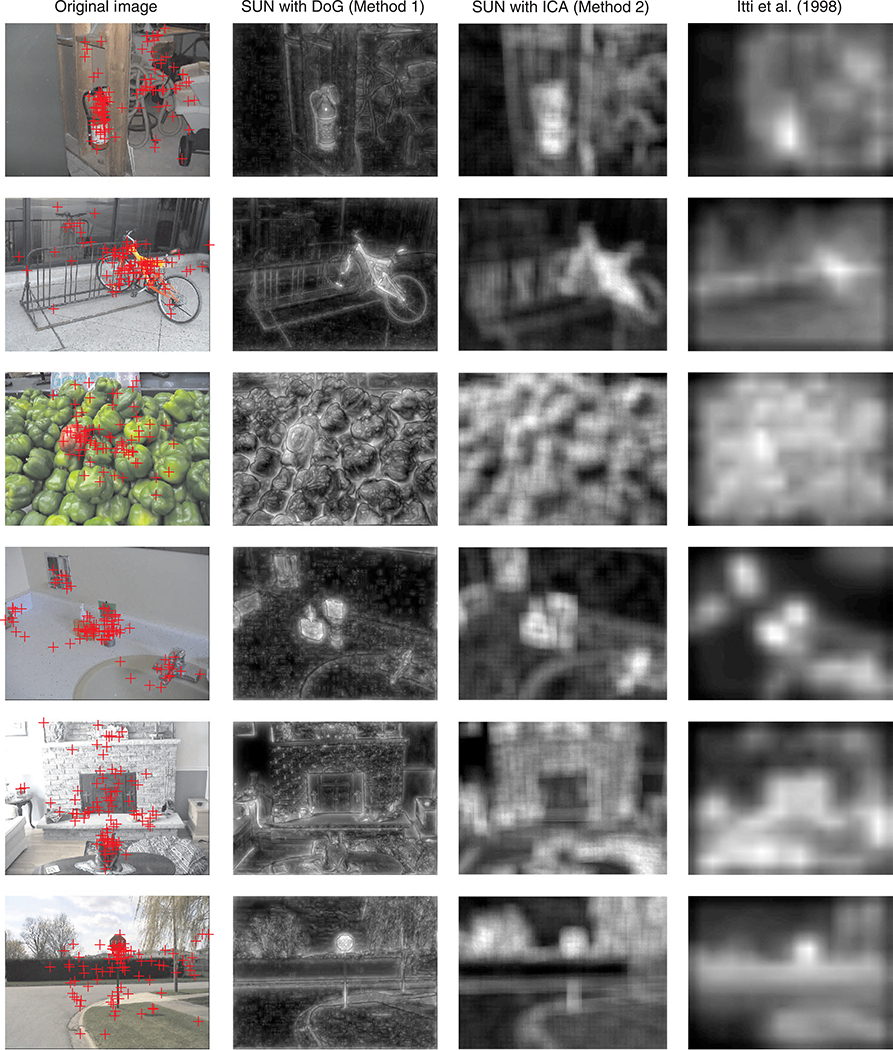
We propose a definition of saliency by considering what the visual system is trying to optimize when directing attention. The resulting model is a Bayesian framework from which bottom-up saliency emerges naturally as the self-information of visual features, and overall saliency (incorporating top-down information with bottom-up saliency) emerges as the pointwise mutual information between the features and the target when searching for a target. An implementation of our framework demonstrates that our model's bottom-up saliency maps perform as well as or better than existing algorithms in predicting people's fixations in free viewing. Unlike existing saliency measures, which depend on the statistics of the particular image being viewed, our measure of saliency is derived from natural image statistics, obtained in advance from a collection of natural images. For this reason, we call our model SUN (Saliency Using Natural statistics). A measure of saliency based on natural image statistics, rather than based on a single test image, provides a straightforward explanation for many search asymmetries observed in humans; the statistics of a single test image lead to predictions that are not consistent with these asymmetries. In our model, saliency is computed locally, which is consistent with the neuroanatomy of the early visual system and results in an efficient algorithm with few free parameters.
我们通过考虑视觉系统在引导注意力时试图优化的内容来提出一种显著性的定义。由此产生的模型是一个贝叶斯框架,自下而上的显著性作为视觉特征的自信息自然出现,而整体显著性(将自上而下的信息与自下而上的显著性相结合)在搜索目标时作为特征与目标之间的逐点互信息出现。我们框架的一个实现表明,在预测人们自由观看时的注视点方面,我们模型的自下而上显著性图的表现与现有算法相当或更好。与现有的显著性度量不同,现有的显著性度量依赖于所观看特定图像的统计信息,而我们的显著性度量是从自然图像统计中得出的,这些统计信息预先从一组自然图像中获得。因此,我们将我们的模型称为SUN(使用自然统计的显著性)。基于自然图像统计而不是基于单个测试图像的显著性度量,为在人类中观察到的许多搜索不对称性提供了一个直接的解释;单个测试图像的统计信息导致的预测与这些不对称性不一致。在我们的模型中,显著性是局部计算的,这与早期视觉系统的神经解剖结构一致,并导致一个具有很少自由参数的高效算法。