DSMZ-German Collection of Microorganisms and Cell Cultures, Braunschweig, Germany.
J Hematol Oncol. 2009 Jan 23;2:3. doi: 10.1186/1756-8722-2-3.
SET-NUP214 fusion resulting from a recurrent cryptic deletion, del(9)(q34.11q34.13) has recently been described in T-cell acute lymphoblastic leukemia (T-ALL) and in one case of acute myeloid leukemia (AML). The fusion protein appears to promote elevated expression of HOXA cluster genes in T-ALL and may contribute to the pathogenesis of the disease. We screened a panel of ALL and AML cell lines for SET-NUP214 expression to find model systems that might help to elucidate the cellular function of this fusion gene.
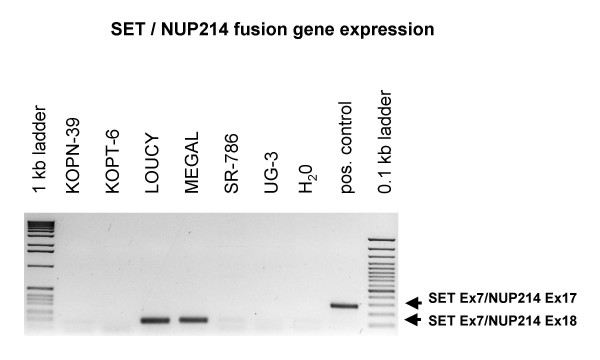
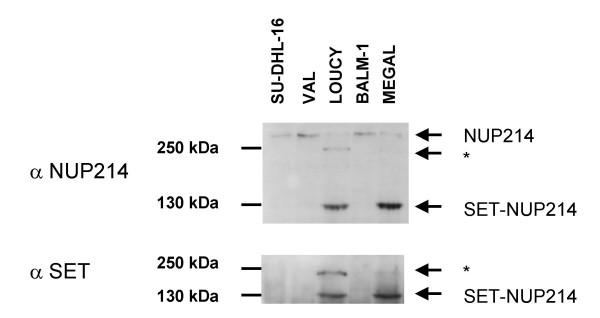
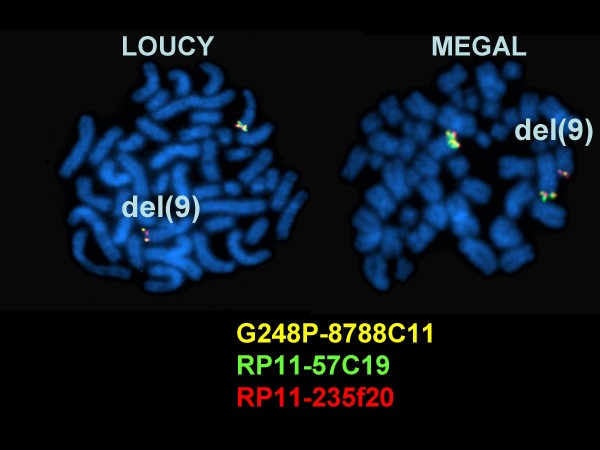
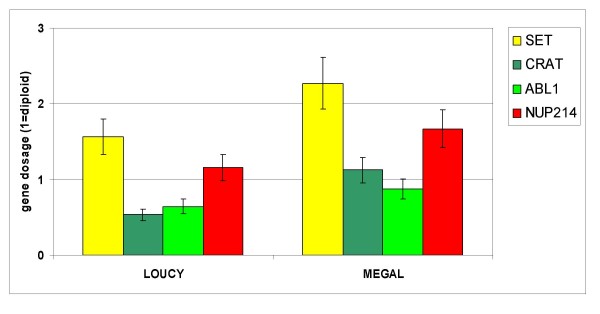
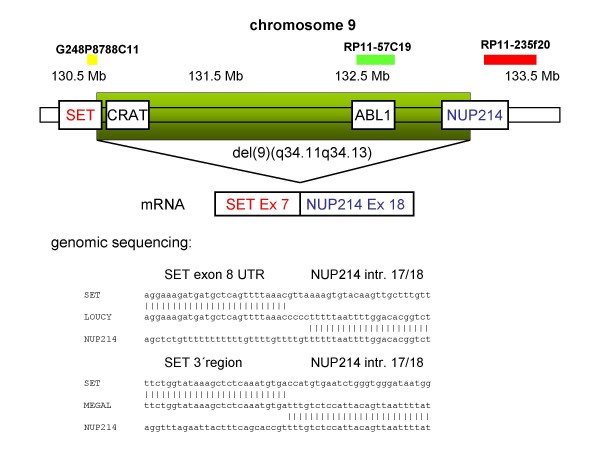
Of 141 human leukemia/lymphoma cell lines tested, only the T-ALL cell line LOUCY and the AML cell line MEGAL expressed the SET(TAF-Ibeta)-NUP214 fusion gene transcript. RT-PCR analysis specifically recognizing the alternative first exons of the two TAF-I isoforms revealed that the cell lines also expressed TAF-Ialpha-NUP214 mRNA. Results of fluorescence in situ hybridization (FISH) and array-based copy number analysis were both consistent with del(9)(q34.11q34.13) as described. Quantitative genomic PCR also confirmed loss of genomic material between SET and NUP214 in both cell lines. Genomic sequencing localized the breakpoints of the SET gene to regions downstream of the stop codon and to NUP214 intron 17/18 in both LOUCY and MEGAL cells. Both cell lines expressed the 140 kDa SET-NUP214 fusion protein.
Cell lines LOUCY and MEGAL express the recently described SET-NUP214 fusion gene. Of special note is that the formation of the SET exon 7/NUP214 exon 18 gene transcript requires alternative splicing as the SET breakpoint is located downstream of the stop codon in exon 8. The cell lines are promising model systems for SET-NUP214 studies and should facilitate investigating cellular functions of the the SET-NUP214 protein.
最近在 T 细胞急性淋巴细胞白血病(T-ALL)和一例急性髓系白血病(AML)中描述了由反复隐匿性缺失 del(9)(q34.11q34.13) 引起的 SET-NUP214 融合。融合蛋白似乎促进了 T-ALL 中 HOXA 簇基因的高表达,并且可能有助于疾病的发病机制。我们筛选了一组 ALL 和 AML 细胞系以检测 SET-NUP214 的表达,以寻找可能有助于阐明该融合基因的细胞功能的模型系统。
在测试的 141 个人类白血病/淋巴瘤细胞系中,只有 T-ALL 细胞系 LOUCY 和 AML 细胞系 MEGAL 表达 SET(TAF-Ibeta)-NUP214 融合基因转录本。专门识别两种 TAF-I 同工型的替代第一个外显子的 RT-PCR 分析表明,这些细胞系还表达了 TAF-Ialpha-NUP214 mRNA。荧光原位杂交(FISH)和基于阵列的拷贝数分析的结果均与描述的 del(9)(q34.11q34.13) 一致。定量基因组 PCR 还证实了这两个细胞系中 SET 和 NUP214 之间基因组物质的缺失。基因组测序将 SET 基因的断点定位于终止密码子下游和 LOUCY 和 MEGAL 细胞中 NUP214 内含子 17/18。这两个细胞系均表达了 140 kDa 的 SET-NUP214 融合蛋白。
细胞系 LOUCY 和 MEGAL 表达最近描述的 SET-NUP214 融合基因。特别值得注意的是,SET 外显子 7/NUP214 外显子 18 基因转录本的形成需要选择性剪接,因为 SET 断点位于外显子 8 的终止密码子下游。这些细胞系是 SET-NUP214 研究的有前途的模型系统,应该有助于研究 SET-NUP214 蛋白的细胞功能。