Vogler Erwin A, Siedlecki Christopher A
Department of Bioengineering, The Pennsylvania State University, University Park, PA 16802, USA.
Biomaterials. 2009 Apr;30(10):1857-69. doi: 10.1016/j.biomaterials.2008.12.041. Epub 2009 Jan 24.
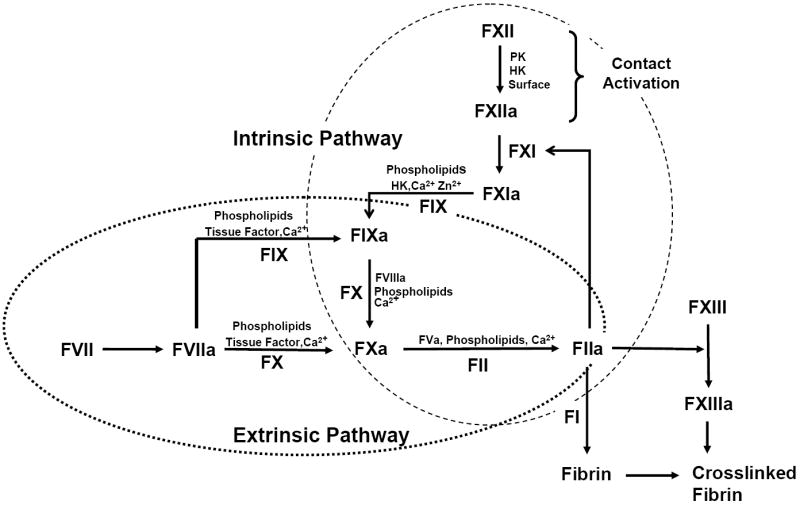
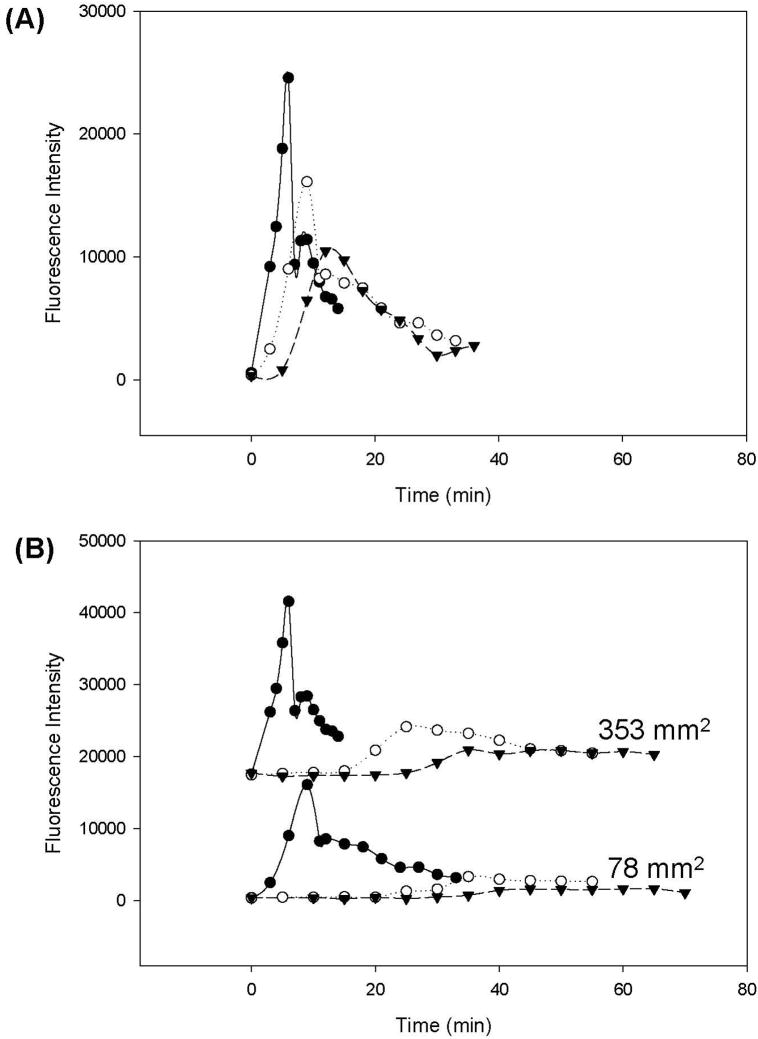
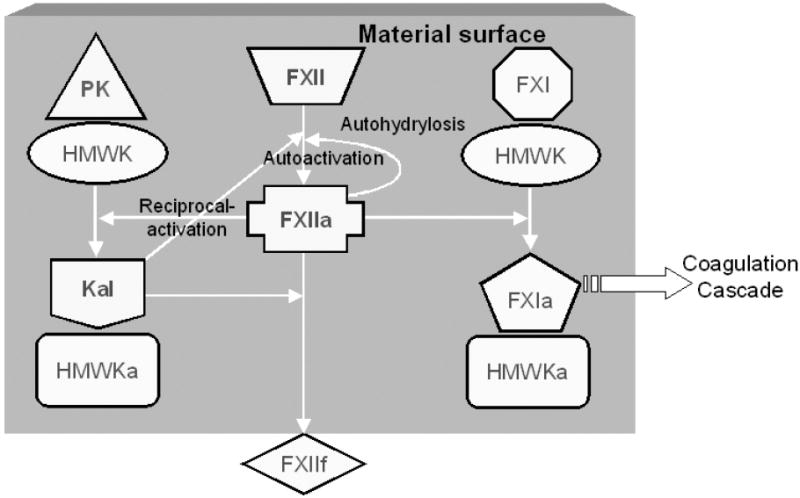
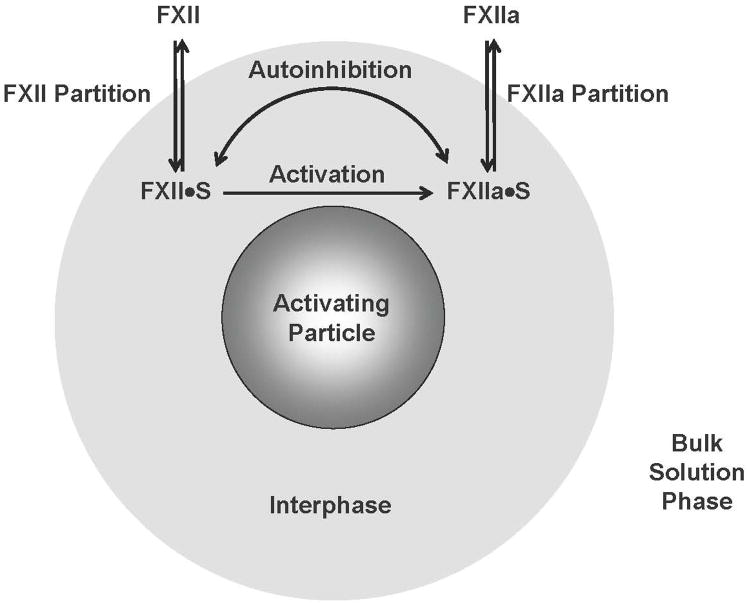
This opinion identifies inconsistencies in the generally-accepted surface biophysics involved in contact activation of blood-plasma coagulation, reviews recent experimental work aimed at resolving inconsistencies, and concludes that this standard paradigm requires substantial revision to accommodate new experimental observations. Foremost among these new findings is that surface-catalyzed conversion of the blood zymogen factor XII (FXII, Hageman factor) to the enzyme FXIIa (FXII [surface] --> FXIIa, a.k.a. autoactivation) is not specific for anionic surfaces, as proposed by the standard paradigm. Furthermore, it is found that surface activation is moderated by the protein composition of the fluid phase in which FXII autoactivation occurs by what appears to be a protein-adsorption-competition effect. Both of these findings argue against the standard view that contact activation of plasma coagulation is potentiated by the assembly of activation-complex proteins (FXII, FXI, prekallikrein, and high-molecular weight kininogen) directly onto activating surfaces (procoagulants) through specific protein/surface interactions. These new findings supplement the observation that adsorption behavior of FXII and FXIIa is not remarkably different from a wide variety of other blood proteins surveyed. Similarity in adsorption properties further undermines the idea that FXII and/or FXIIa are distinguished from other blood proteins by unusual adsorption properties resulting in chemically-specific interactions with activating anionic surfaces. IMPACT STATEMENT: This review shows that the consensus biochemical mechanism of contact activation of blood-plasma coagulation that has long served as a rationale for poor hemocompatibility is an inadequate basis for surface engineering of advanced cardiovascular biomaterials.
本观点指出了血浆凝血接触激活过程中普遍接受的表面生物物理学存在的不一致性,回顾了旨在解决这些不一致性的近期实验工作,并得出结论,即这一标准范式需要进行重大修订以适应新的实验观察结果。这些新发现中最为重要的是,血液中酶原因子XII(FXII,哈格曼因子)向酶FXIIa的表面催化转化(FXII[表面]→FXIIa,即自动激活)并不像标准范式所提出的那样对阴离子表面具有特异性。此外,研究发现,FXII自动激活所发生的液相蛋白质组成通过一种看似蛋白质吸附竞争效应来调节表面激活。这两个发现都与标准观点相悖,该观点认为血浆凝血的接触激活是通过激活复合物蛋白(FXII、FXI、前激肽释放酶和高分子量激肽原)通过特定的蛋白质/表面相互作用直接组装到激活表面(促凝剂)上而增强的。这些新发现补充了以下观察结果:FXII和FXIIa的吸附行为与所调查的多种其他血液蛋白并无显著差异。吸附特性的相似性进一步削弱了这样一种观点,即FXII和/或FXIIa通过异常的吸附特性与激活阴离子表面发生化学特异性相互作用而与其他血液蛋白区分开来。影响声明:本综述表明,长期以来作为血液相容性差的理论基础的血浆凝血接触激活的共识生化机制,对于先进心血管生物材料的表面工程而言是一个不充分的基础。