Beevers Christopher S, Chen Long, Liu Lei, Luo Yan, Webster Nicholas J G, Huang Shile
Department of Biochemistry and Molecular Biology, Feist-Weiller Cancer Center, Louisiana State University Health Sciences Center, Shreveport, Louisiana 71130-3932, USA.
Cancer Res. 2009 Feb 1;69(3):1000-8. doi: 10.1158/0008-5472.CAN-08-2367. Epub 2009 Jan 27.
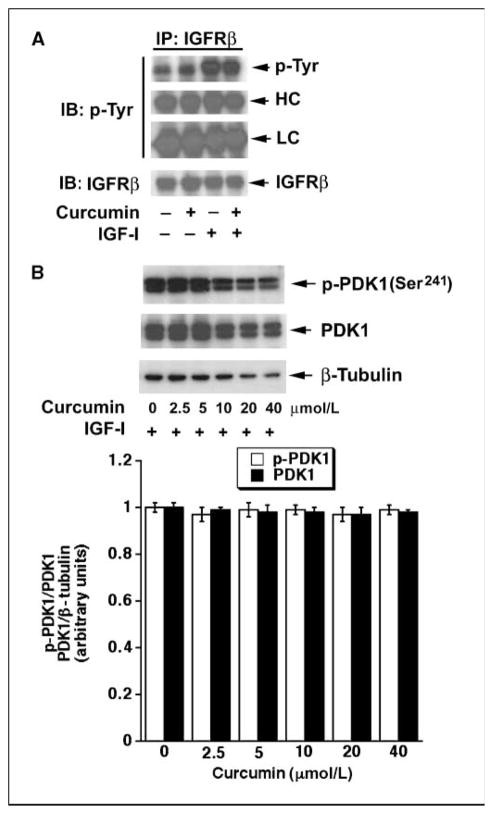
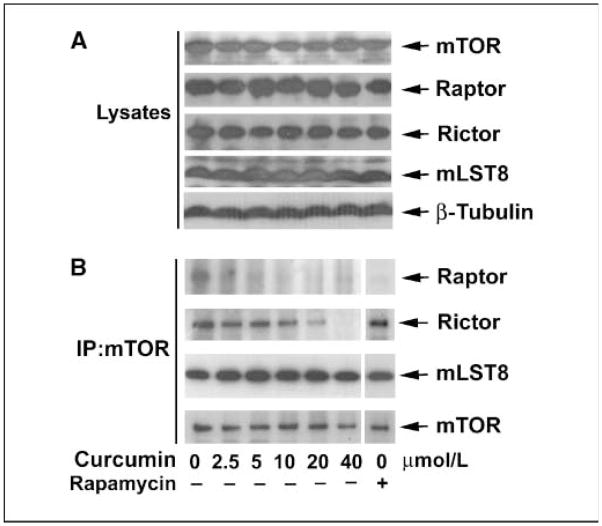
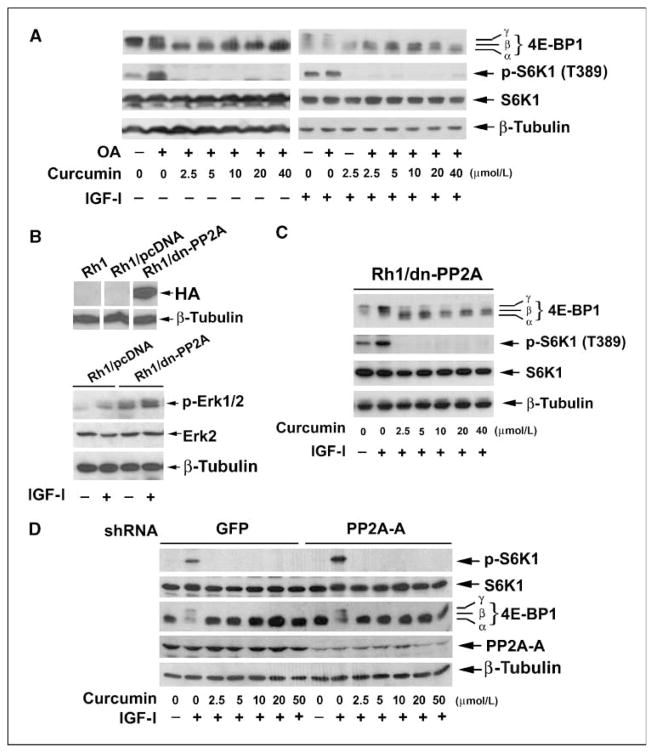
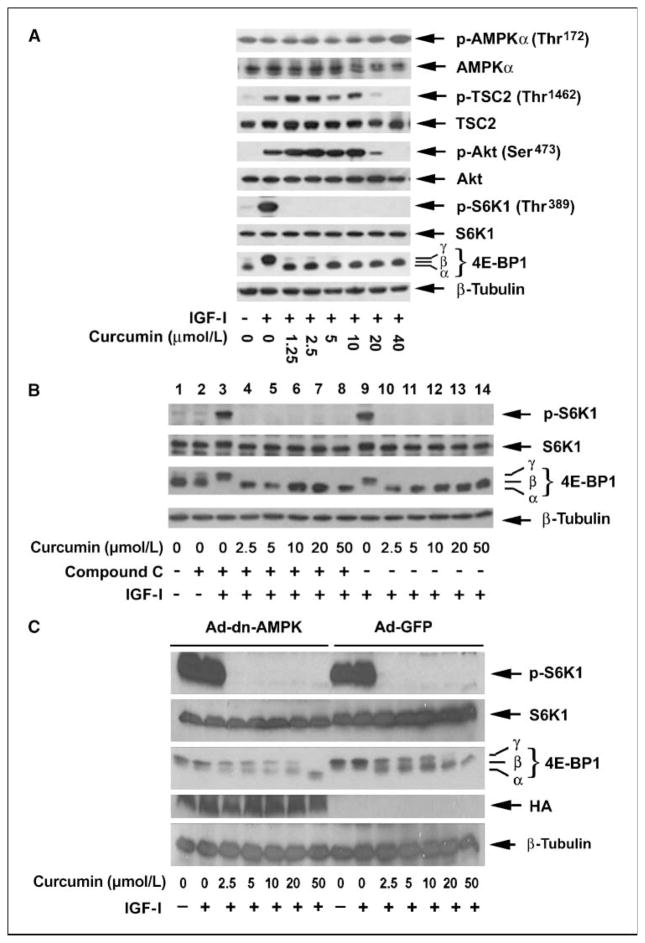
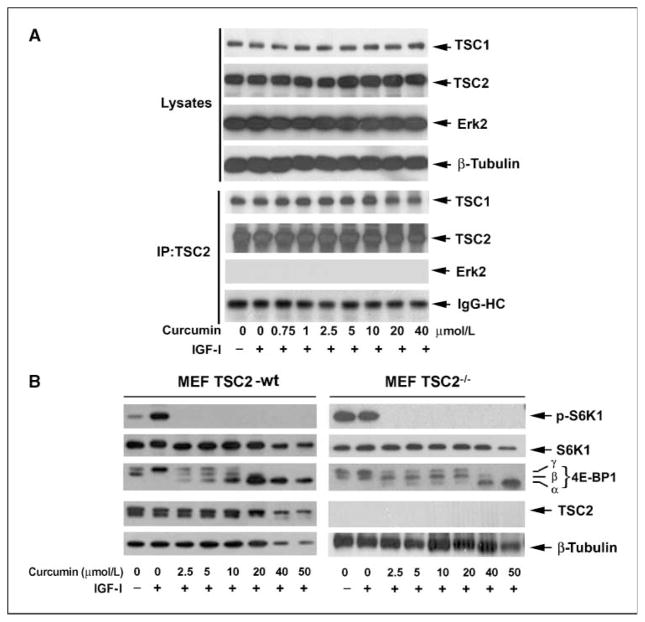
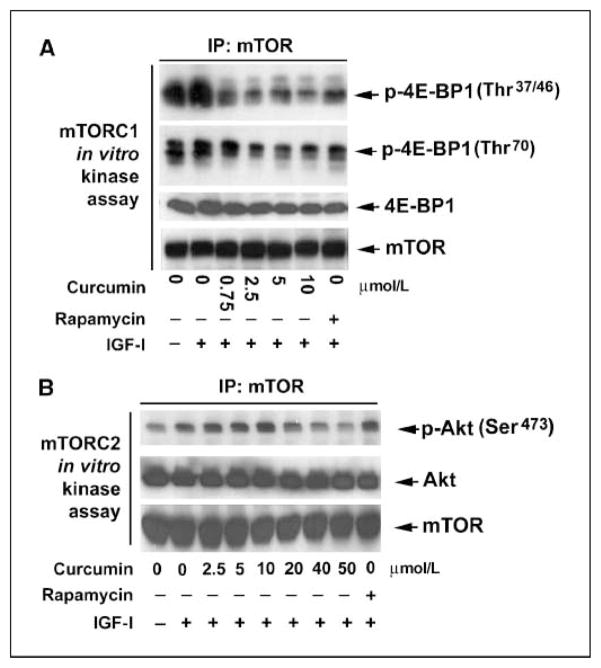
Curcumin (diferuloylmethane), a polyphenol natural product of the plant Curcuma longa, is undergoing early clinical trials as a novel anticancer agent. However, the anticancer mechanism of curcumin remains to be elucidated. Recently, we have shown that curcumin inhibits phosphorylation of p70 S6 kinase 1 (S6K1) and eukaryotic initiation factor 4E (eIF4E) binding protein 1 (4E-BP1), two downstream effector molecules of the mammalian target of rapamycin complex 1 (mTORC1) in numerous cancer cell lines. This study was designed to elucidate the underlying mechanism. We observed that curcumin inhibited mTORC1 signaling not by inhibition of the upstream kinases, such as insulin-like growth factor 1 receptor (IGF-IR) and phosphoinositide-dependent kinase 1 (PDK1). Further, we found that curcumin inhibited mTORC1 signaling independently of protein phosphatase 2A (PP2A) or AMP-activated protein kinase AMPK-tuberous sclerosis complex (TSC). This is evidenced by the findings that curcumin was able to inhibit phosphorylation of S6K1 and 4E-BP1 in the cells pretreated with PP2A inhibitor (okadaic acid) or AMPK inhibitor (compound C), or in the cells expressing dominant-negative (dn) PP2A, shRNA to PP2A-A subunit, or dn-AMPKalpha. Curcumin did not alter the TSC1/2 interaction. Knockout of TSC2 did not affect curcumin inhibition of mTOR signaling. Finally, we identified that curcumin was able to dissociate raptor from mTOR, leading to inhibition of mTORC1 activity. Therefore, our data indicate that curcumin may represent a new class of mTOR inhibitor.
姜黄素(二阿魏酰甲烷)是植物姜黄中的一种多酚类天然产物,正作为一种新型抗癌剂进行早期临床试验。然而,姜黄素的抗癌机制仍有待阐明。最近,我们发现姜黄素在众多癌细胞系中可抑制雷帕霉素靶蛋白复合物1(mTORC1)的两个下游效应分子——p70 S6激酶1(S6K1)和真核起始因子4E(eIF4E)结合蛋白1(4E-BP1)的磷酸化。本研究旨在阐明其潜在机制。我们观察到姜黄素并非通过抑制上游激酶,如胰岛素样生长因子1受体(IGF-IR)和磷酸肌醇依赖性激酶1(PDK1)来抑制mTORC1信号传导。此外,我们发现姜黄素独立于蛋白磷酸酶2A(PP2A)或AMP活化蛋白激酶AMPK-结节性硬化复合物(TSC)抑制mTORC1信号传导。这一发现的证据是,姜黄素能够在经PP2A抑制剂(冈田酸)或AMPK抑制剂(化合物C)预处理的细胞中,或在表达显性负性(dn)PP2A、PP2A-A亚基的短发夹RNA(shRNA)或dn-AMPKα的细胞中抑制S6K1和4E-BP1的磷酸化。姜黄素未改变TSC1/2的相互作用。敲除TSC2并不影响姜黄素对mTOR信号传导的抑制作用。最后,我们确定姜黄素能够使raptor与mTOR解离,从而导致mTORC1活性受到抑制。因此,我们的数据表明姜黄素可能代表一类新型的mTOR抑制剂。