Department of Biochemistry and Molecular Biology, Louisiana State University Health Sciences Center, Shreveport, LA, USA.
Lab Invest. 2010 May;90(5):762-73. doi: 10.1038/labinvest.2010.36. Epub 2010 Feb 8.
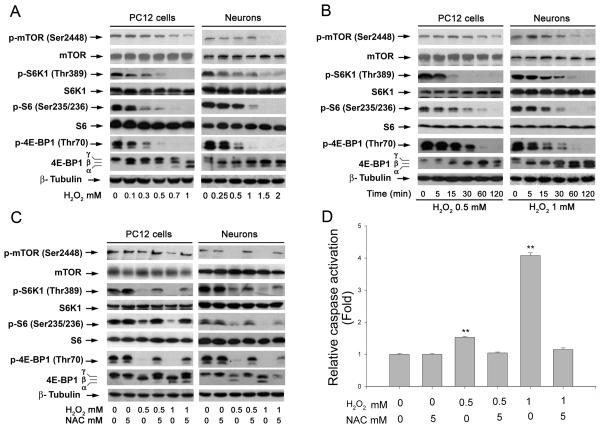
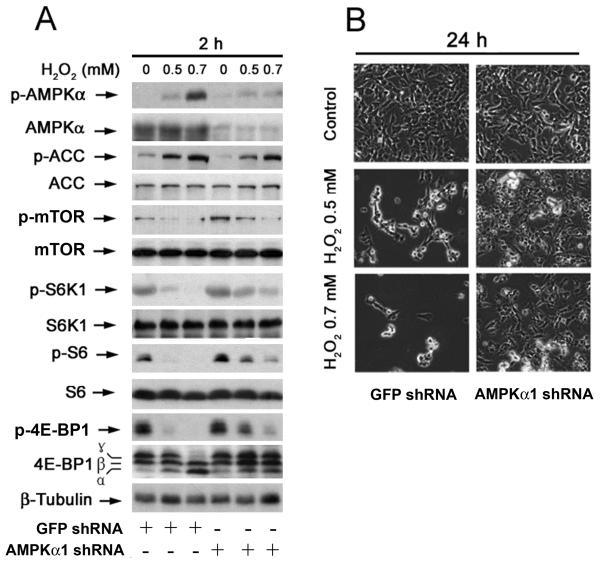
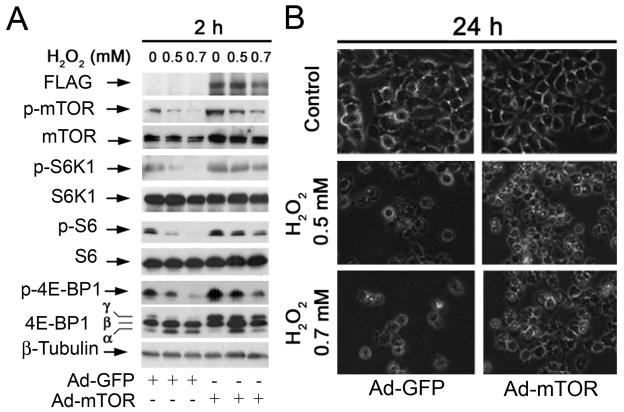
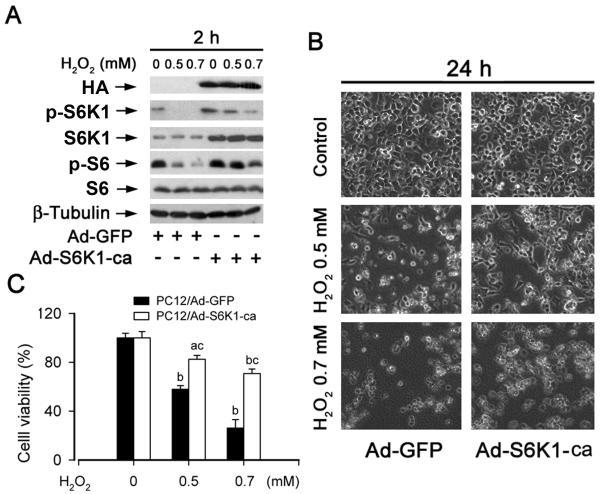
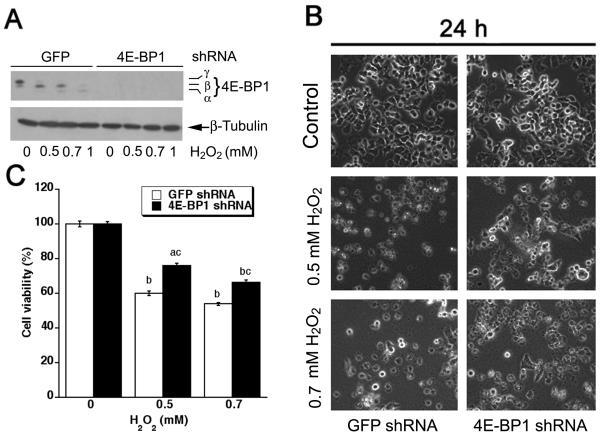
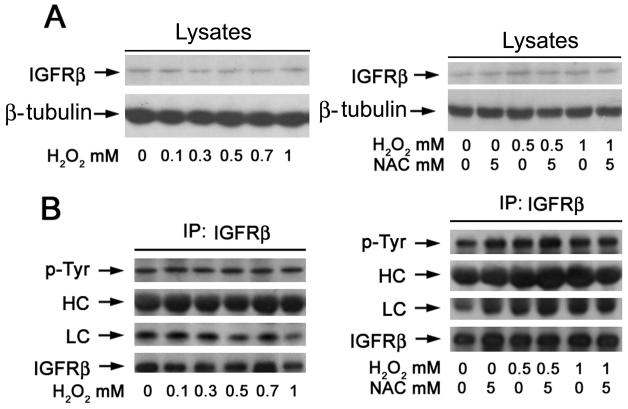
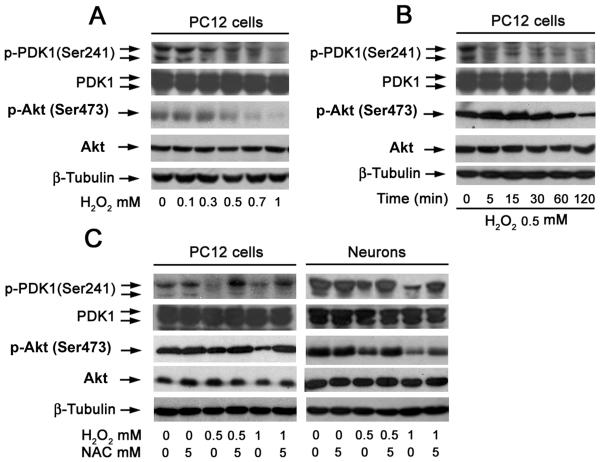
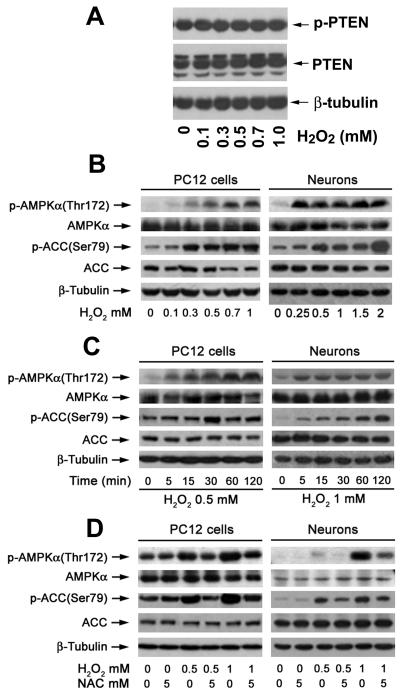
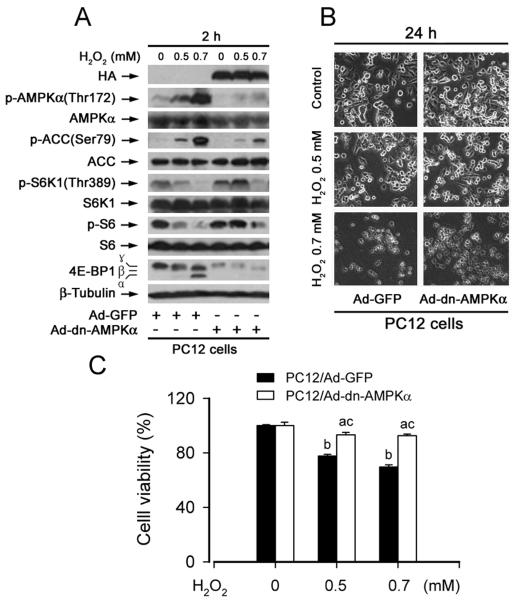
Oxidative stress results in apoptosis of neuronal cells, leading to neurodegenerative disorders. However, the underlying molecular mechanism remains to be elucidated. Here, we show that hydrogen peroxide (H(2)O(2)), a major oxidant generated when oxidative stress occurs, induced apoptosis of neuronal cells (PC12 cells and primary murine neurons), by inhibiting the mammalian target of rapamycin (mTOR)-mediated phosphorylation of ribosomal p70 S6 kinase (S6K1) and eukaryotic initiation factor 4E (eIF4E)-binding protein 1 (4E-BP1). N-acetyl-L-cysteine (NAC), a scavenger of reactive oxygen species (ROS), blocked H(2)O(2) inhibition of mTOR signaling. Ectopic expression of wild-type (wt) mTOR, constitutively active S6K1 or downregulation of 4E-BP1 partially prevented H(2)O(2) induction of apoptosis. Furthermore, we identified that H(2)O(2) induction of ROS inhibited the upstream kinases, Akt and phosphoinositide-dependent kinase 1 (PDK1), but not the type I insulin-like growth factor receptor (IGFR), and activated the negative regulator, AMP-activated protein kinase alpha (AMPKalpha), but not the phosphatase and tensin homolog (PTEN) in the cells. Expression of a dominant negative AMPKalpha or downregulation of AMPKalpha1 conferred partial resistance to H(2)O(2) inhibition of phosphorylation of S6K1 and 4E-BP1, as well as cell viability, indicating that H(2)O(2) inhibition of mTOR signaling is at least in part through activation of AMPK. Our findings suggest that AMPK inhibitors may be exploited for prevention of H(2)O(2)-induced neurodegenerative diseases.
氧化应激导致神经元细胞凋亡,从而引发神经退行性疾病。然而,其潜在的分子机制仍有待阐明。在这里,我们发现,当氧化应激发生时,主要的氧化剂过氧化氢(H₂O₂)通过抑制哺乳动物雷帕霉素靶蛋白(mTOR)介导的核糖体 p70 S6 激酶(S6K1)和真核起始因子 4E(eIF4E)结合蛋白 1(4E-BP1)磷酸化,诱导神经元细胞(PC12 细胞和原代小鼠神经元)凋亡。N-乙酰-L-半胱氨酸(NAC),一种活性氧(ROS)清除剂,阻断了 H₂O₂对 mTOR 信号的抑制。外源性表达野生型(wt)mTOR、组成型激活的 S6K1 或下调 4E-BP1 部分阻止了 H₂O₂诱导的细胞凋亡。此外,我们发现 H₂O₂诱导的 ROS 抑制了上游激酶 Akt 和磷酸肌醇依赖性激酶 1(PDK1),但不抑制 I 型胰岛素样生长因子受体(IGFR),并激活了负调节因子 AMP 激活的蛋白激酶α(AMPKα),而不是在细胞中磷酸酶和张力蛋白同源物(PTEN)。表达显性负性 AMPKα或下调 AMPKα1 部分抵抗 H₂O₂对 S6K1 和 4E-BP1 磷酸化以及细胞活力的抑制作用,表明 H₂O₂对 mTOR 信号的抑制至少部分是通过激活 AMPK 实现的。我们的研究结果表明,AMPK 抑制剂可能被用于预防 H₂O₂ 诱导的神经退行性疾病。