Lazarow Katina, Lütticke Stephanie
Biocenter Klein Flottbek, University of Hamburg, Hamburg, Germany.
BMC Genomics. 2009 Jan 29;10:55. doi: 10.1186/1471-2164-10-55.
Gene trapping is a powerful tool for gene discovery and functional genomics in both animals and plants. Upon insertion of the gene trap construct into an expressed gene, splice donor and acceptor sites facilitate the generation of transcriptional fusions between the flanking sequence and the reporter. Consequently, detection of reporter gene expression allows the identification of genes based on their expression pattern. Up to now rice is the only cereal crop for which gene trap approaches exist. In this study we describe a gene trap system in barley (Hordeum vulgare L.) based on the maize transposable elements Ac/Ds.
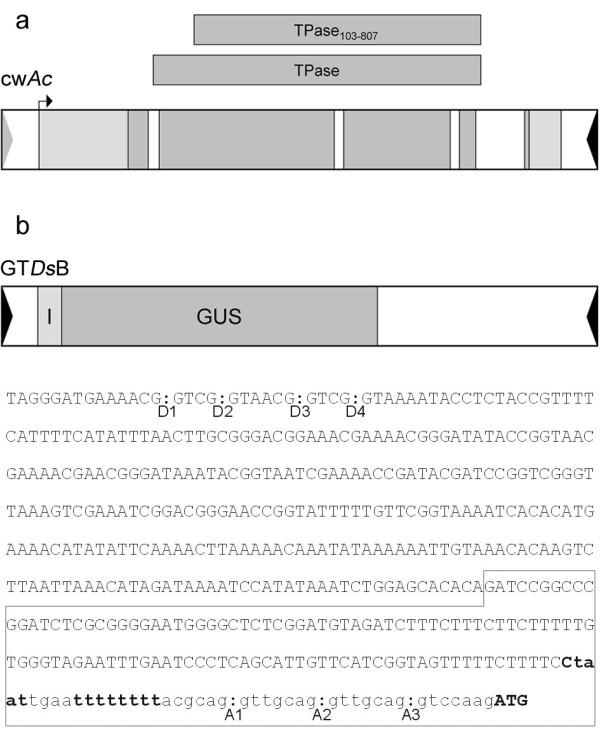
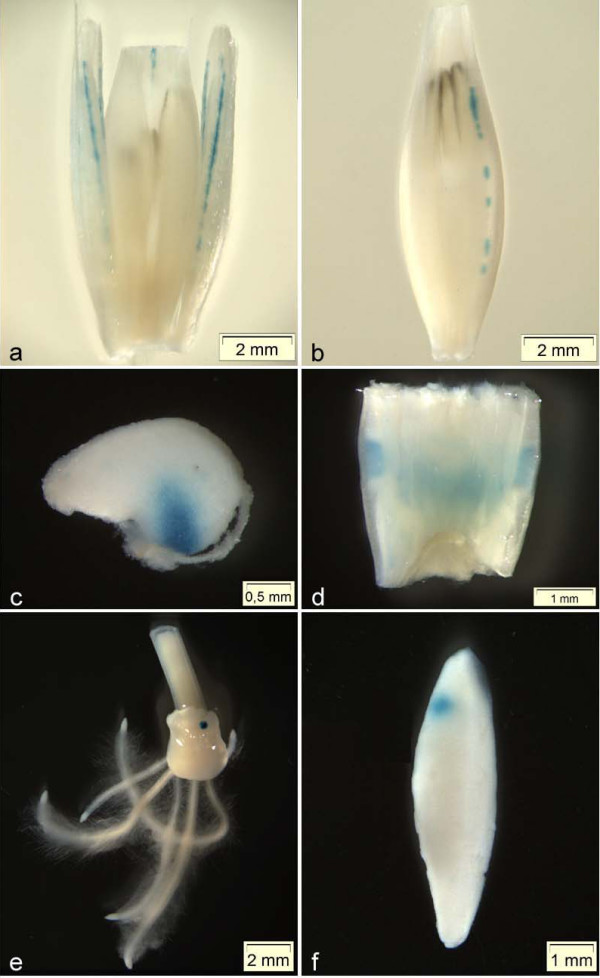
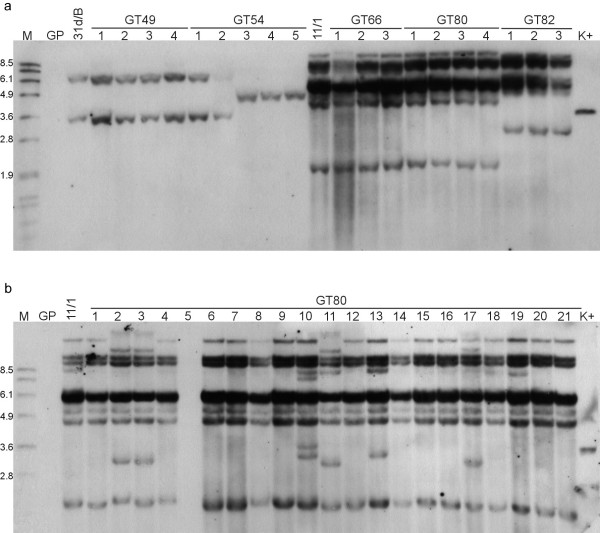
We generated gene trap barley lines by crossing Ac transposase expressing plants with multiple independent transformants carrying the Ds based gene trap construct GTDsB. Upstream of the beta-Glucuronidase start codon GTDsB carries splice donor and acceptor sites optimized for monocotyledonous plants. DNA blot analysis revealed GTDsB transposition frequencies of 11% and 26% in the F1 and F2 generation of gene trap lines and perpetuation of transposition activity in later generations. Furthermore, analysis of sequences flanking transposed GTDsB elements evidenced preferential insertion into expressed regions of the barley genome. We screened leaves, nodes, immature florets, pollinated florets, immature grains and seedlings of F2 plants and detected GUS expression in 51% (72/141) of the plants. Thus, reporter gene expression was found in 24 of the 28 F1 lines tested and in progeny of all GTDsB parental lines.
Due to the frequent transposition of GTDsB and the efficient expression of the GUS reporter gene, we conclude that this Ac/Ds-based gene trap system is an applicable approach for gene discovery in barley. The successful introduction of a gene trap construct optimized for monocots in barley contributes a novel functional genomics tool for this cereal crop.
基因捕获是动植物基因发现和功能基因组学研究的强大工具。将基因捕获构建体插入到一个表达基因中后,剪接供体和受体位点有助于在侧翼序列与报告基因之间产生转录融合。因此,通过检测报告基因的表达,能够根据基因的表达模式来鉴定基因。到目前为止,水稻是唯一有基因捕获方法的谷类作物。在本研究中,我们描述了一种基于玉米转座元件Ac/Ds的大麦(Hordeum vulgare L.)基因捕获系统。
我们通过将表达Ac转座酶的植株与携带基于Ds的基因捕获构建体GTDsB的多个独立转化体杂交,培育出了基因捕获大麦株系。GTDsB在β-葡萄糖醛酸酶起始密码子上游携带了为单子叶植物优化的剪接供体和受体位点。DNA印迹分析显示,在基因捕获株系的F1和F2代中,GTDsB的转座频率分别为11%和26%,并且在后代中转座活性得以持续。此外,对转座后的GTDsB元件侧翼序列的分析证明,其优先插入到大麦基因组的表达区域。我们对F2代植株的叶片、节、未成熟小花、授粉小花、未成熟籽粒和幼苗进行了筛选,在51%(72/141)的植株中检测到了GUS表达。因此,在测试的28个F1株系中的24个以及所有GTDsB亲本品系的后代中都发现了报告基因的表达。
由于GTDsB频繁转座以及GUS报告基因的高效表达,我们得出结论,这种基于Ac/Ds的基因捕获系统是大麦基因发现的一种适用方法。在大麦中成功引入为单子叶植物优化的基因捕获构建体,为这种谷类作物提供了一种新的功能基因组学工具。