Wodarz Dominik, Komarova Natalia
Department of Ecology and Evolution, University of California Irvine, Irvine, California, United States of America.
PLoS One. 2009;4(1):e4271. doi: 10.1371/journal.pone.0004271. Epub 2009 Jan 30.
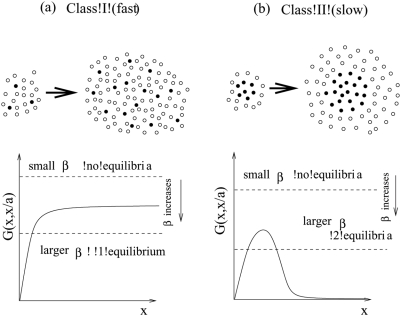
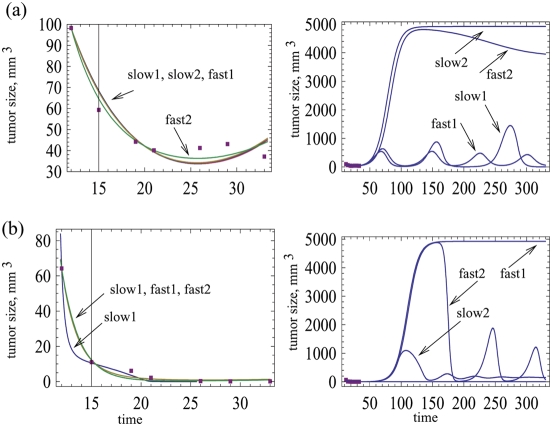
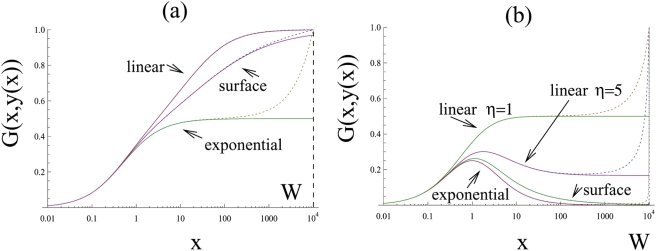
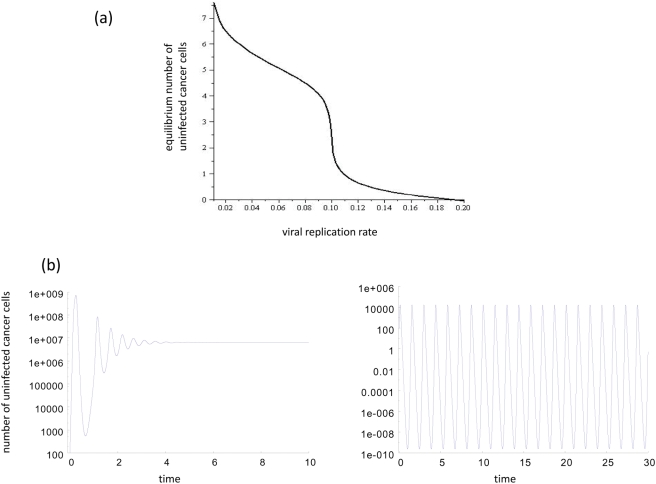
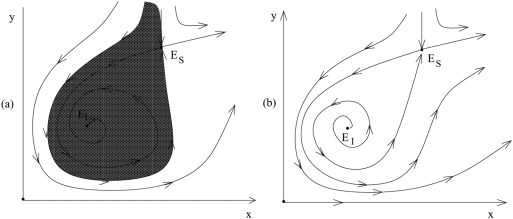
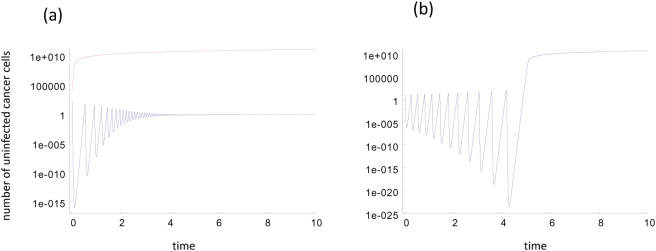
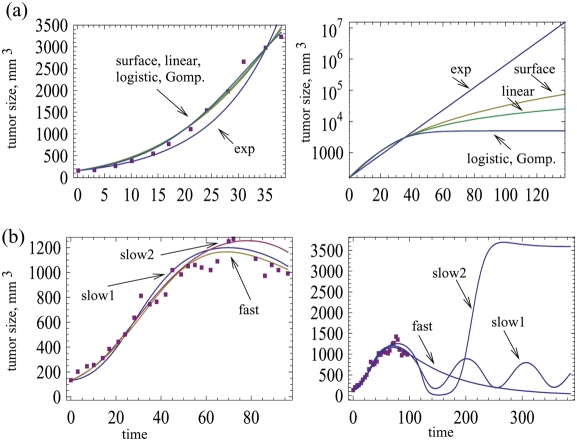
Oncolytic viruses are viruses that specifically infect cancer cells and kill them, while leaving healthy cells largely intact. Their ability to spread through the tumor makes them an attractive therapy approach. While promising results have been observed in clinical trials, solid success remains elusive since we lack understanding of the basic principles that govern the dynamical interactions between the virus and the cancer. In this respect, computational models can help experimental research at optimizing treatment regimes. Although preliminary mathematical work has been performed, this suffers from the fact that individual models are largely arbitrary and based on biologically uncertain assumptions. Here, we present a general framework to study the dynamics of oncolytic viruses that is independent of uncertain and arbitrary mathematical formulations. We find two categories of dynamics, depending on the assumptions about spatial constraints that govern that spread of the virus from cell to cell. If infected cells are mixed among uninfected cells, there exists a viral replication rate threshold beyond which tumor control is the only outcome. On the other hand, if infected cells are clustered together (e.g. in a solid tumor), then we observe more complicated dynamics in which the outcome of therapy might go either way, depending on the initial number of cells and viruses. We fit our models to previously published experimental data and discuss aspects of model validation, selection, and experimental design. This framework can be used as a basis for model selection and validation in the context of future, more detailed experimental studies. It can further serve as the basis for future, more complex models that take into account other clinically relevant factors such as immune responses.
溶瘤病毒是一类专门感染癌细胞并将其杀死的病毒,同时能使健康细胞基本保持完好。它们在肿瘤中扩散的能力使其成为一种颇具吸引力的治疗方法。尽管在临床试验中已观察到有前景的结果,但由于我们对病毒与癌症之间动态相互作用的基本原理缺乏了解,尚未取得确凿的成功。在这方面,计算模型有助于实验研究优化治疗方案。虽然已经开展了初步的数学研究,但这些研究存在个体模型很大程度上具有随意性且基于生物学上不确定假设的问题。在此,我们提出一个研究溶瘤病毒动力学的通用框架,该框架独立于不确定且随意的数学公式。根据关于病毒在细胞间传播的空间限制的假设,我们发现了两类动力学。如果感染细胞与未感染细胞混合在一起,存在一个病毒复制率阈值,超过该阈值后肿瘤控制是唯一结果。另一方面,如果感染细胞聚集在一起(例如在实体瘤中),那么我们会观察到更复杂的动力学,治疗结果可能朝任何一个方向发展,这取决于细胞和病毒的初始数量。我们将模型与先前发表的实验数据进行拟合,并讨论模型验证、选择和实验设计的相关方面。这个框架可作为未来更详细实验研究中模型选择和验证的基础。它还可以作为未来考虑其他临床相关因素(如免疫反应)的更复杂模型的基础。