Okrent Rachel A, Brooks Matthew D, Wildermuth Mary C
Department of Plant and Microbial Biology, University of California, Berkeley, California 94720-3102, USA.
J Biol Chem. 2009 Apr 10;284(15):9742-54. doi: 10.1074/jbc.M806662200. Epub 2009 Feb 2.
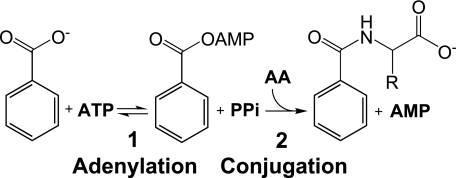
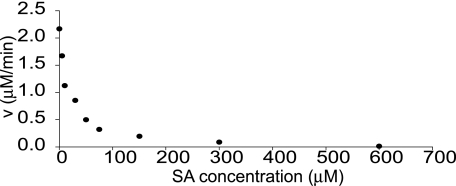
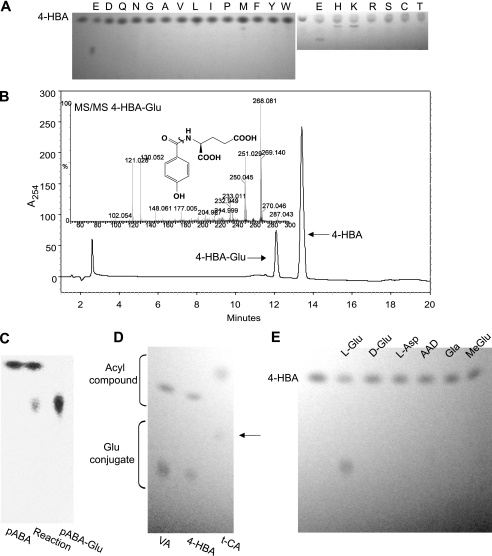
Salicylate (SA, 2-hydroxybenzoate) is a phytohormone best known for its role as a critical mediator of local and systemic plant defense responses. In response to pathogens such as Pseudomonas syringae, SA is synthesized and activates widespread gene expression. In gh3.12/pbs3 mutants of Arabidopsis thaliana, induced total SA accumulation is significantly compromised as is SA-dependent gene expression and plant defense. AtGH3 subfamily I and II members have been shown to conjugate phytohormone acyl substrates to amino acids in vitro, with this role supported by in planta analyses. Here we sought to determine the in vitro biochemical activity and kinetic properties of GH3.12/avrPphB susceptible 3 (PBS3), a member of the uncharacterized AtGH3 subfamily III. Using a novel high throughput adenylation assay, we characterized the acyl substrate preference of PBS3. We found PBS3 favors 4-substituted benzoates such as 4-aminobenzoate and 4-hydroxybenzoate, with moderate activity on benzoate and no observed activity with 2-substituted benzoates. Similar to known GH3 enzymes, PBS3 catalyzes the conjugation of specific amino acids (e.g. Glu) to its preferred acyl substrates. Kinetic analyses indicate 4-aminobenzoate and 4-hydroxybenzoate are preferred acyl substrates as PBS3 exhibits both higher affinities (apparent K(m) = 153 and 459 microm, respectively) and higher catalytic efficiencies (k(cat)/K(m) = 0.0179 and 0.0444 microm(-1) min(-1), respectively) with these acyl substrates compared with benzoate (apparent K(m) = 867 microm, k(cat)/K(m) = 0.0046 microm(-1) min(-1)). Notably, SA specifically and reversibly inhibits PBS3 activity with an IC(50) of 15 microm. This suggests a general mechanism for the rapid, reversible regulation of GH3 activity and small molecule cross-talk. For PBS3, this may allow for coordination of flux through diverse chorismate-derived pathways.
水杨酸(SA,2-羟基苯甲酸)是一种植物激素,因其作为局部和系统植物防御反应的关键介质而闻名。响应诸如丁香假单胞菌等病原体时,SA会合成并激活广泛的基因表达。在拟南芥的gh3.12/pbs3突变体中,诱导的总SA积累显著受损,SA依赖的基因表达和植物防御也是如此。AtGH3亚家族I和II成员已被证明在体外能将植物激素酰基底物与氨基酸结合,这一作用得到了体内分析的支持。在这里,我们试图确定未表征的AtGH3亚家族III成员GH3.12/avrPphB敏感3(PBS3)的体外生化活性和动力学特性。使用一种新型的高通量腺苷化测定法,我们表征了PBS3的酰基底物偏好性。我们发现PBS3偏爱4-取代苯甲酸,如4-氨基苯甲酸和4-羟基苯甲酸,对苯甲酸有中等活性,对2-取代苯甲酸未观察到活性。与已知的GH3酶类似,PBS3催化特定氨基酸(如Glu)与其偏好的酰基底物结合。动力学分析表明,4-氨基苯甲酸和4-羟基苯甲酸是PBS3偏好的酰基底物,因为与苯甲酸(表观K(m)=867 μM,k(cat)/K(m)=0.0046 μM(-1) min(-1))相比,PBS3对这些酰基底物表现出更高的亲和力(表观K(m)分别为153和459 μM)和更高的催化效率(k(cat)/K(m)分别为0.0179和0.0444 μM(-1) min(-1))。值得注意的是,SA以15 μM的IC(50)特异性且可逆地抑制PBS3活性。这表明了一种快速、可逆调节GH3活性和小分子相互作用的一般机制。对于PBS3而言,这可能允许协调通过多种分支酸衍生途径的通量。