Smith Lesley A, Foxcroft David R
School of Health and Social Care, Oxford Brookes University, Oxford, OX3 0FL, UK.
BMC Public Health. 2009 Feb 6;9:51. doi: 10.1186/1471-2458-9-51.
The effect of alcohol portrayals and advertising on the drinking behaviour of young people is a matter of much debate. We evaluated the relationship between exposure to alcohol advertising, marketing and portrayal on subsequent drinking behaviour in young people by systematic review of cohort (longitudinal) studies.
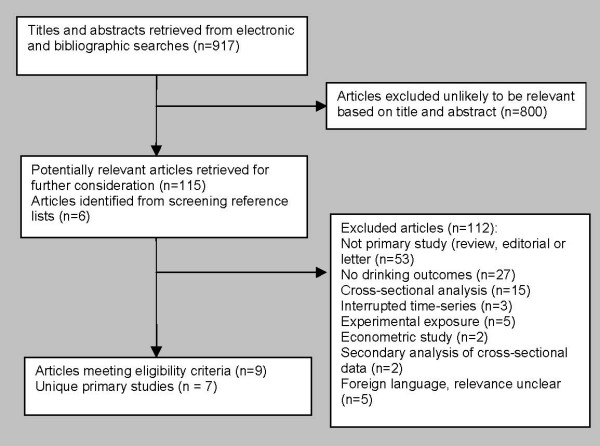
studies were identified in October 2006 by searches of electronic databases, with no date restriction, supplemented with hand searches of reference lists of retrieved articles. Cohort studies that evaluated exposure to advertising or marketing or alcohol portrayals and drinking at baseline and assessed drinking behaviour at follow-up in young people were selected and reviewed.
seven cohort studies that followed up more than 13,000 young people aged 10 to 26 years old were reviewed. The studies evaluated a range of different alcohol advertisement and marketing exposures including print and broadcast media. Two studies measured the hours of TV and music video viewing. All measured drinking behaviour using a variety of outcome measures. Two studies evaluated drinkers and non-drinkers separately. Baseline non-drinkers were significantly more likely to have become a drinker at follow-up with greater exposure to alcohol advertisements. There was little difference in drinking frequency at follow-up in baseline drinkers. In studies that included drinkers and non-drinkers, increased exposure at baseline led to significant increased risk of drinking at follow-up. The strength of the relationship varied between studies but effect sizes were generally modest. All studies controlled for age and gender, however potential confounding factors adjusted for in analyses varied from study to study. Important risk factors such as peer drinking and parental attitudes and behaviour were not adequately accounted for in some studies.
data from prospective cohort studies suggest there is an association between exposure to alcohol advertising or promotional activity and subsequent alcohol consumption in young people. Inferences about the modest effect sizes found are limited by the potential influence of residual or unmeasured confounding.
酒精的呈现及广告对年轻人饮酒行为的影响是一个备受争议的问题。我们通过对队列(纵向)研究进行系统综述,评估了接触酒精广告、营销及呈现与年轻人后续饮酒行为之间的关系。
2006年10月通过检索电子数据库确定研究,检索无日期限制,并辅以对检索到文章的参考文献列表进行手工检索。选择并综述了评估年轻人在基线时接触广告、营销或酒精呈现情况以及饮酒情况,并在随访时评估饮酒行为的队列研究。
对7项队列研究进行了综述,这些研究跟踪了13000多名10至26岁的年轻人。这些研究评估了一系列不同的酒精广告和营销接触情况,包括印刷和广播媒体。两项研究测量了观看电视和音乐视频的时长。所有研究都使用了多种结局指标来测量饮酒行为。两项研究分别评估了饮酒者和非饮酒者。基线时的非饮酒者在随访时更有可能成为饮酒者,且接触酒精广告的程度越高这种可能性越大。基线饮酒者在随访时的饮酒频率差异不大。在包括饮酒者和非饮酒者的研究中,基线时接触增加导致随访时饮酒风险显著增加。不同研究之间这种关系的强度有所不同,但效应大小一般较小。所有研究都对年龄和性别进行了控制,然而分析中调整的潜在混杂因素因研究而异。一些研究没有充分考虑重要的风险因素,如同伴饮酒以及父母的态度和行为。
前瞻性队列研究的数据表明,接触酒精广告或促销活动与年轻人随后的酒精消费之间存在关联。关于所发现的适度效应大小的推断受到残留或未测量混杂因素潜在影响的限制。