Macqueen Daniel J, Johnston Ian A
Gatty Marine Laboratory, School of Biology, University of St Andrews, Fife, UK.
BMC Evol Biol. 2009 Feb 6;9:34. doi: 10.1186/1471-2148-9-34.
Akirins are nuclear proteins that form part of an innate immune response pathway conserved in Drosophila and mice. This studies aim was to characterise the evolution of akirin gene structure and protein function in the eukaryotes.
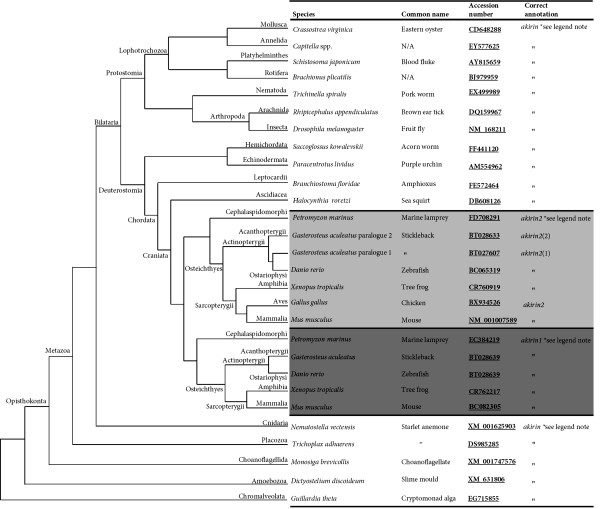
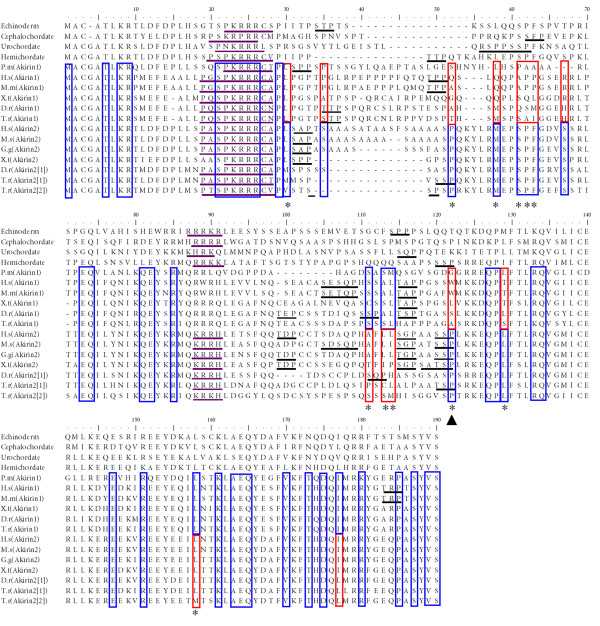
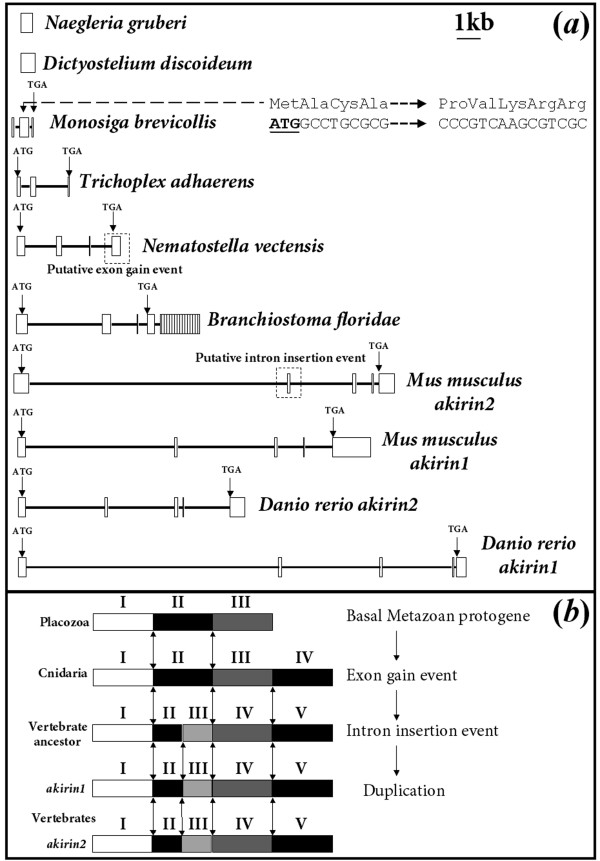
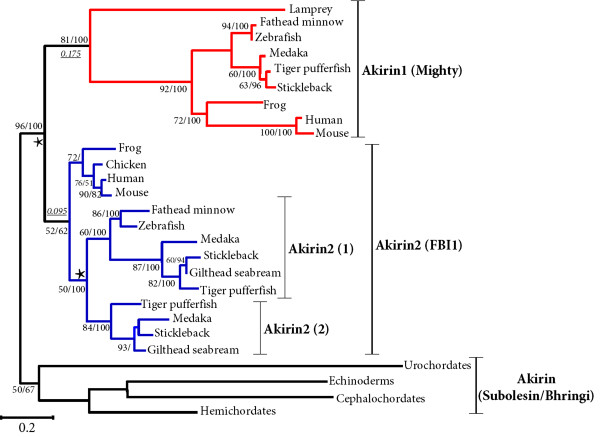
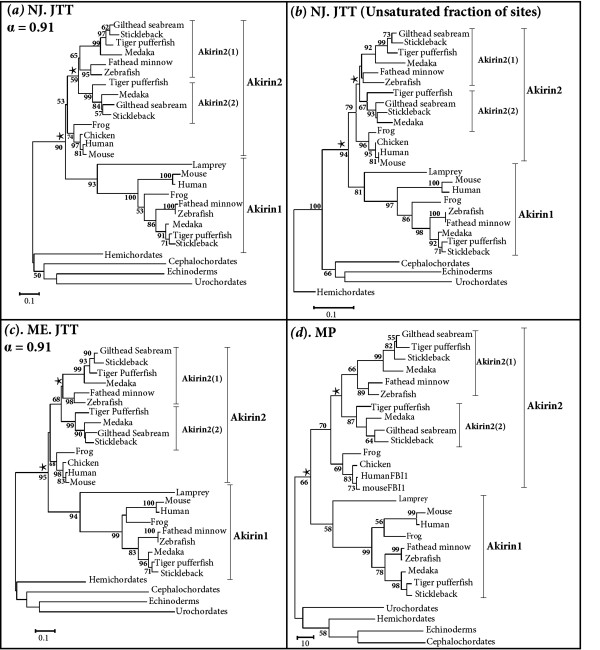
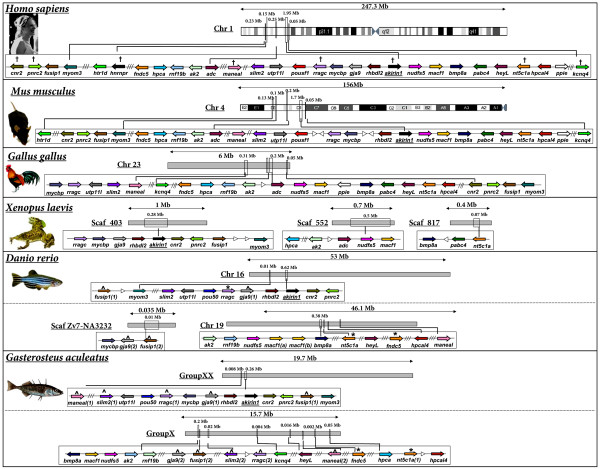
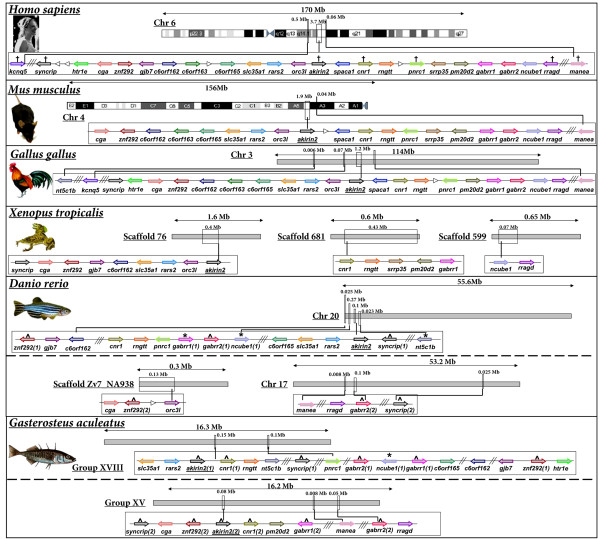
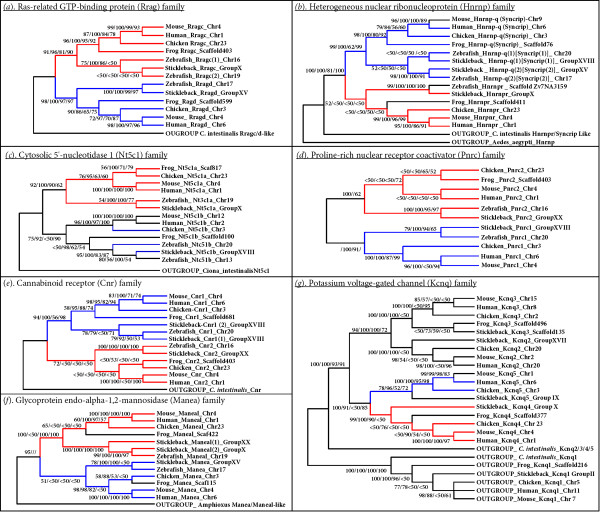
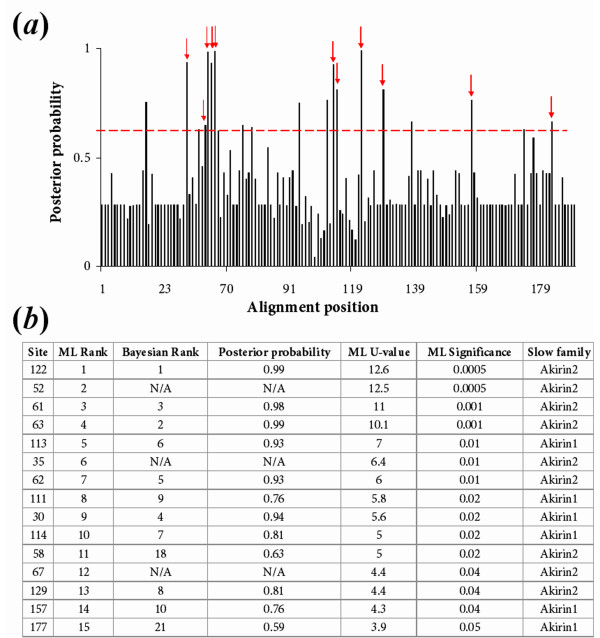
akirin genes are present throughout the metazoa and arose before the separation of animal, plant and fungi lineages. Using comprehensive phylogenetic analysis, coupled with comparisons of conserved synteny and genomic organisation, we show that the intron-exon structure of metazoan akirin genes was established prior to the bilateria and that a single proto-orthologue duplicated in the vertebrates, before the gnathostome-agnathan separation, producing akirin1 and akirin2. Phylogenetic analyses of seven vertebrate gene families with members in chromosomal proximity to both akirin1 and akirin2 were compatible with a common duplication event affecting the genomic neighbourhood of the akirin proto-orthologue. A further duplication of akirins occurred in the teleost lineage and was followed by lineage-specific patterns of paralogue loss. Remarkably, akirins have been independently characterised by five research groups under different aliases and a comparison of the available literature revealed diverse functions, generally in regulating gene expression. For example, akirin was characterised in arthropods as subolesin, an important growth factor and in Drosophila as bhringi, which has an essential myogenic role. In vertebrates, akirin1 was named mighty in mice and was shown to regulate myogenesis, whereas akirin2 was characterised as FBI1 in rats and promoted carcinogenesis, acting as a transcriptional repressor when bound to a 14-3-3 protein. Both vertebrate Akirins have evolved under comparably strict constraints of purifying selection, although a likelihood ratio test predicted that functional divergence has occurred between paralogues. Bayesian and maximum likelihood tests identified amino-acid positions where the rate of evolution had shifted significantly between paralogues. Interestingly, the highest scoring position was within a conserved, validated binding-site for 14-3-3 proteins.
This work offers an evolutionary framework to facilitate future studies of eukaryotic akirins and provides insight into their multifaceted and conserved biochemical functions.
Akirins是核蛋白,是果蝇和小鼠中保守的先天免疫反应途径的一部分。本研究的目的是表征真核生物中akirin基因结构和蛋白质功能的进化。
akirin基因存在于整个后生动物中,在动物、植物和真菌谱系分离之前就已出现。通过全面的系统发育分析,结合保守的同线性和基因组组织比较,我们表明后生动物akirin基因的内含子-外显子结构在两侧对称动物之前就已确立,并且在有颌类-无颌类分离之前,一个单一的原直系同源基因在脊椎动物中发生了复制,产生了akirin1和akirin2。对七个脊椎动物基因家族进行系统发育分析,这些家族的成员在染色体上与akirin1和akirin2都很接近,结果与影响akirin原直系同源基因基因组邻域的共同复制事件一致。硬骨鱼谱系中发生了akirin的进一步复制,随后是旁系同源基因丢失的谱系特异性模式。值得注意的是,五个研究小组分别以不同的别名独立鉴定了akirin,对现有文献的比较揭示了其多种功能,通常是在调节基因表达方面。例如,akirin在节肢动物中被鉴定为亚油酸结合蛋白,一种重要的生长因子,在果蝇中被鉴定为brhingi,具有重要的生肌作用。在脊椎动物中,akirin1在小鼠中被命名为强大蛋白,并被证明调节肌生成,而akirin2在大鼠中被鉴定为FBI1,并促进致癌作用,当与14-3-3蛋白结合时作为转录抑制因子发挥作用。尽管似然比检验预测旁系同源基因之间发生了功能分化,但两种脊椎动物的Akirins都在相当严格的纯化选择约束下进化。贝叶斯和最大似然检验确定了旁系同源基因之间进化速率发生显著变化的氨基酸位置。有趣的是,得分最高的位置位于一个保守的、经验证的14-3-3蛋白结合位点内。
这项工作提供了一个进化框架,以促进未来对真核生物akirin的研究,并深入了解其多方面的保守生化功能。