Tong Xuemei, Zhao Fangping, Thompson Craig B
Department of Cancer Biology, Abramson Cancer Center, University of Pennsylvania, Philadelphia, PA 19104-6160, USA.
Curr Opin Genet Dev. 2009 Feb;19(1):32-7. doi: 10.1016/j.gde.2009.01.002. Epub 2009 Feb 5.
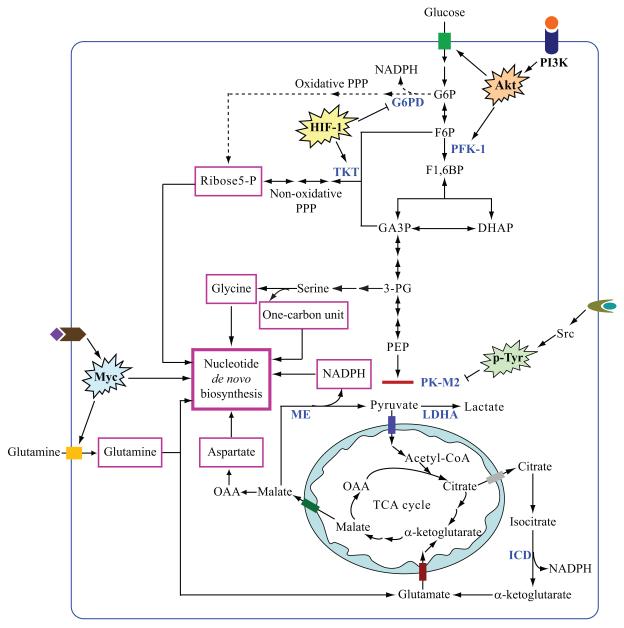
Tumor cells increase the use of anabolic pathways to satisfy the metabolic requirements associated with a high growth rate. Transformed cells take up and metabolize nutrients such as glucose and glutamine at high levels that support anabolic growth. Oncogenic signaling through the PI3K/Akt and Myc pathways directly control glucose and glutamine uptake, respectively. In order to achieve elevated rates of nucleotide biosynthesis, neoplastic cells must divert carbon from PI3K/Akt-induced glycolytic flux into the nonoxidative branch of the pentose phosphate pathway to generate ribose-5-phosphate. This redirection of glucose catabolism appears to be regulated by cytoplasmic tyrosine kinases. Myc-induced glutamine metabolism also increases the abundance and activity of different rate-limiting enzymes that produce the molecular precursors required for de novo nucleotide synthesis. In this review, we will focus on recent progress in understanding how glucose and glutamine metabolism is redirected by oncogenes in order to support de novo nucleotide biosynthesis during proliferation and how metabolic reprogramming can be potentially exploited in the development of new cancer therapies.
肿瘤细胞增加合成代谢途径的利用,以满足与高生长速率相关的代谢需求。转化细胞高水平摄取和代谢葡萄糖和谷氨酰胺等营养物质,以支持合成代谢生长。通过PI3K/Akt和Myc途径的致癌信号分别直接控制葡萄糖和谷氨酰胺的摄取。为了实现核苷酸生物合成速率的提高,肿瘤细胞必须将PI3K/Akt诱导的糖酵解通量中的碳转移到磷酸戊糖途径的非氧化分支,以生成5-磷酸核糖。葡萄糖分解代谢的这种重定向似乎受细胞质酪氨酸激酶调节。Myc诱导的谷氨酰胺代谢还增加了不同限速酶的丰度和活性,这些酶产生从头合成核苷酸所需的分子前体。在本综述中,我们将关注在理解癌基因如何重定向葡萄糖和谷氨酰胺代谢以支持增殖过程中的从头核苷酸生物合成以及如何在新癌症治疗开发中潜在利用代谢重编程方面的最新进展。