Harris Diana M, van der Krogt Zita A, Klaassen Paul, Raamsdonk Leonie M, Hage Susanne, van den Berg Marco A, Bovenberg Roel A L, Pronk Jack T, Daran Jean-Marc
Department of Biotechnology, Delft University of Technology, Delft, The Netherlands.
BMC Genomics. 2009 Feb 10;10:75. doi: 10.1186/1471-2164-10-75.
Since the discovery of the antibacterial activity of penicillin by Fleming 80 years ago, improvements of penicillin titer were essentially achieved by classical strain improvement through mutagenesis and screening. The recent sequencing of Penicillium chrysogenum strain Wisconsin1255-54 and the availability of genomics tools such as DNA-microarray offer new perspective.
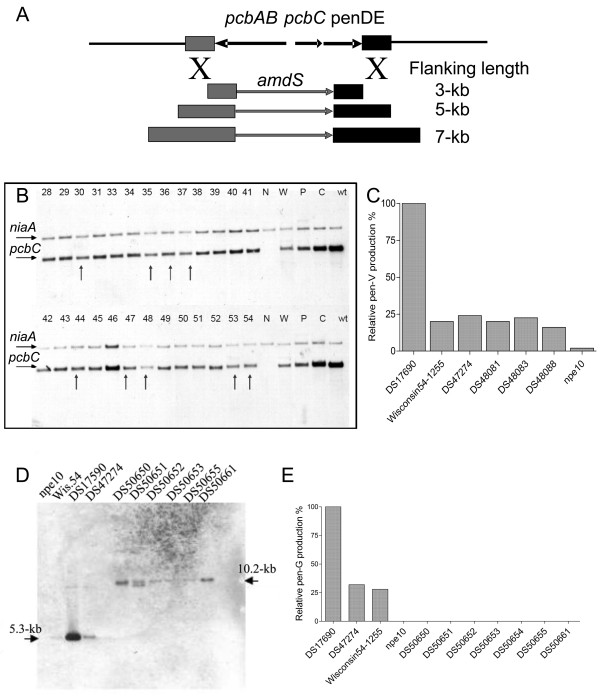
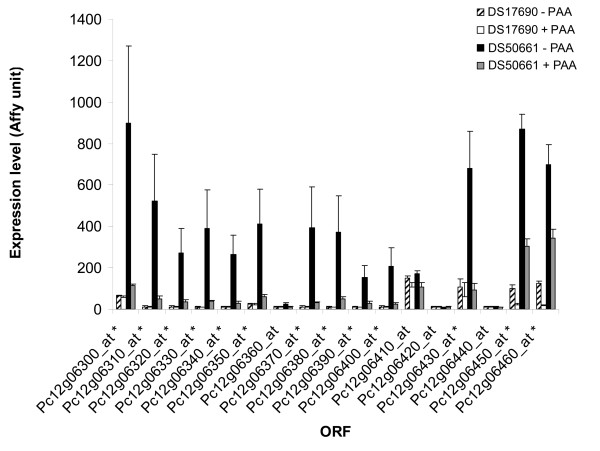
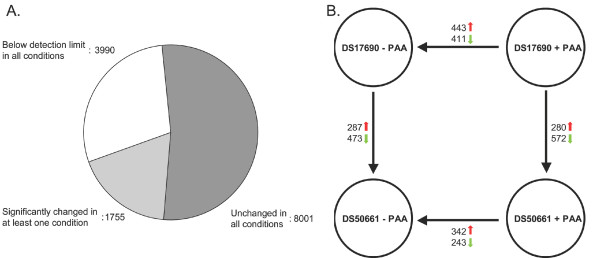
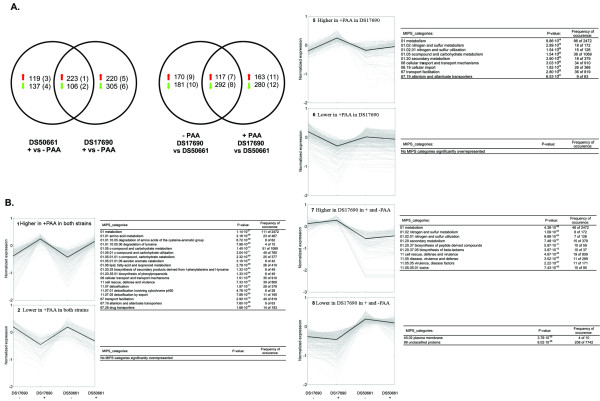
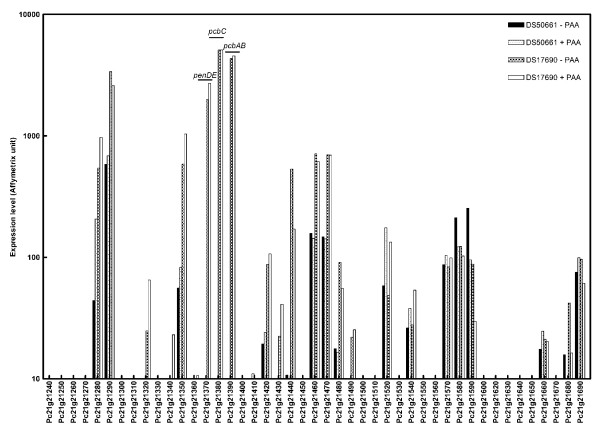
In studies on beta-lactam production by P. chrysogenum, addition and omission of a side-chain precursor is commonly used to generate producing and non-producing scenarios. To dissect effects of penicillinG production and of its side-chain precursor phenylacetic acid (PAA), a derivative of a penicillinG high-producing strain without a functional penicillin-biosynthesis gene cluster was constructed. In glucose-limited chemostat cultures of the high-producing and cluster-free strains, PAA addition caused a small reduction of the biomass yield, consistent with PAA acting as a weak-organic-acid uncoupler. Microarray-based analysis on chemostat cultures of the high-producing and cluster-free strains, grown in the presence and absence of PAA, showed that: (i) Absence of a penicillin gene cluster resulted in transcriptional upregulation of a gene cluster putatively involved in production of the secondary metabolite aristolochene and its derivatives, (ii) The homogentisate pathway for PAA catabolism is strongly transcriptionally upregulated in PAA-supplemented cultures (iii) Several genes involved in nitrogen and sulfur metabolism were transcriptionally upregulated under penicillinG producing conditions only, suggesting a drain of amino-acid precursor pools. Furthermore, the number of candidate genes for penicillin transporters was strongly reduced, thus enabling a focusing of functional analysis studies.
This study demonstrates the usefulness of combinatorial transcriptome analysis in chemostat cultures to dissect effects of biological and process parameters on gene expression regulation. This study provides for the first time clear-cut target genes for metabolic engineering, beyond the three genes of the beta-lactam pathway.
自80年前弗莱明发现青霉素的抗菌活性以来,青霉素效价的提高主要是通过诱变和筛选等经典菌株改良方法实现的。产黄青霉Wisconsin1255 - 54菌株的近期测序以及DNA微阵列等基因组学工具的出现提供了新的视角。
在关于产黄青霉β-内酰胺生产的研究中,添加和省略侧链前体常用于产生生产和非生产情况。为了剖析青霉素G生产及其侧链前体苯乙酸(PAA)的影响,构建了一个青霉素G高产菌株的衍生物,该菌株没有功能性的青霉素生物合成基因簇。在高产和无基因簇菌株的葡萄糖限制恒化器培养中,添加PAA导致生物量产量略有下降,这与PAA作为弱有机酸解偶联剂的作用一致。对高产和无基因簇菌株在添加和不添加PAA的情况下进行恒化器培养的基于微阵列的分析表明:(i)青霉素基因簇的缺失导致一个可能参与次生代谢物马兜铃烯及其衍生物生产的基因簇转录上调,(ii)在添加PAA的培养物中,PAA分解代谢的尿黑酸途径转录强烈上调,(iii)仅在青霉素G生产条件下,几个参与氮和硫代谢的基因转录上调,表明氨基酸前体池被消耗。此外,青霉素转运蛋白的候选基因数量大幅减少,从而能够聚焦功能分析研究。
本研究证明了在恒化器培养中进行组合转录组分析以剖析生物学和工艺参数对基因表达调控影响的有用性。本研究首次为代谢工程提供了明确的目标基因,超出了β-内酰胺途径的三个基因。