Dubey Manish K, Aamir Mohd, Kaushik Manish S, Khare Saumya, Meena Mukesh, Singh Surendra, Upadhyay Ram S
Centre of Advanced Study in Botany, Institute of Science, Banaras Hindu University, Varanasi, India.
Department of Biochemistry, Institute of Science, Banaras Hindu University, Varanasi, India.
Front Pharmacol. 2018 Mar 29;9:288. doi: 10.3389/fphar.2018.00288. eCollection 2018.
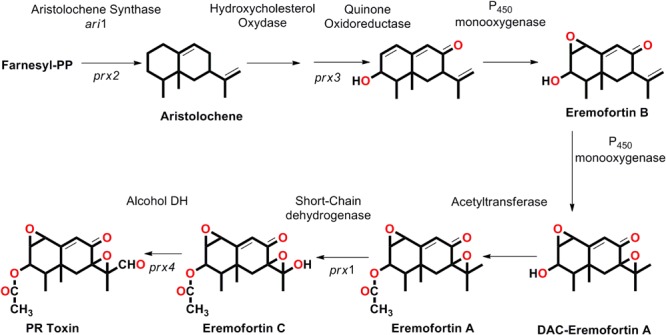
Out of the various mycotoxigenic food and feed contaminant, the fungal species belonging to genera, particularly is of great economic importance, and well known for its crucial role in the manufacturing of Roquefort and Gorgonzola cheese. The mycotoxicosis effect of this mold is due to secretion of several metabolites, of which PR toxin is of considerable importance, with regard to food quality and safety challenges issues. The food products and silages enriched with PR toxin could lead into damage to vital internal organs, gastrointestinal perturbations, carcinogenicity, immunotoxicity, necrosis, and enzyme inhibition. Moreover, it also has the significant mutagenic potential to disrupt/alter the crucial processes like DNA replication, transcription, and translation at the molecular level. The high genetic diversities in between the various strains of persuaded their nominations with Protected Geographical Indication (PGI), accordingly to the cheese type, they have been employed. Recently, the biosynthetic mechanism and toxicogenetic studies unraveled the role of and gene clusters that cross-talk with the synthesis of other metabolites or involve other cross-regulatory pathways to negatively regulate/inhibit the other biosynthetic route targeted for production of a strain-specific metabolites. Interestingly, the chemical conversion that imparts toxic properties to PR toxin is the substitution/oxidation of functional hydroxyl group (-OH) to aldehyde group (-CHO). The rapid conversion of PR toxin to the other derivatives such as PR imine, PR amide, and PR acid, based on conditions available reflects their unstability and degradative aspects. Since the PR toxin-induced toxicity could not be eliminated safely, the assessment of dose-response and other pharmacological aspects for its safe consumption is indispensable. The present review describes the natural occurrences, diversity, biosynthesis, genetics, toxicological aspects, control and prevention strategies, and other management aspects of PR toxin with paying special attention on economic impacts with intended legislations for avoiding PR toxin contamination with respect to food security and other biosafety purposes.
在各种产毒真菌导致的食品和饲料污染物中,属于特定属的真菌物种,特别是[具体真菌名称未给出],具有重大经济意义,并且因其在罗克福尔奶酪和戈贡佐拉奶酪制造中的关键作用而闻名。这种霉菌的霉菌毒素中毒作用归因于几种代谢产物的分泌,其中PR毒素在食品质量和安全挑战问题方面具有相当重要性。富含PR毒素的食品和青贮饲料可能导致重要内部器官受损、胃肠道紊乱、致癌性、免疫毒性、坏死和酶抑制。此外,它还具有显著的诱变潜力,可在分子水平上破坏/改变DNA复制、转录和翻译等关键过程。[具体真菌名称未给出]不同菌株之间的高度遗传多样性促使它们根据所用于的奶酪类型获得了受保护地理标志(PGI)提名。最近,生物合成机制和毒理学研究揭示了[具体基因名称未给出]和[具体基因名称未给出]基因簇的作用,它们与其他代谢产物的合成相互作用,或涉及其他交叉调节途径,以负向调节/抑制针对生产菌株特异性代谢产物的其他生物合成途径。有趣的是,赋予PR毒素毒性的化学转化是功能性羟基(-OH)被醛基(-CHO)取代/氧化。基于现有条件,PR毒素快速转化为其他衍生物,如PR亚胺、PR酰胺和PR酸,反映了它们的不稳定性和降解特性。由于PR毒素诱导的毒性无法安全消除,因此评估其安全消费的剂量反应和其他药理学方面是必不可少的。本综述描述了PR毒素的自然发生、多样性、生物合成、遗传学、毒理学方面、控制和预防策略以及其他管理方面,特别关注其经济影响以及为避免PR毒素污染而制定的相关立法,以实现食品安全和其他生物安全目的。