Russell Rebecca A, Moore Michael D, Hu Wei-Shau, Pathak Vinay K
Viral Mutation Section, HIV Drug Resistance Program, Center for Cancer Research, National Cancer Institute at Frederick, Frederick, MD 21702, USA.
Retrovirology. 2009 Feb 13;6:16. doi: 10.1186/1742-4690-6-16.
Naturally occurring Vif variants that are unable to inhibit the host restriction factor APOBEC3G (A3G) have been isolated from infected individuals. A3G can potentially induce G-to-A hypermutation in these viruses, and hypermutation could contribute to genetic variation in HIV-1 populations through recombination between hypermutant and wild-type genomes. Thus, hypermutation could contribute to the generation of immune escape and drug resistant variants, but the genetic contribution of hypermutation to the viral evolutionary potential is poorly understood. In addition, the mechanisms by which these viruses persist in the host despite the presence of A3G remain unknown.
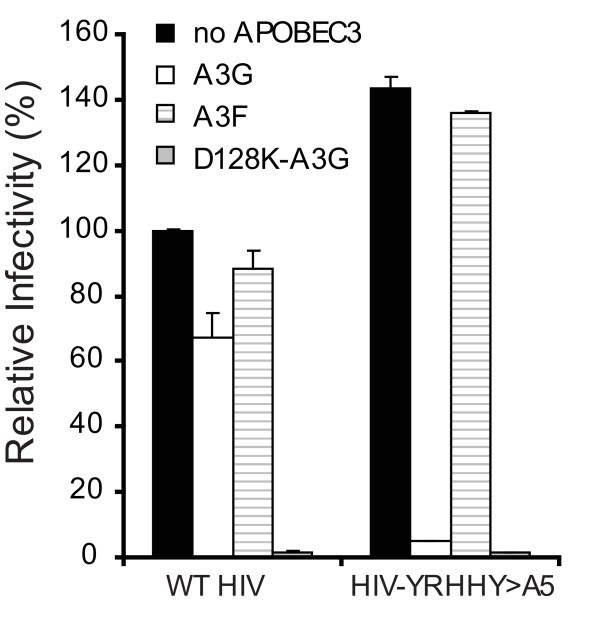
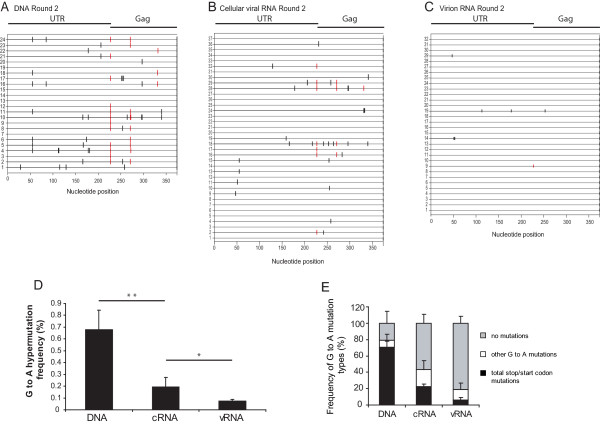
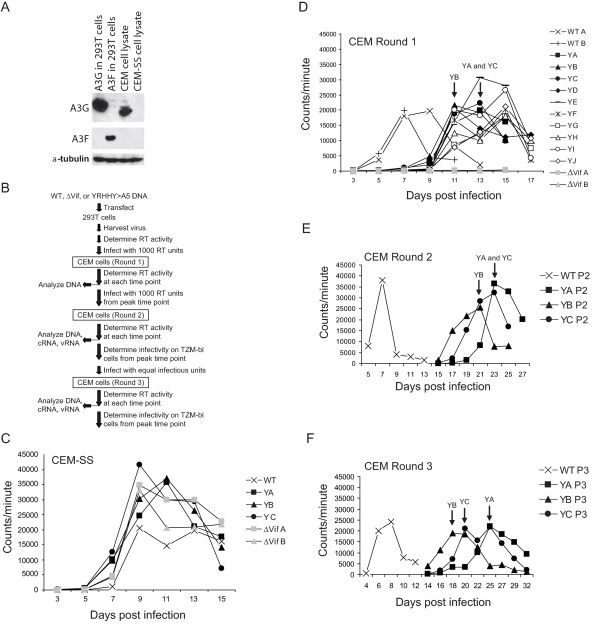
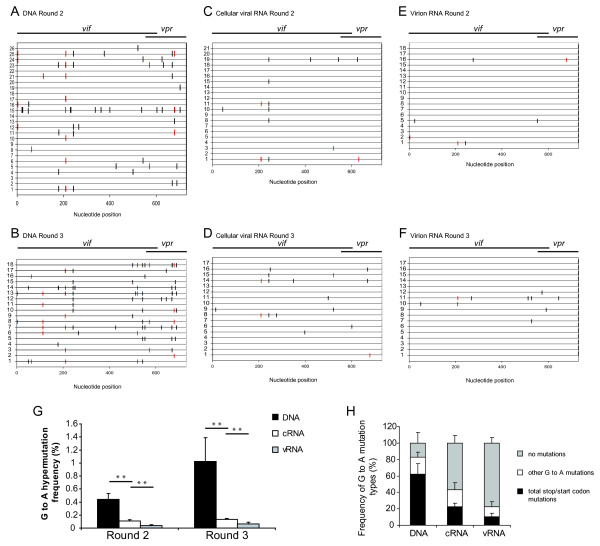
To address these questions, we generated a replication-competent HIV-1 Vif mutant in which the A3G-binding residues of Vif, Y(40)RHHY(44), were substituted with five alanines. As expected, the mutant was severely defective in an A3G-expressing T cell line and exhibited a significant delay in replication kinetics. Analysis of viral DNA showed the expected high level of G-to-A hypermutation; however, we found substantially reduced levels of G-to-A hypermutation in intracellular viral RNA (cRNA), and the levels of G-to-A mutations in virion RNA (vRNA) were even further reduced. The frequencies of hypermutation in DNA, cRNA, and vRNA were 0.73%, 0.12%, and 0.05% of the nucleotides sequenced, indicating a gradient of hypermutation. Additionally, genomes containing start codon mutations and early termination codons within gag were isolated from the vRNA.
These results suggest that sublethal levels of hypermutation coupled with purifying selection at multiple steps during the early phase of viral replication lead to the packaging of largely unmutated genomes, providing a mechanism by which mutant Vif variants can persist in infected individuals. The persistence of genomes containing mutated gag genes despite this selection pressure indicates that dual infection and complementation can result in the packaging of hypermutated genomes which, through recombination with wild-type genomes, could increase viral genetic variation and contribute to evolution.
已从受感染个体中分离出天然存在的无法抑制宿主限制因子载脂蛋白B mRNA编辑酶催化多肽样 3G(APOBEC3G,A3G)的Vif变体。A3G可能会在这些病毒中诱导G到A的超突变,并且超突变可能通过超突变体和野生型基因组之间的重组导致HIV-1群体的遗传变异。因此,超突变可能有助于免疫逃逸和耐药变体的产生,但超突变对病毒进化潜力的遗传贡献尚不清楚。此外,尽管存在A3G,这些病毒在宿主中持续存在的机制仍然未知。
为了解决这些问题,我们构建了一种具有复制能力的HIV-1 Vif突变体,其中Vif的A3G结合残基Y(40)RHHY(44)被五个丙氨酸取代。正如预期的那样,该突变体在表达A3G的T细胞系中存在严重缺陷,并且在复制动力学上表现出显著延迟。对病毒DNA的分析显示出预期的高水平G到A超突变;然而,我们发现细胞内病毒RNA(cRNA)中的G到A超突变水平大幅降低,而病毒粒子RNA(vRNA)中的G到A突变水平甚至进一步降低。DNA、cRNA和vRNA中的超突变频率分别为测序核苷酸的0.73%、0.12%和0.05%,表明存在超突变梯度。此外,从vRNA中分离出了在gag内包含起始密码子突变和早期终止密码子的基因组。
这些结果表明,亚致死水平的超突变与病毒复制早期多个步骤的纯化选择相结合,导致主要未突变的基因组被包装,这为突变的Vif变体能够在受感染个体中持续存在提供了一种机制。尽管存在这种选择压力,但含有突变gag基因的基因组的持续存在表明,双重感染和互补可导致超突变基因组的包装,这些基因组通过与野生型基因组重组,可能增加病毒遗传变异并促进进化。