Korompilias Anastasios V, Beris Alexandros E, Lykissas Marios G, Vekris Marios D, Kontogeorgakos Vasileios A, Soucacos Panayiotis N
Department of Orthopaedic Surgery, University of Ioannina School of Medicine, Ioannina, Greece.
J Orthop Surg Res. 2009 Feb 13;4:4. doi: 10.1186/1749-799X-4-4.
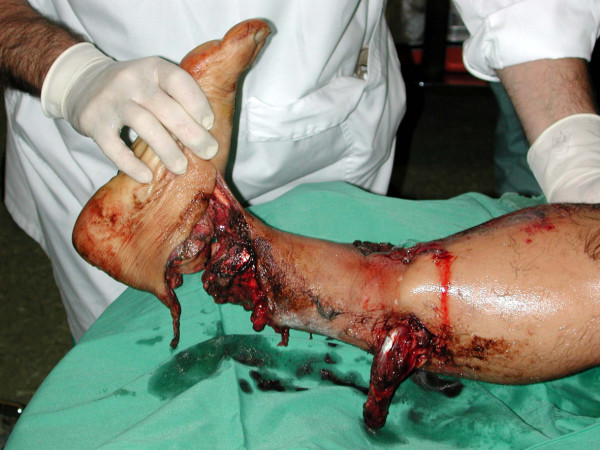
The decision, whether to amputate or reconstruct a mangled extremity remains the subject of extensive debate since multiple factors influence the decision.
Sixty three patients with high energy extremity trauma and attempts at limb salvage were retrospectively reviewed. We analyzed 10 cases of massive extremity trauma where there was made an attempt to salvage limbs, although there was a controversy between salvage and amputation.
All of the patients except one had major vascular injury and ischemia requiring repair. Three patients died. All of the remaining patients were amputated within 15 days after the salvage procedure, mainly because of extremity sepsis. Seven patients required treatment at the intensive care unit. All patients had at least 2 reconstruction procedures and multiple surgical debridements.
The functional outcome should be considered realistically before a salvage decision making for extremities with indeterminate prognosis.
由于多种因素影响决策,对于严重毁损肢体是截肢还是重建的决定仍是广泛争论的主题。
回顾性分析63例接受肢体挽救术的高能肢体创伤患者。我们分析了10例严重肢体创伤患者,尽管在保肢与截肢之间存在争议,但仍尝试进行肢体挽救。
除1例患者外,所有患者均有主要血管损伤及缺血需要修复。3例患者死亡。其余所有患者在挽救手术后15天内均接受了截肢,主要原因是肢体脓毒症。7例患者需要在重症监护病房接受治疗。所有患者至少接受了2次重建手术和多次外科清创术。
对于预后不确定的肢体,在做出挽救决策前应切实考虑功能结局。