Hunziker Sabina, Tschan Franziska, Semmer Norbert K, Zobrist Roger, Spychiger Martin, Breuer Marc, Hunziker Patrick R, Marsch Stephan C
Medical Intensive Care Unit, University of Basel, 4031 Basel, Switzerland.
BMC Emerg Med. 2009 Feb 14;9:3. doi: 10.1186/1471-227X-9-3.
Cardiac arrests are handled by teams rather than by individual health-care workers. Recent investigations demonstrate that adherence to CPR guidelines can be less than optimal, that deviations from treatment algorithms are associated with lower survival rates, and that deficits in performance are associated with shortcomings in the process of team-building. The aim of this study was to explore and quantify the effects of ad-hoc team-building on the adherence to the algorithms of CPR among two types of physicians that play an important role as first responders during CPR: general practitioners and hospital physicians.
To unmask team-building this prospective randomised study compared the performance of preformed teams, i.e. teams that had undergone their process of team-building prior to the onset of a cardiac arrest, with that of teams that had to form ad-hoc during the cardiac arrest. 50 teams consisting of three general practitioners each and 50 teams consisting of three hospital physicians each, were randomised to two different versions of a simulated witnessed cardiac arrest: the arrest occurred either in the presence of only one physician while the remaining two physicians were summoned to help ("ad-hoc"), or it occurred in the presence of all three physicians ("preformed"). All scenarios were videotaped and performance was analysed post-hoc by two independent observers.
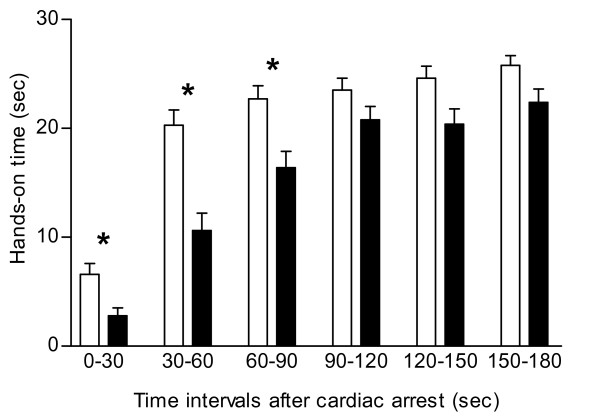
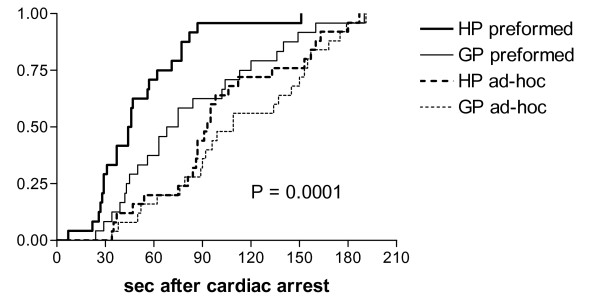
Compared to preformed teams, ad-hoc forming teams had less hands-on time during the first 180 seconds of the arrest (93 +/- 37 vs. 124 +/- 33 sec, P < 0.0001), delayed their first defibrillation (67 +/- 42 vs. 107 +/- 46 sec, P < 0.0001), and made less leadership statements (15 +/- 5 vs. 21 +/- 6, P < 0.0001).
Hands-on time and time to defibrillation, two performance markers of CPR with a proven relevance for medical outcome, are negatively affected by shortcomings in the process of ad-hoc team-building and particularly deficits in leadership. Team-building has thus to be regarded as an additional task imposed on teams forming ad-hoc during CPR. All physicians should be aware that early structuring of the own team is a prerequisite for timely and effective execution of CPR.
心脏骤停由团队而非个体医护人员进行处理。近期调查表明,对心肺复苏(CPR)指南的遵循情况可能不尽如人意,偏离治疗算法与较低的生存率相关,而操作表现的不足与团队建设过程中的缺陷有关。本研究的目的是探讨并量化临时团队建设对两类在CPR期间作为第一反应者发挥重要作用的医生(全科医生和医院医生)遵循CPR算法情况的影响。
为揭示团队建设的作用,这项前瞻性随机研究将预先组建的团队(即在心脏骤停发生前已经历团队建设过程的团队)的表现与在心脏骤停期间必须临时组建的团队的表现进行了比较。50个由三名全科医生组成的团队和50个由三名医院医生组成的团队被随机分配到两种不同版本的模拟目击心脏骤停场景中:骤停发生时只有一名医生在场,其余两名医生被召唤前来协助(“临时组建”),或者三名医生都在场(“预先组建”)。所有场景均被录像,两名独立观察者在事后对操作表现进行分析。
与预先组建的团队相比,临时组建的团队在骤停后的前180秒内实际操作时间较短(93±37秒对124±33秒,P<0.0001),首次除颤延迟(67±42秒对107±46秒,P<0.0001),且做出的领导性陈述较少(15±5次对21±6次,P<0.0001)。
实际操作时间和除颤时间是CPR的两个操作表现指标,已证实与医疗结果相关,它们会受到临时团队建设过程中的缺陷,尤其是领导能力不足的负面影响。因此,团队建设应被视为CPR期间临时组建团队所面临的一项额外任务。所有医生都应意识到,尽早构建自己的团队是及时有效实施CPR的先决条件。