Woolcott Christy G, Maskarinec Gertraud, Haiman Christopher A, Verheus Martijn, Pagano Ian S, Le Marchand Loïc, Henderson Brian E, Kolonel Laurence N
Cancer Research Center of Hawaii, University of Hawaii, 1236 Lauhala Street, Honolulu, HI 96813, USA.
Breast Cancer Res. 2009;11(1):R10. doi: 10.1186/bcr2229. Epub 2009 Feb 21.
Mammographic density is a strong risk factor for breast cancer. Our objective was to examine its association with polymorphisms identifying breast cancer susceptibility loci that were ascertained in recent genome-wide association studies.
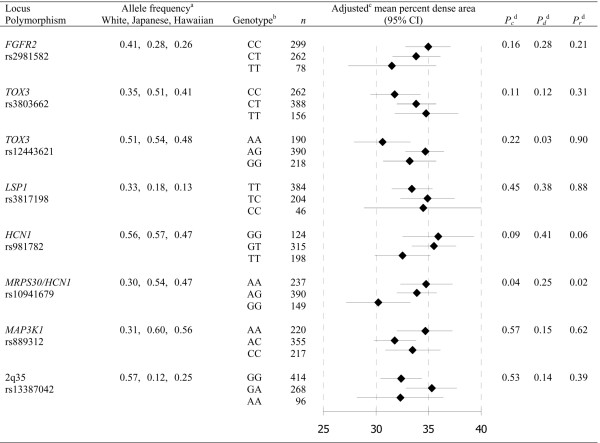
Subjects were 825 women who participated in previous case-control studies of mammographic density and genetic factors nested within the Multiethnic Cohort study and were from three ethnic groups (White, Japanese American, Native Hawaiian). Eight polymorphisms (rs2981582 in FGFR2, rs3803662 and rs12443621in TOX3, rs3817198 in LSP1, rs981782 and rs10941679 near HCN1/MRPS30, rs889312 in MAP3K1, and rs13387042 at 2q) were examined. Mammographic density was quantified with a computer-assisted method as the percent dense area: the area of radiologically dense fibroglandular tissue relative to the total breast area that also includes radiologically lucent fatty tissue.
The polymorphism rs12443621 in TOX3 was associated with percent dense area; women with at least one G allele (previously associated with increased breast cancer risk) had 3% to 4% higher densities than women with two A alleles. The polymorphism rs10941679 near HCN1/MRPS30 was also associated with percent dense area; women who were homozygous for the G allele (previously associated with increased breast cancer risk) had 4% to 5% lower densities than women with at least one A allele. The other polymorphisms were not associated with percent dense area.
The available data suggest that the effects of most of these polymorphisms on breast cancer are not mediated by mammographic density. Some effects may have been too small to be detected. The association with rs12443621 may provide clues as to how variation in TOX3 influences breast cancer risk.
乳腺X线密度是乳腺癌的一个重要风险因素。我们的目的是研究它与在近期全基因组关联研究中确定的乳腺癌易感基因座多态性之间的关联。
研究对象为825名女性,她们参与了之前嵌套在多民族队列研究中的乳腺X线密度与遗传因素的病例对照研究,来自三个种族群体(白人、日裔美国人、夏威夷原住民)。检测了8个多态性位点(FGFR2中的rs2981582、TOX3中的rs3803662和rs12443621、LSP1中的rs3817198、HCN1/MRPS30附近的rs981782和rs10941679、MAP3K1中的rs889312以及2q处的rs13387042)。采用计算机辅助方法将乳腺X线密度量化为致密面积百分比:即放射学上致密的纤维腺组织面积相对于包括放射学上透亮脂肪组织的整个乳房面积的比例。
TOX3中的多态性位点rs12443621与致密面积百分比相关;至少携带一个G等位基因(先前与乳腺癌风险增加相关)的女性比携带两个A等位基因的女性密度高3%至4%。HCN1/MRPS30附近的多态性位点rs10941679也与致密面积百分比相关;G等位基因纯合子(先前与乳腺癌风险增加相关)的女性比至少携带一个A等位基因的女性密度低4%至5%。其他多态性位点与致密面积百分比无关。
现有数据表明,这些多态性位点中的大多数对乳腺癌的影响并非通过乳腺X线密度介导。有些影响可能太小而无法检测到。与rs12443621的关联可能为TOX3的变异如何影响乳腺癌风险提供线索。