Yoon Jeongah, Deisboeck Thomas S
Complex Biosystems Modeling Laboratory, Harvard-MIT (HST) Athinoula A Martinos Center for Biomedical Imaging, Massachusetts General Hospital, Charlestown, Massachusetts, United States of America.
PLoS One. 2009;4(2):e4560. doi: 10.1371/journal.pone.0004560. Epub 2009 Feb 23.
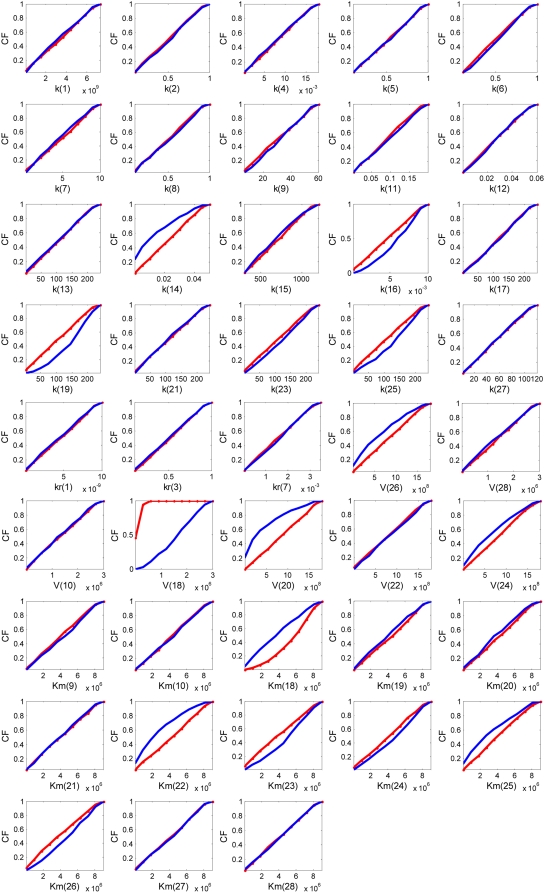
Cell growth critically depends on signalling pathways whose regulation is the focus of intense research. Without utilizing a priori knowledge of the relative importance of pathway components, we have applied in silico computational methods to the EGF-induced MAPK cascade. Specifically, we systematically perturbed the entire parameter space, including initial conditions, using a Monte Carlo approach, and investigate which protein components or kinetic reaction steps contribute to the differentiation of ERK responses. The model, based on previous work by Brightman and Fell (2000), is composed of 28 reactions, 27 protein molecules, and 48 parameters from both mass action and Michaelis-Menten kinetics. Our multi-parametric systems analysis confirms that Raf inactivation is one of the key steps regulating ERK responses to be either transient or sustained. Furthermore, the results of amplitude-differential ERK phosphorylations within the transient case are mainly attributed to the balance between activation and inactivation of Ras while duration-differential ERK responses for the sustained case are, in addition to Ras, markedly affected by dephospho-/phosphorylation of both MEK and ERK. Our sub-module perturbations showed that MEK and ERK's contribution to this differential ERK activation originates from fluctuations in intermediate pathway module components such as Ras and Raf, implicating a cooperative regulatory mode among the key components. The initial protein concentrations of corresponding reactions such as Ras, GAP, and Raf also influence the distinct signalling outputs of ERK activation. We then compare these results with those obtained from a single-parametric perturbation approach using an overall state sensitivity (OSS) analysis. The OSS findings indicate a more pronounced role of ERK's inhibitory feedback effect on catalysing the dissociation of the SOS complex. Both approaches reveal the presence of multiple specific reactions involved in the distinct dynamics of ERK responses and the cell fate decisions they trigger. This work adds a mechanistic insight of the contribution of key pathway components, thus may support the identification of biomarkers for pharmaceutical drug discovery processes.
细胞生长严重依赖于信号通路,其调控是深入研究的焦点。在不利用通路成分相对重要性的先验知识的情况下,我们已将计算机计算方法应用于表皮生长因子(EGF)诱导的丝裂原活化蛋白激酶(MAPK)级联反应。具体而言,我们使用蒙特卡罗方法系统地扰动了整个参数空间,包括初始条件,并研究哪些蛋白质成分或动力学反应步骤有助于细胞外调节蛋白激酶(ERK)反应的分化。该模型基于布莱特曼和费尔(2000年)之前的工作,由28个反应、27个蛋白质分子以及来自质量作用和米氏动力学的48个参数组成。我们的多参数系统分析证实,Raf失活是调节ERK反应为瞬时或持续反应的关键步骤之一。此外,瞬时情况下ERK磷酸化幅度差异的结果主要归因于Ras激活与失活之间的平衡,而持续情况下ERK反应持续时间差异除了Ras之外,还明显受到丝裂原活化蛋白激酶/细胞外信号调节激酶(MEK)和ERK去磷酸化/磷酸化的影响。我们的子模块扰动表明,MEK和ERK对这种差异性ERK激活的贡献源于中间通路模块成分(如Ras和Raf)的波动,这意味着关键成分之间存在协同调节模式。相应反应(如Ras、GAP和Raf)的初始蛋白质浓度也会影响ERK激活的不同信号输出。然后,我们使用整体状态敏感性(OSS)分析将这些结果与从单参数扰动方法获得的结果进行比较。OSS研究结果表明ERK的抑制性反馈效应在催化SOS复合物解离方面发挥了更显著的作用。两种方法都揭示了ERK反应独特动力学及其引发的细胞命运决定过程中涉及多个特定反应。这项工作增加了对关键通路成分贡献的机制性见解,因此可能有助于在药物研发过程中识别生物标志物。