Vahey M D, Voldman J
Department of Electrical Engineering and Computer Science, Massachusetts Institute of Technology, 77 Massachusetts Avenue, Building 36-824, Cambridge, Massachusetts 02139, USA.
Anal Chem. 2009 Apr 1;81(7):2446-55. doi: 10.1021/ac8019575.
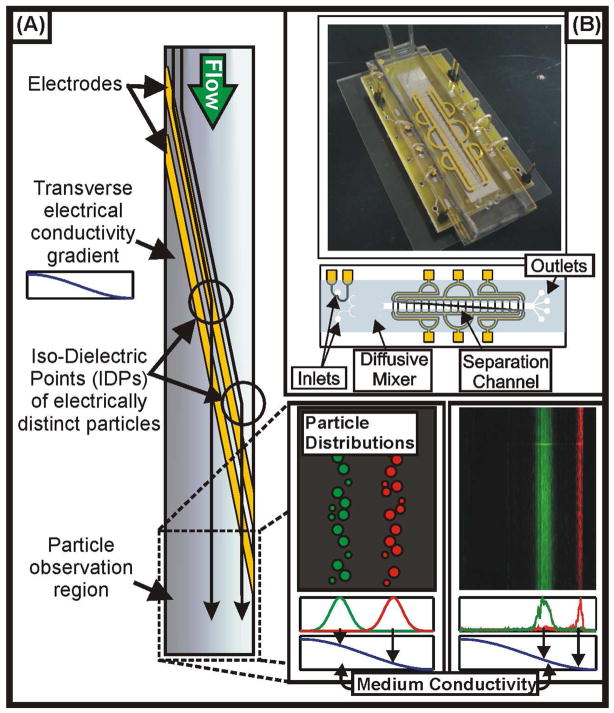
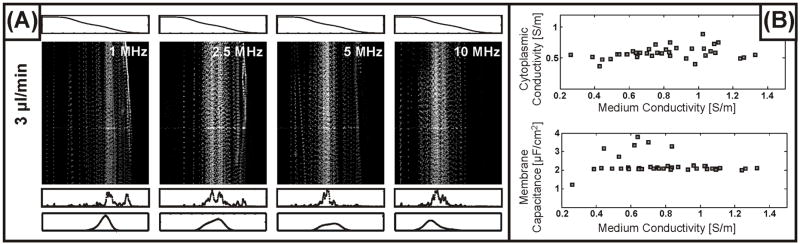
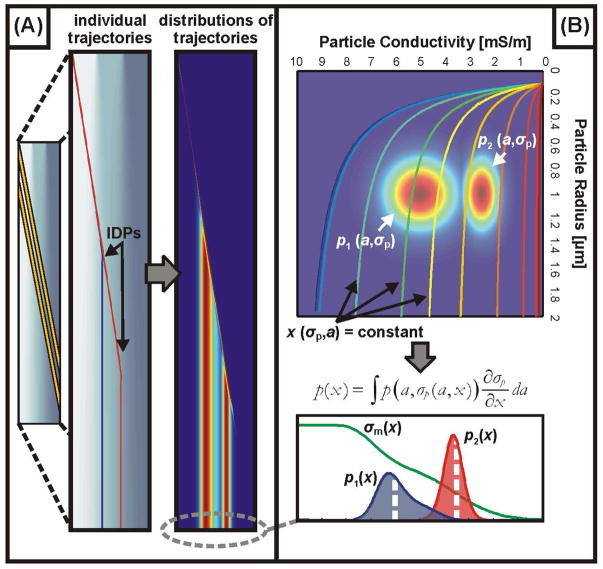
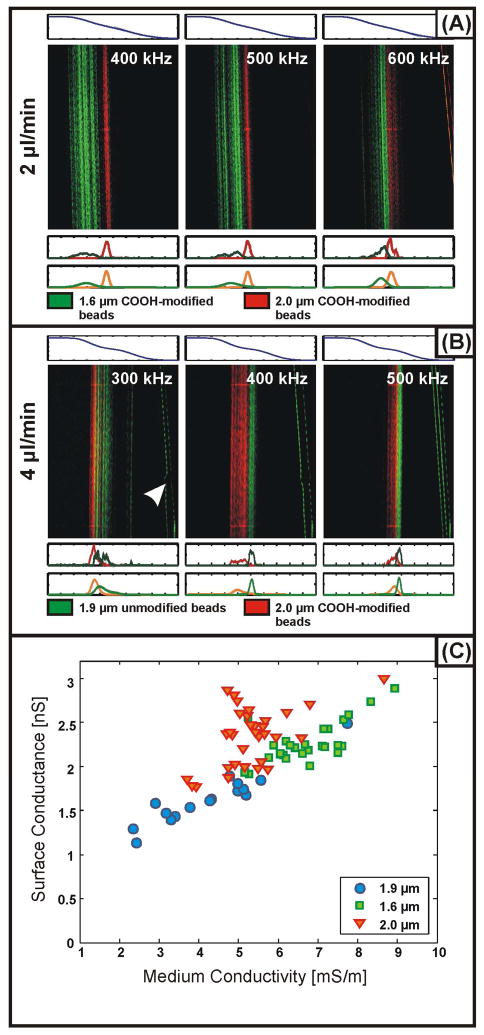
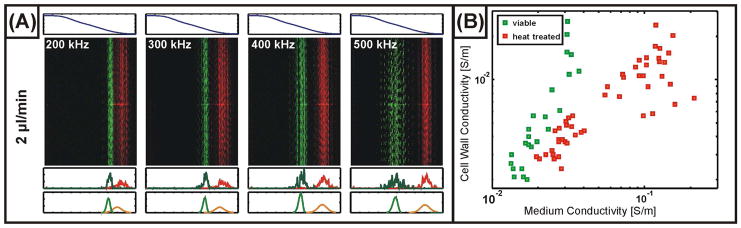
Separations can be broadly categorized as preparative, where the objective is to extract purified quantities of a sample from a complex mixture, or analytic, where the goal is to determine and quantify the contents of the original mixture. Here we demonstrate the application of a new microfluidic separation method, isodielectric separation (IDS), to a range of analytic separations involving cells and particles spanning several orders of magnitude in volume and electrical conductivity. In IDS, cells are dielectrophoretically concentrated to the region along an electrical conductivity gradient where their polarizability vanishes; by measuring this position--the isodielectric point (IDP)--as operating conditions such as the frequency and voltage of the applied electric field are varied, we are able to sort cells or particles with distinct IDPs while simultaneously characterizing their electrical properties. We apply this technique to measure the electrical properties of polystyrene microspheres, viable and nonviable cells of the budding yeast Saccharomyces cerevisiae , and murine pro B cells, including how these electrical properties vary with the electrical conductivity of the surrounding solvent.
分离方法大致可分为制备型和分析型。制备型分离的目的是从复杂混合物中提取纯化的样品量;分析型分离的目标是确定并量化原始混合物的成分。在此,我们展示了一种新型微流控分离方法——等介电分离(IDS)在一系列分析分离中的应用,这些分离涉及体积和电导率跨越几个数量级的细胞和颗粒。在等介电分离中,细胞通过介电泳作用被浓缩到沿电导率梯度的一个区域,在该区域它们的极化率消失;通过在改变诸如施加电场的频率和电压等操作条件时测量这个位置——等介电点(IDP),我们能够对具有不同等介电点的细胞或颗粒进行分选,同时表征它们的电学性质。我们应用这项技术来测量聚苯乙烯微球、出芽酵母酿酒酵母的活细胞和死细胞以及小鼠前B细胞的电学性质,包括这些电学性质如何随周围溶剂的电导率而变化。