Silsupadol Patima, Shumway-Cook Anne, Lugade Vipul, van Donkelaar Paul, Chou Li-Shan, Mayr Ulrich, Woollacott Marjorie H
Department of Physical Therapy, The Faculty of Associated Medical Sciences, Chiang Mai University, Chiang Mai, Thailand.
Arch Phys Med Rehabil. 2009 Mar;90(3):381-7. doi: 10.1016/j.apmr.2008.09.559.
To compare the effect of 3 different approaches to balance training on dual-task balance performance in older adults with balance impairment.
A double-blind, randomized controlled trial.
University research laboratory.
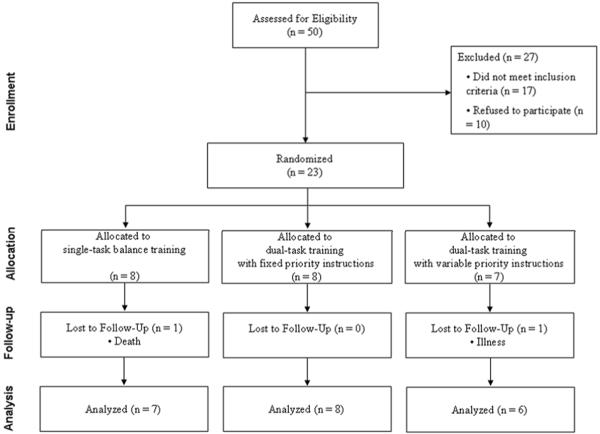
Older adults (N=23) with balance impairment (mean age, 74.8y). They scored 52 or less on the Berg Balance Scale (BBS) and/or walked with a self-selected gait speed of 1.1m/s or less.
Participants were randomly assigned to 1 of 3 interventions: single-task training, dual-task training with fixed-priority instructions, and dual-task training with variable-priority instructions. Participants received 45-minute individualized training sessions, 3 times a week for 4 weeks.
Gait speed under single-task and dual-task conditions was obtained at baseline, the second week, the end of training, and the twelfth week after the end of training. Other measures, including the BBS and the Activities-specific Balance Confidence (ABC) Scale, were collected at baseline and after training.
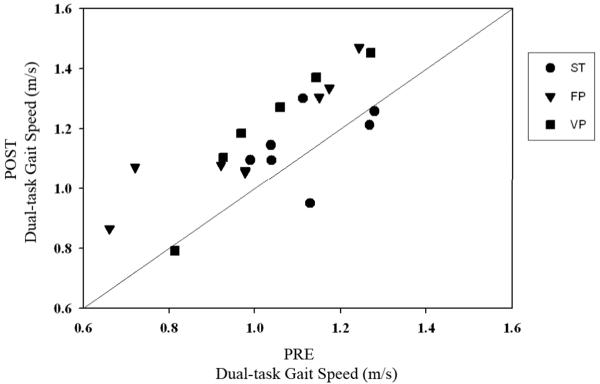
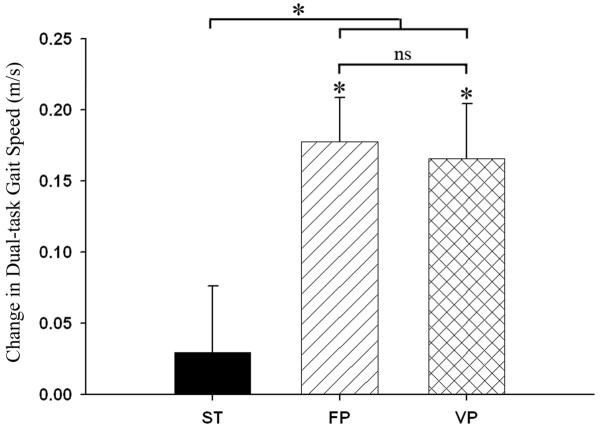
Participants in all groups improved on the BBS (P<.001; effect size [ES]=.72), and walked significantly faster after training (P=.02; ES=.27). When a cognitive task was added, however, only participants who received dual-task training with fixed-priority instructions and dual-task training with variable-priority instructions exhibited significant improvements in gait speed (P<.001, ES=.57; and P<.001, ES=.46, respectively). In addition, only the dual-task training with variable-priority instructions group demonstrated a dual-task training effect at the second week of training and maintained the training effect at the 12-week follow-up. Only the single-task training group showed a significant increase on the ABC after training (P<.001; ES=.61).
Dual-task training is effective in improving gait speed under dual-task conditions in elderly participants with balance impairment. Training balance under single-task conditions may not generalize to balance control during dual-task contexts. Explicit instruction regarding attentional focus is an important factor contributing to the rate of learning and the retention of the dual-task training effect.
比较3种不同的平衡训练方法对平衡功能受损老年人双任务平衡能力的影响。
双盲随机对照试验。
大学研究实验室。
平衡功能受损的老年人(N = 23)(平均年龄74.8岁)。他们在伯格平衡量表(BBS)上的得分≤52分,和/或以≤1.1m/s的自选步态速度行走。
参与者被随机分配到3种干预措施中的一种:单任务训练、固定优先级指令的双任务训练和可变优先级指令的双任务训练。参与者接受45分钟的个性化训练课程,每周3次,共4周。
在基线、第2周、训练结束时以及训练结束后第12周获取单任务和双任务条件下的步态速度。在基线和训练后收集其他指标,包括BBS和特定活动平衡信心(ABC)量表。
所有组的参与者BBS得分均有所提高(P <.001;效应量[ES]=.72),训练后行走速度显著加快(P =.02;ES =.2)。然而,当添加认知任务时,只有接受固定优先级指令双任务训练和可变优先级指令双任务训练的参与者步态速度有显著改善(分别为P <.001,ES =.57;P <.001,ES =.46)。此外,只有可变优先级指令双任务训练组在训练第2周表现出双任务训练效果,并在12周随访时维持训练效果。只有单任务训练组训练后ABC量表得分显著增加(P <.001;ES =.61)。
双任务训练对改善平衡功能受损老年参与者在双任务条件下的步态速度有效。单任务条件下的平衡训练可能无法推广到双任务情境中的平衡控制。关于注意力焦点的明确指导是影响学习速度和双任务训练效果保持的重要因素。