Maskarinec Gertraud, Erber Eva, Grandinetti Andrew, Verheus Martijn, Oum Robert, Hopping Beth N, Schmidt Mark M, Uchida Aileen, Juarez Deborah Taira, Hodges Krista, Kolonel Laurence N
Cancer Research Center, University of Hawaii, Honolulu, Hawaii, USA.
Diabetes. 2009 Aug;58(8):1732-8. doi: 10.2337/db08-1685. Epub 2009 Mar 3.
Using the Hawaii component of the Multiethnic Cohort (MEC), we estimated diabetes incidence among Caucasians, Japanese Americans, and Native Hawaiians.
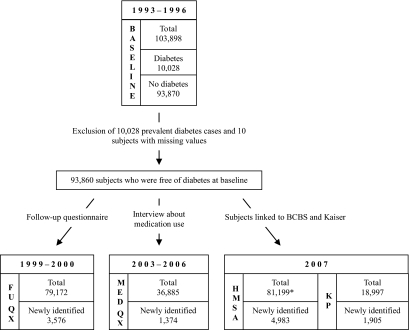
After excluding subjects who reported diabetes at baseline or had missing values, 93,860 cohort members were part of this analysis. New case subjects were identified through a follow-up questionnaire (1999-2000), a medication questionnaire (2003-2006), and linkage with two major health plans (2007). We computed age-standardized incidence rates and estimated hazard ratios (HRs) for ethnicity, BMI, education, and combined effects of these variables using Cox regression analysis.
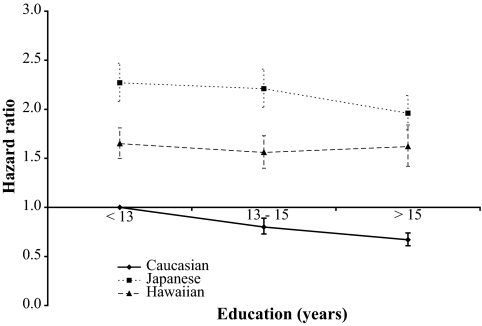
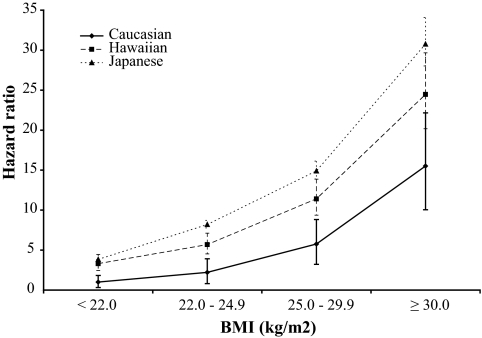
After a total follow-up time of 1,119,224 person-years, 11,838 incident diabetic case subjects were identified with an annual incidence rate of 10.4 per 1,000 person-years. Native Hawaiians had the highest rate with 15.5, followed by Japanese Americans with 12.5, and Caucasians with 5.8 per 1,000 person-years; the adjusted HRs were 2.65 for Japanese Americans and 1.93 for Native Hawaiians. BMI was positively related to incidence in all ethnic groups. Compared with the lowest category, the respective HRs for BMIs of 22.0-24.9, 25.0-29.9, and > or =30.0 kg/m(2) were 2.10, 4.12, and 9.48. However, the risk was highest for Japanese Americans and intermediate for Native Hawaiians in each BMI category. Educational achievement showed an inverse association with diabetes risk, but the protective effect was limited to Caucasians.
Within this multiethnic population, diabetes incidence was twofold higher in Japanese Americans and Native Hawaiians than in Caucasians. The significant interaction of ethnicity with BMI and education suggests ethnic differences in diabetes etiology.
利用多民族队列研究(MEC)中的夏威夷部分,我们估算了白种人、日裔美国人和夏威夷原住民中的糖尿病发病率。
在排除基线时报告患有糖尿病或有缺失值的受试者后,93,860名队列成员参与了此次分析。通过随访问卷(1999 - 2000年)、用药问卷(2003 - 2006年)以及与两个主要健康计划的关联(2007年)来确定新发病例受试者。我们使用Cox回归分析计算年龄标准化发病率,并估算种族、体重指数(BMI)、教育程度以及这些变量的综合效应的风险比(HRs)。
在总计1,119,224人年的随访时间后,确定了11,838例糖尿病新发病例受试者,年发病率为每1,000人年10.4例。夏威夷原住民的发病率最高,为每1,000人年15.5例,其次是日裔美国人,为每1,000人年12.5例,白种人为每1,000人年5.8例;日裔美国人的校正风险比为2.65,夏威夷原住民为1.93。BMI在所有种族群体中均与发病率呈正相关。与最低类别相比,BMI为22.0 - 24.9、25.0 - 29.9以及≥30.0 kg/m²时各自的风险比分别为2.10、4.12和9.48。然而,在每个BMI类别中,日裔美国人的风险最高,夏威夷原住民处于中等水平。教育成就与糖尿病风险呈负相关,但保护作用仅限于白种人。
在这个多民族人群中,日裔美国人和夏威夷原住民的糖尿病发病率是白种人的两倍。种族与BMI和教育程度之间的显著相互作用表明糖尿病病因存在种族差异。