Foxman Betsy, Goldberg Deborah, Murdock Courtney, Xi Chuanwu, Gilsdorf Janet R
Department of Epidemiology, University of Michigan, Ann Arbor, MI 48109, USA.
Interdiscip Perspect Infect Dis. 2008;2008:613979. doi: 10.1155/2008/613979. Epub 2008 Oct 29.
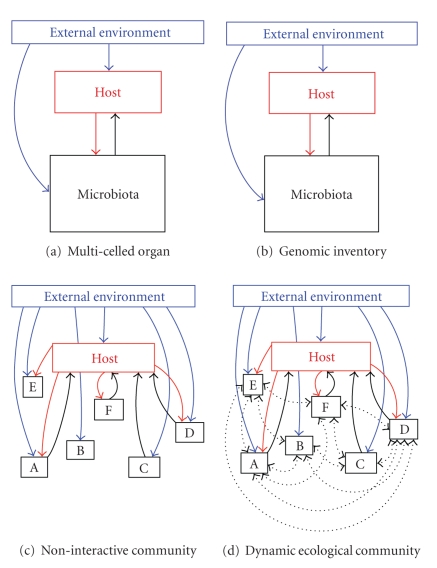
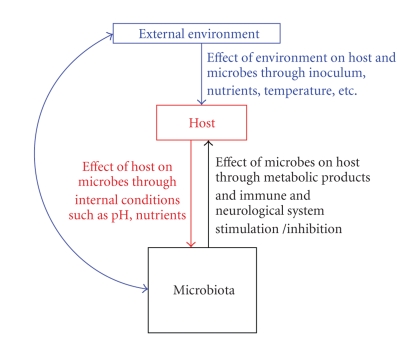
The microbiota of a typical, healthy human contains 10 times as many cells as the human body and incorporates bacteria, viruses, archea, protozoans, and fungi. This diverse microbiome (the collective genomes of the microbial symbionts that inhabit a human host) is essential for human functioning. We discuss the unstated assumptions and implications of current conceptualizations of human microbiota: (1) a single unit that interacts with the host and the external environment; a multicelled organ; (2) an assemblage of multiple taxa, but considered as a single unit in its interactions with the host; (3) an assemblage of multiple taxa, which each interacts with the host and the environment independently; and (4) a dynamic ecological community consisting of multiple taxa each potentially interacting with each other, the host, and the environment. Each conceptualization leads to different predictions, methodologies, and research strategies.
一个典型健康人的微生物群包含的细胞数量是人体细胞数量的10倍,其中包括细菌、病毒、古菌、原生动物和真菌。这种多样的微生物组(居住在人类宿主中的微生物共生体的集体基因组)对人类的机能至关重要。我们讨论了当前人类微生物群概念化中未阐明的假设和影响:(1)作为一个与宿主和外部环境相互作用的单一单元;一个多细胞器官;(2)多个分类群的集合,但在与宿主的相互作用中被视为一个单一单元;(3)多个分类群的集合,每个分类群都独立地与宿主和环境相互作用;(4)一个动态的生态群落,由多个分类群组成,每个分类群都可能相互作用,也可能与宿主和环境相互作用。每种概念化都导致不同的预测、方法和研究策略。