Matsumoto Masatoshi, Ishikawa Shizukiyo, Kayaba Kazunori, Gotoh Tadao, Nago Naoki, Tsutsumi Akizumi, Kajii Eiji
Division of Community and Family Medicine, Center for Community Medicine, Jichi Medical University, Tochigi 329-0498, Japan.
J Epidemiol. 2009;19(2):94-100. doi: 10.2188/jea.je20080081. Epub 2009 Mar 6.
Risk charts that depict the absolute risk of myocardial infarction (MI) for each combination of risk factors in individuals are convenient and beneficial tools for primary prevention of ischemic heart disease. Although risk charts have been developed using data from North American and European cardiovascular cohort studies, there is no such chart derived from cardiovascular incidence data obtained from the Japanese population.
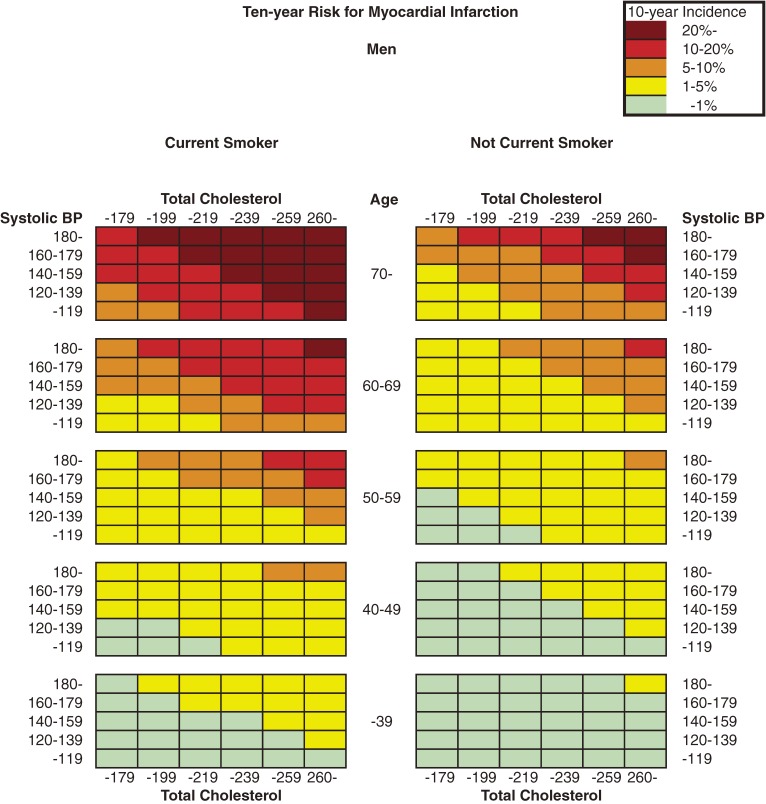
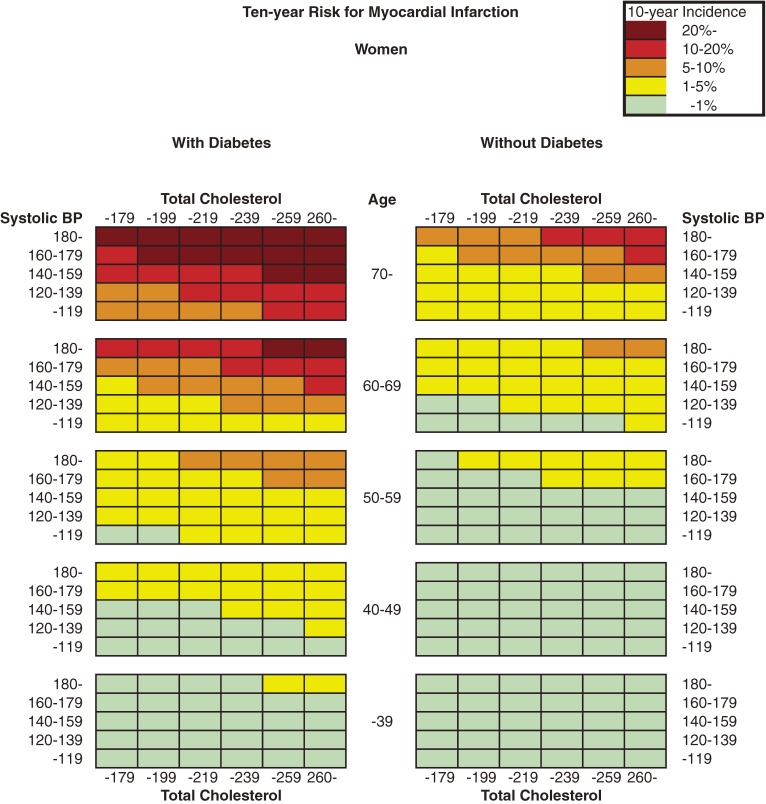
We calculated and constructed risk charts that estimate the 10-year absolute risk of MI by using data from the Jichi Medical School (JMS) Cohort Study--a prospective cohort study which followed 12 490 participants in 12 Japanese rural communities for an average of 10.9 years. We identified 92 cases of a clinically-certified MI event. Color-coded risk charts were created by calculating the absolute risk associated with the following conventional cardiovascular risk factors: age, sex, smoking status, diabetes status, systolic blood pressure, and serum total cholesterol.
In health education and clinical practice, particularly in rural communities, these charts should prove useful in understanding the risks of MI, without the need for cumbersome calculations. In addition, they can be expected to provide benefits by improving existing risk factors in individuals.
描绘个体中每种危险因素组合的心肌梗死(MI)绝对风险的风险图表,是缺血性心脏病一级预防的便捷且有益的工具。尽管已利用北美和欧洲心血管队列研究的数据开发出风险图表,但尚无基于日本人群心血管发病率数据得出的此类图表。
我们通过使用自治医科大学(JMS)队列研究的数据计算并构建了估计MI 10年绝对风险的风险图表,该前瞻性队列研究对日本12个农村社区的12490名参与者进行了平均10.9年的随访。我们确定了92例经临床认证的MI事件。通过计算与以下传统心血管危险因素相关的绝对风险,创建了彩色编码风险图表:年龄、性别、吸烟状况、糖尿病状况、收缩压和血清总胆固醇。
在健康教育和临床实践中,尤其是在农村社区,这些图表应有助于理解MI风险,而无需进行繁琐的计算。此外,有望通过改善个体现有的危险因素而带来益处。