Stabler Thomas V, Byers Samuel S, Zura Robert D, Kraus Virginia Byers
Department of Medicine, Duke University Medical Center, Durham, NC 27710, USA.
Arthritis Res Ther. 2009;11(2):R34. doi: 10.1186/ar2639. Epub 2009 Mar 6.
Certain amino acids within proteins have been reported to change from the L form to the D form over time. This process is known as racemization and is most likely to occur in long-lived low-turnover tissues such as normal cartilage. We hypothesized that diseased tissue, as found in an osteoarthritic (OA) joint, would have increased turnover reflected by a decrease in the racemized amino acid content.
Using high-performance liquid chromatography methods, we quantified the L and D forms of amino acids reported to racemize in vivo on a biological timescale: alanine, aspartate (Asp), asparagine (Asn), glutamate, glutamine, isoleucine, leucine (Leu), and serine (Ser). Furthermore, using a metabolically inactive control material (tooth dentin) and a control material with normal metabolism (normal articular cartilage), we developed an age adjustment in order to make inferences about the state of protein turnover in cartilage and meniscus.
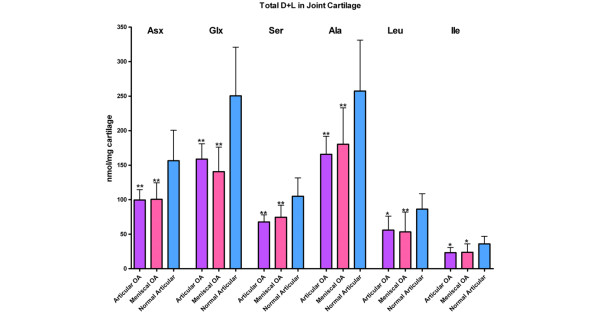
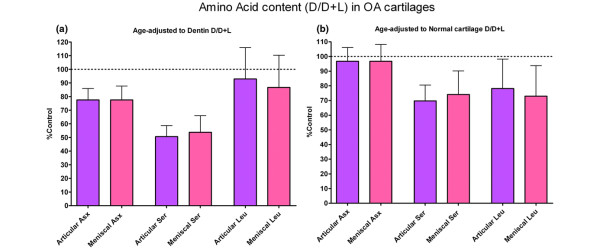
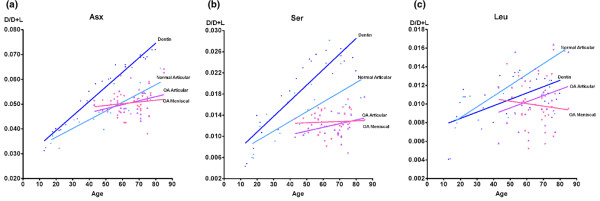
In the metabolically inactive control material (n = 25, ages 13 to 80 years) and the normal metabolizing control material (n = 19, ages 17 to 83 years), only Asp + Asn (Asx), Ser, and Leu showed a significant change (increase) in racemization with age (P < 0.01). The age-adjusted proportions of racemized to total amino acid (D/D+L expressed as a percentage of the control material) for Asx, Ser, and Leu when compared with the normal articular cartilage control were 97%, 74%, and 73% in OA meniscal cartilage and 97%, 70%, and 78% in OA articular cartilage. We also observed lower amino acid content in OA articular and meniscal cartilages compared with normal articular cartilage as well as a loss of total amino acids with age in the OA meniscal but not the OA articular cartilage.
These data demonstrate comparable anabolic responses for non-lesioned OA articular cartilage and OA meniscal cartilage but an excess of catabolism over anabolism for the meniscal cartilage.
据报道,蛋白质中的某些氨基酸会随着时间的推移从L型转变为D型。这个过程被称为消旋化,最有可能发生在诸如正常软骨等长寿、低周转率的组织中。我们推测,骨关节炎(OA)关节中发现的病变组织周转率会增加,表现为消旋化氨基酸含量降低。
我们使用高效液相色谱法,对据报道在生物学时间尺度上会在体内发生消旋化的氨基酸的L型和D型进行了定量:丙氨酸、天冬氨酸(Asp)、天冬酰胺(Asn)、谷氨酸、谷氨酰胺、异亮氨酸、亮氨酸(Leu)和丝氨酸(Ser)。此外,我们使用代谢不活跃的对照材料(牙本质)和具有正常代谢的对照材料(正常关节软骨),进行了年龄校正,以便推断软骨和半月板中蛋白质周转的状态。
在代谢不活跃的对照材料(n = 25,年龄13至80岁)和正常代谢的对照材料(n = 19,年龄17至83岁)中,只有天冬氨酸 + 天冬酰胺(Asx)、丝氨酸和亮氨酸的消旋化随年龄有显著变化(增加)(P < 0.01)。与正常关节软骨对照相比,OA半月板软骨中Asx、丝氨酸和亮氨酸的消旋化氨基酸与总氨基酸的年龄校正比例(D/D+L以对照材料的百分比表示)分别为97%、74%和73%,OA关节软骨中分别为97%、70%和78%。我们还观察到,与正常关节软骨相比,OA关节软骨和半月板软骨中的氨基酸含量较低,并且OA半月板软骨中总氨基酸随年龄减少,但OA关节软骨中没有。
这些数据表明,非损伤性OA关节软骨和OA半月板软骨的合成代谢反应相当,但半月板软骨的分解代谢超过合成代谢。