Lee Seok-Jin R, Escobedo-Lozoya Yasmin, Szatmari Erzsebet M, Yasuda Ryohei
Department of Neurobiology, Duke University Medical Center, Durham, North Carolina 27710, USA.
Nature. 2009 Mar 19;458(7236):299-304. doi: 10.1038/nature07842.
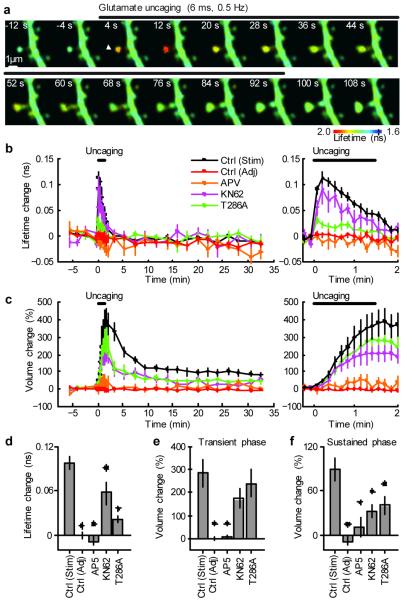
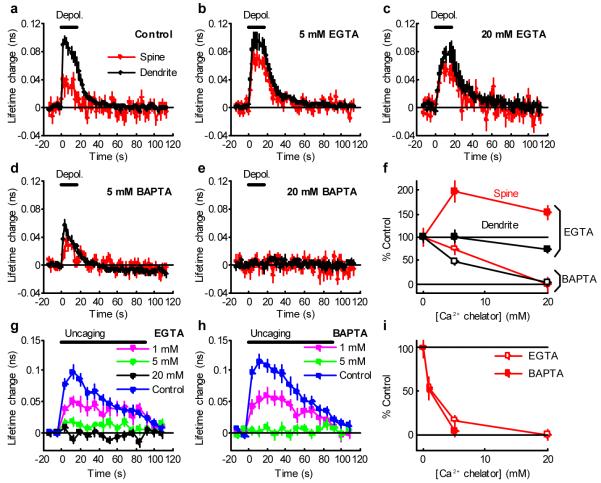
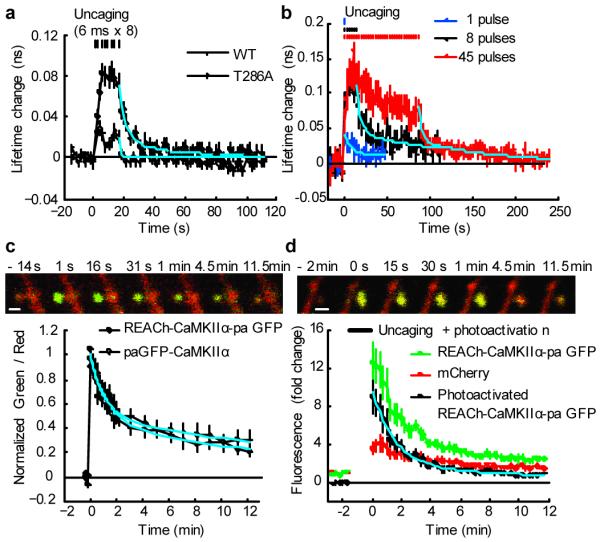
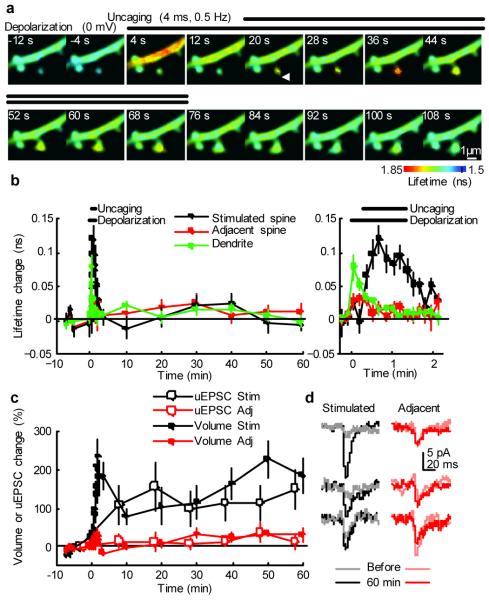
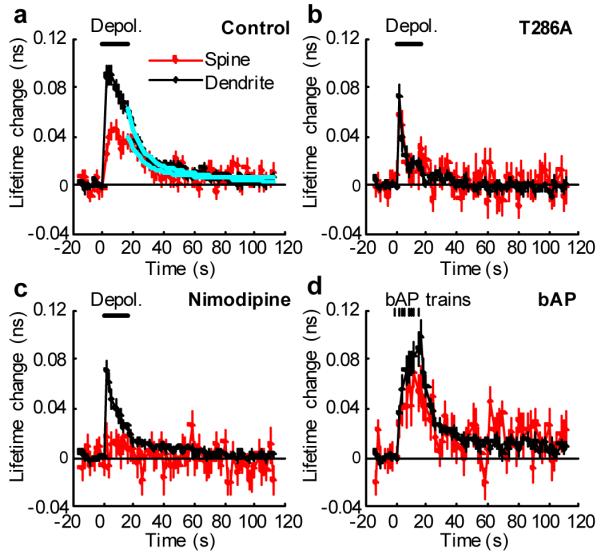
Calcium/calmodulin-dependent kinase II (CaMKII) plays a central part in long-term potentiation (LTP), which underlies some forms of learning and memory. Here we monitored the spatiotemporal dynamics of CaMKII activation in individual dendritic spines during LTP using two-photon fluorescence lifetime imaging microscopy, in combination with two-photon glutamate uncaging. Induction of LTP and associated spine enlargement in single spines triggered transient ( approximately 1 min) CaMKII activation restricted to the stimulated spines. CaMKII in spines was specifically activated by NMDA receptors and L-type voltage-sensitive calcium channels, presumably by nanodomain Ca(2+) near the channels, in response to glutamate uncaging and depolarization, respectively. The high degree of compartmentalization and channel specificity of CaMKII signalling allow stimuli-specific spatiotemporal patterns of CaMKII signalling and may be important for synapse-specificity of synaptic plasticity.
钙/钙调蛋白依赖性激酶II(CaMKII)在长时程增强(LTP)中起核心作用,而LTP是某些形式的学习和记忆的基础。在此,我们使用双光子荧光寿命成像显微镜,并结合双光子谷氨酸解笼技术,监测了长时程增强过程中单个树突棘内CaMKII激活的时空动态变化。单个棘突中长时程增强的诱导及相关的棘突增大引发了局限于受刺激棘突的短暂(约1分钟)CaMKII激活。棘突中的CaMKII分别响应谷氨酸解笼和去极化,由NMDA受体和L型电压敏感性钙通道特异性激活,推测是由通道附近的纳米域Ca(2+)介导的。CaMKII信号的高度区室化和通道特异性允许CaMKII信号产生刺激特异性的时空模式,这可能对突触可塑性的突触特异性很重要。