Vernon Margaret, Leidy Nancy Kline, Nacson Alise, Nelsen Linda
United BioSource Corporation, Bethesda, MD, USA.
Merck & Co Inc, North Wales, PA, USA.
Cough. 2009 Mar 19;5:5. doi: 10.1186/1745-9974-5-5.
In order to assess severity of cough from patients' perspectives and capture the effects of treatment in clinical trials, a measurement tool must show evidence of validity and reliability. The purpose of this study was to characterize cough severity from patients' perspectives as the initial step in the development of a new patient-reported outcome (PRO) measure for use in clinical trials.
This focus groups study included patients with clinician confirmed chronic cough recruited from a large internal medicine clinic in the US. A semi-structured focus group guide was designed to elicit information about patients' experiences with cough severity and their characterization of symptoms. The focus group data were coded to identify concepts and terminology of cough severity.
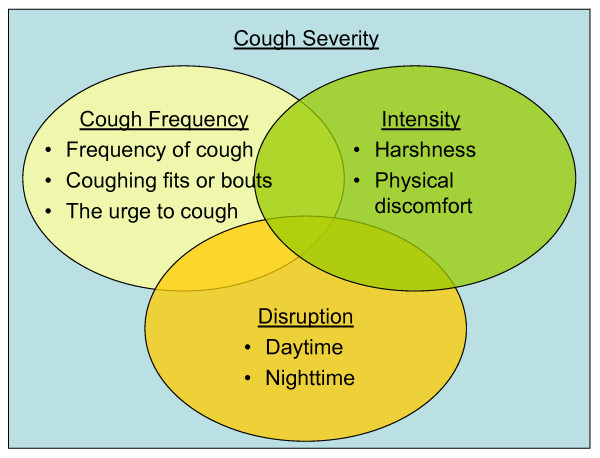
Three focus groups were conducted [n = 22; 6 male; mean age 66.1 (+/- 12.9)]. Etiology included GERD, asthma, bronchitis, post-nasal drip, and other. Three domains of cough severity were identified: frequency, intensity, and disruption. In addition to a single cough, participants in all focus groups described coughing in uncontrollable paroxysms they called "fits," "bouts," "spells," or "episodes." The urge to cough, described as an important sign of impending cough, was considered a component of cough frequency. Participants also described daytime activity and nighttime sleep disruption as an indication of cough severity. Finally, participants described variability in cough severity.
Results suggest that patients describe cough severity in terms of frequency, intensity, and disruptiveness, indicating these 3 domains should be addressed when evaluating cough severity and outcomes of treatment.
为了从患者角度评估咳嗽的严重程度,并在临床试验中体现治疗效果,一种测量工具必须具备有效性和可靠性的证据。本研究的目的是从患者角度描述咳嗽严重程度,作为开发一种用于临床试验的新患者报告结局(PRO)测量方法的第一步。
这项焦点小组研究纳入了从美国一家大型内科诊所招募的经临床医生确诊为慢性咳嗽的患者。设计了一个半结构化的焦点小组指南,以获取有关患者咳嗽严重程度经历及其症状特征的信息。对焦点小组数据进行编码,以确定咳嗽严重程度的概念和术语。
进行了三个焦点小组访谈[n = 22;6名男性;平均年龄66.1(±12.9)]。病因包括胃食管反流病、哮喘、支气管炎、鼻后滴漏及其他。确定了咳嗽严重程度的三个领域:频率、强度和干扰。除了单次咳嗽外,所有焦点小组的参与者都描述了他们称之为“阵咳”“发作”“ spells”或“ episodes”的无法控制的咳嗽发作。咳嗽冲动被认为是即将咳嗽的重要迹象,被视为咳嗽频率的一个组成部分。参与者还将白天活动和夜间睡眠干扰描述为咳嗽严重程度的指标。最后,参与者描述了咳嗽严重程度的变异性。
结果表明,患者从频率、强度和干扰性方面描述咳嗽严重程度,这表明在评估咳嗽严重程度和治疗结果时应考虑这三个领域。