Frye Richard E
Department of Pediatrics, University of Texas Health Science Center, Houston, Texas, USA.
Pediatr Neurol. 2009 Apr;40(4):298-301. doi: 10.1016/j.pediatrneurol.2008.10.024.
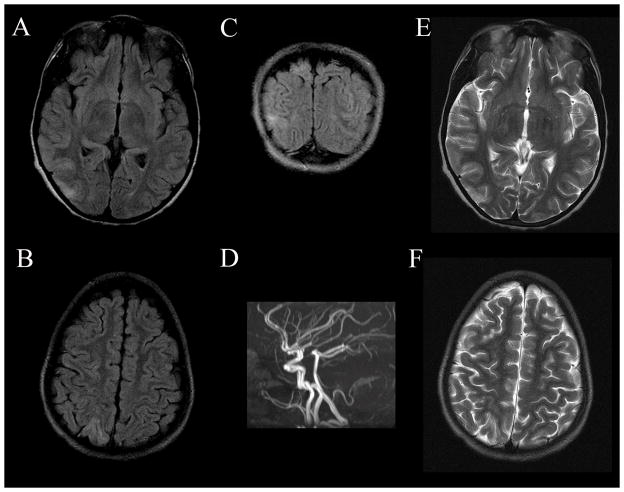
A 10-year-old African American girl with sickle-cell anemia developed headaches and seizures associated with hypertension during hospitalization for a pulmonary abscess. Hypertension developed after multiple transfusions, associated with abnormally high hematocrit and headache. Magnetic resonance imaging was consistent with posterior leukoencephalopathy. Neurologic signs, hypertension, and high hematocrit resolved after erythrocytapheresis. Magnetic resonance imaging, 1 month after the episode, produced normal results. Because reversible posterior leukoencephalopathy syndrome was only described in sickle-cell anemia during severe acute chest syndrome, this report documents that milder illness can be associated with reversible posterior leukoencephalopathy syndrome in sickle-cell anemia, and also highlights subtle signs that may herald serious neurologic events in high-risk patients. Examination of the pathophysiology of reversible posterior leukoencephalopathy syndrome in the context of sickle-cell anemia suggests that patients with sickle-cell anemia and subtle neurologic signs should be treated with high vigilance.
一名患有镰状细胞贫血的10岁非裔美国女孩在因肺脓肿住院期间出现头痛和与高血压相关的癫痫发作。高血压在多次输血后出现,伴有异常高的血细胞比容和头痛。磁共振成像与后部白质脑病相符。红细胞单采术后,神经体征、高血压和高血细胞比容得到缓解。发作1个月后的磁共振成像结果正常。由于可逆性后部白质脑病综合征仅在镰状细胞贫血的严重急性胸部综合征期间被描述过,本报告记录了较轻的疾病也可能与镰状细胞贫血中的可逆性后部白质脑病综合征相关,并且还强调了可能预示高危患者严重神经事件的细微体征。在镰状细胞贫血的背景下对可逆性后部白质脑病综合征的病理生理学进行检查表明,对有细微神经体征的镰状细胞贫血患者应高度警惕地进行治疗。