State Key Laboratory of Food Science and Technology, Jiangnan University, Wuxi, Jiangsu 214122, P. R. China.
Research Institute of Food Nutrition and Safety, School of Food Science and Technology, Jiangnan University, Wuxi, Jiangsu 214122, P. R. China.
Int J Mol Sci. 2008 Apr;9(4):464-475. doi: 10.3390/ijms9040464. Epub 2008 Apr 2.
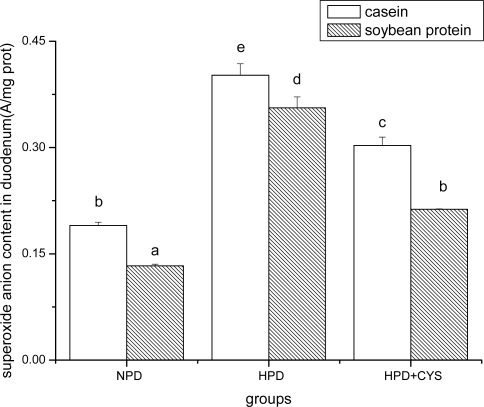
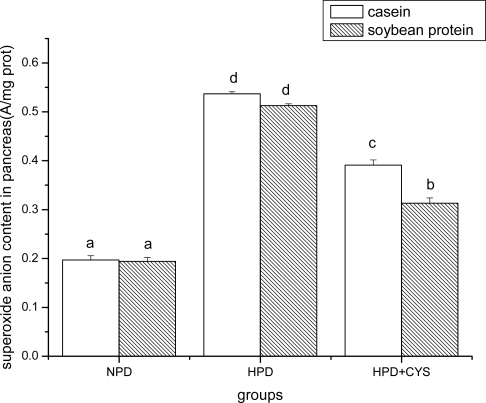
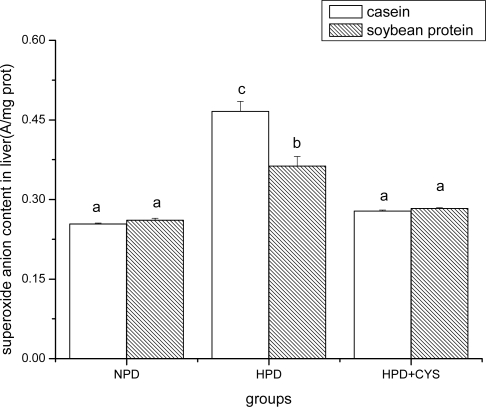
The present study was undertaken to evaluate the effects of high protein (soybean protein or casein) on the balance between production of free radicals and antioxidant level in digestive organs of mice. For this purpose, male (C57BL/6J) mice were adapted to experimental diets containing soybean protein or casein with 20% (normal protein diets, NPDs) or 60% (high protein diets, HPDs), and HPDs supplemented with 0.06 g/kg cysteamine. After two weeks of feeding, oxidative and antioxidative parameters in duodenum, liver and pancreas were measured. The results show that ingestion of high protein markedly increased contents of superoxide anion and malondialdehyde (MDA), decreased activities of superoxide dismutase (SOD), glutathione peroxidase (GSH-Px), catalase (CAT) and Na(+) K(+)-ATPase, and content of reduced glutathione (GSH) in digestive organs of mice (P<0.05). Levels of oxidative parameters were lower and antioxidant capacity of both enzyme and non-enzyme was higher in mice fed with soybean protein than those fed with casein. In groups fed HPDs supplemented with cysteamine, oxidative stress was mitigated. However, oxidative parameter levels were still higher than those of NPD-fed groups. The present study indicates that ingestion of high protein diets could result in an imbalance between oxidant and antioxidant, and thus induce oxidative stress in digestive organs of mice. The oxidative damage was smaller in mice fed with high level of soy protein in comparison with casein.
本研究旨在评估高蛋白(大豆蛋白或酪蛋白)对小鼠消化器官自由基产生与抗氧化水平平衡的影响。为此,雄性(C57BL/6J)小鼠适应于含有 20%(正常蛋白饮食,NPDs)或 60%(高蛋白饮食,HPDs)大豆蛋白或酪蛋白的实验饮食,并且 HPDs 补充 0.06 g/kg 半胱胺。喂养两周后,测量十二指肠、肝脏和胰腺中的氧化和抗氧化参数。结果表明,高蛋白饮食显著增加了超氧阴离子和丙二醛(MDA)的含量,降低了超氧化物歧化酶(SOD)、谷胱甘肽过氧化物酶(GSH-Px)、过氧化氢酶(CAT)和 Na(+) K(+)-ATP 酶的活性以及还原型谷胱甘肽(GSH)的含量(P<0.05)。与酪蛋白相比,摄食大豆蛋白的小鼠的氧化参数水平较低,且酶和非酶抗氧化能力较高。在补充半胱胺的 HPDs 喂养组中,氧化应激得到缓解。然而,氧化参数水平仍高于 NPD 喂养组。本研究表明,高蛋白饮食的摄入可能导致氧化和抗氧化之间的不平衡,从而导致小鼠消化器官的氧化应激。与酪蛋白相比,高水平的大豆蛋白摄入可减轻氧化损伤。