Einvik Gunnar, Ekeberg Oivind, Klemsdal Tor O, Sandvik Leiv, Hjerkinn Elsa M
Division of Medicine, Akershus University Hospital, Lørenskog, Norway.
BMC Cardiovasc Disord. 2009 Mar 30;9:14. doi: 10.1186/1471-2261-9-14.
Self-reported health perceptions such as physical distress and quality of life are suggested independent predictors of mortality and morbidity in patients with established cardiovascular disease. This study examined the associations between these factors and three years incidence of cardiovascular events in a population of elderly men with long term hyperlipidemia.
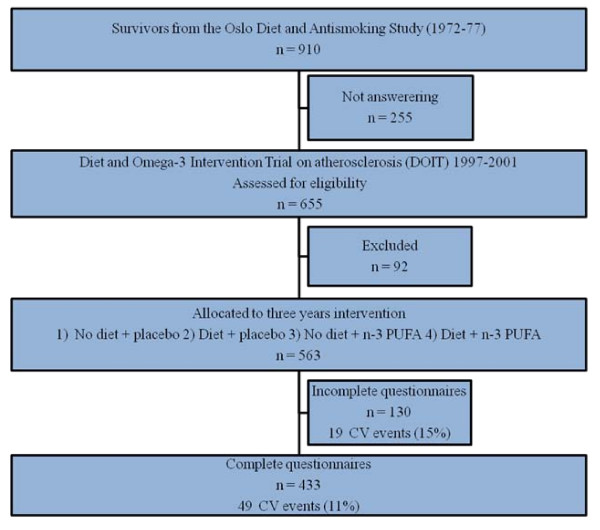
We studied observational data in a cohort of 433 men aged 64-76 years from a prospective, 2 x 2 factorial designed, three-year interventional trial. Information of classical risk factors was obtained and the following questionnaires were administered at baseline: Hospital Anxiety and Depression Scale, Physical Symptom Distress Index and Life Satisfaction Index. The occurrence of cardiovascular death, myocardial infarction, cerebrovascular incidences and peripheral arterial disease were registered throughout the study period. Continuous data with skewed distribution was split into tertiles. Hazard ratios (HR) were calculated from Cox regression analyses to assess the associations between physical distress, quality of life and cardiovascular events.
After three years, 49 cardiovascular events were registered, with similar incidence among subjects with and without established cardiovascular disease. In multivariate analyses adjusted for age, smoking, systolic blood pressure, serum glucose, HADS-anxiety and treatment-intervention, physical distress was positively associated (HR 3.1, 95% CI 1.2 - 7.9 for 3rd versus 1st tertile) and quality of life negatively associated (HR 2.6, 95% CI 1.1-5.8 for 3rd versus 1st tertile) with cardiovascular events. The association remained statistically significant only for physical distress (hazard ratio 2.8 95% CI 1.2 - 6.8, p < 0.05) when both variables were evaluated in the same model.
Physical distress, but not quality of life, was independently associated with increased risk of cardiovascular events in an observational study of elderly men predominantly without established cardiovascular disease.
Trial registration: NCT00764010.
自我报告的健康认知,如身体不适和生活质量,被认为是已确诊心血管疾病患者死亡率和发病率的独立预测因素。本研究调查了这些因素与长期高脂血症老年男性人群中心血管事件三年发病率之间的关联。
我们研究了一项前瞻性、2×2析因设计的三年期干预试验中433名年龄在64 - 76岁男性队列的观察数据。获取了经典危险因素的信息,并在基线时进行了以下问卷调查:医院焦虑抑郁量表、身体症状困扰指数和生活满意度指数。在整个研究期间记录心血管死亡、心肌梗死、脑血管事件和外周动脉疾病的发生情况。将分布呈偏态的连续数据分为三分位数。通过Cox回归分析计算风险比(HR),以评估身体不适、生活质量与心血管事件之间的关联。
三年后,记录到49例心血管事件,在有和没有已确诊心血管疾病的受试者中发病率相似。在对年龄、吸烟、收缩压、血糖、医院焦虑抑郁量表 - 焦虑得分和治疗干预进行调整的多变量分析中,身体不适与心血管事件呈正相关(第三三分位数与第一三分位数相比,HR 3.1,95%CI 1.2 - 7.9),生活质量与心血管事件呈负相关(第三三分位数与第一三分位数相比,HR 2.6,95%CI 1.1 - 5.8)。当在同一模型中评估这两个变量时,仅身体不适的关联仍具有统计学意义(风险比2.8,95%CI 1.2 - 6.8,p < 0.05)。
在一项主要针对没有已确诊心血管疾病的老年男性的观察性研究中,身体不适而非生活质量与心血管事件风险增加独立相关。
试验注册号:NCT00764010。