Tanaka Takuji
Department of Oncologic Pathology, Kanazawa Medical University, 1-1 Daigaku, Uchinada, Ishikawa 920-0293, Japan.
J Carcinog. 2009;8:5. doi: 10.4103/1477-3163.49014.
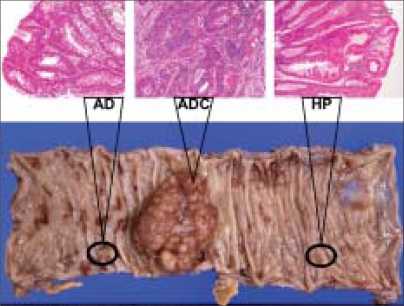
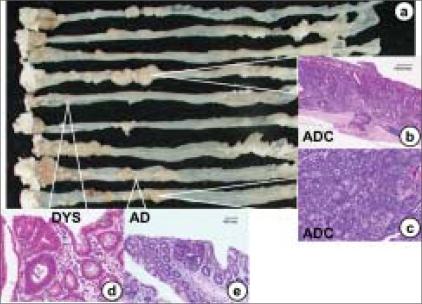
This review gives a comprehensive overview of cancer development and links it to the current understanding of tumorigenesis and malignant progression in colorectal cancer. The focus is on human and murine colorectal carcinogenesis and the histogenesis of this malignant disorder. A summary of a model of colitis-associated colon tumorigenesis (an AOM/DSS model) will also be presented. The earliest phases of colorectal oncogenesis occur in the normal mucosa, with a disorder of cell replication. The large majority of colorectal malignancies develop from an adenomatous polyp (adenoma). These can be defined as well-demarcated masses of epithelial dysplasia, with uncontrolled crypt cell proliferation. When neoplastic cells pass through the muscularis mucosa and infiltrate the submucosa, they are malignant. Carcinomas usually originate from pre-existing adenomas, but this does not imply that all polyps undergo malignant changes and does not exclude de novo oncogenesis. Besides adenomas, there are other types of pre-neoplasia, which include hyperplastic polyps, serrated adenomas, flat adenomas and dysplasia that occurs in the inflamed colon in associated with inflammatory bowel disease. Colorectal neoplasms cover a wide range of pre-malignant and malignant lesions, many of which can easily be removed during endoscopy if they are small. Colorectal neoplasms and/or pre-neoplasms can be prevented by interfering with the various steps of oncogenesis, which begins with uncontrolled epithelial cell replication, continues with the formation of adenomas and eventually evolves into malignancy. The knowledge described herein will help to reduce and prevent this malignancy, which is one of the most frequent neoplasms in some Western and developed countries.
本综述全面概述了癌症发展,并将其与当前对结直肠癌肿瘤发生和恶性进展的理解联系起来。重点是人类和小鼠的结直肠癌发生以及这种恶性疾病的组织发生。还将介绍结肠炎相关结肠肿瘤发生模型(AOM/DSS模型)的总结。结直肠癌发生的最早阶段发生在正常黏膜,伴有细胞复制紊乱。绝大多数结直肠癌起源于腺瘤性息肉(腺瘤)。这些息肉可定义为界限清楚的上皮发育异常肿块,伴有隐窝细胞不受控制的增殖。当肿瘤细胞穿过黏膜肌层并浸润黏膜下层时,它们就是恶性的。癌通常起源于先前存在的腺瘤,但这并不意味着所有息肉都会发生恶性变化,也不排除从头发生肿瘤。除了腺瘤,还有其他类型的癌前病变,包括增生性息肉、锯齿状腺瘤、扁平腺瘤以及与炎症性肠病相关的炎症结肠中出现的发育异常。结直肠肿瘤涵盖了广泛的癌前和恶性病变,如果病变较小,其中许多在结肠镜检查期间很容易切除。通过干扰肿瘤发生的各个步骤可以预防结直肠肿瘤和/或癌前病变,肿瘤发生始于上皮细胞不受控制的复制,接着是腺瘤的形成,最终发展为恶性肿瘤。本文所述的知识将有助于减少和预防这种恶性肿瘤,它是一些西方国家和发达国家最常见的肿瘤之一。