Repsilber Dirk, Martinetz Thomas, Björklund Mats
Department of Genetics and Biometry, Research Institute for the Biology of Farm Animals, Wilhelm-Stahl Allee 2, Dummerstorf, Germany.
EURASIP J Bioinform Syst Biol. 2009;2009(1):618502. doi: 10.1155/2009/618502. Epub 2009 Mar 12.
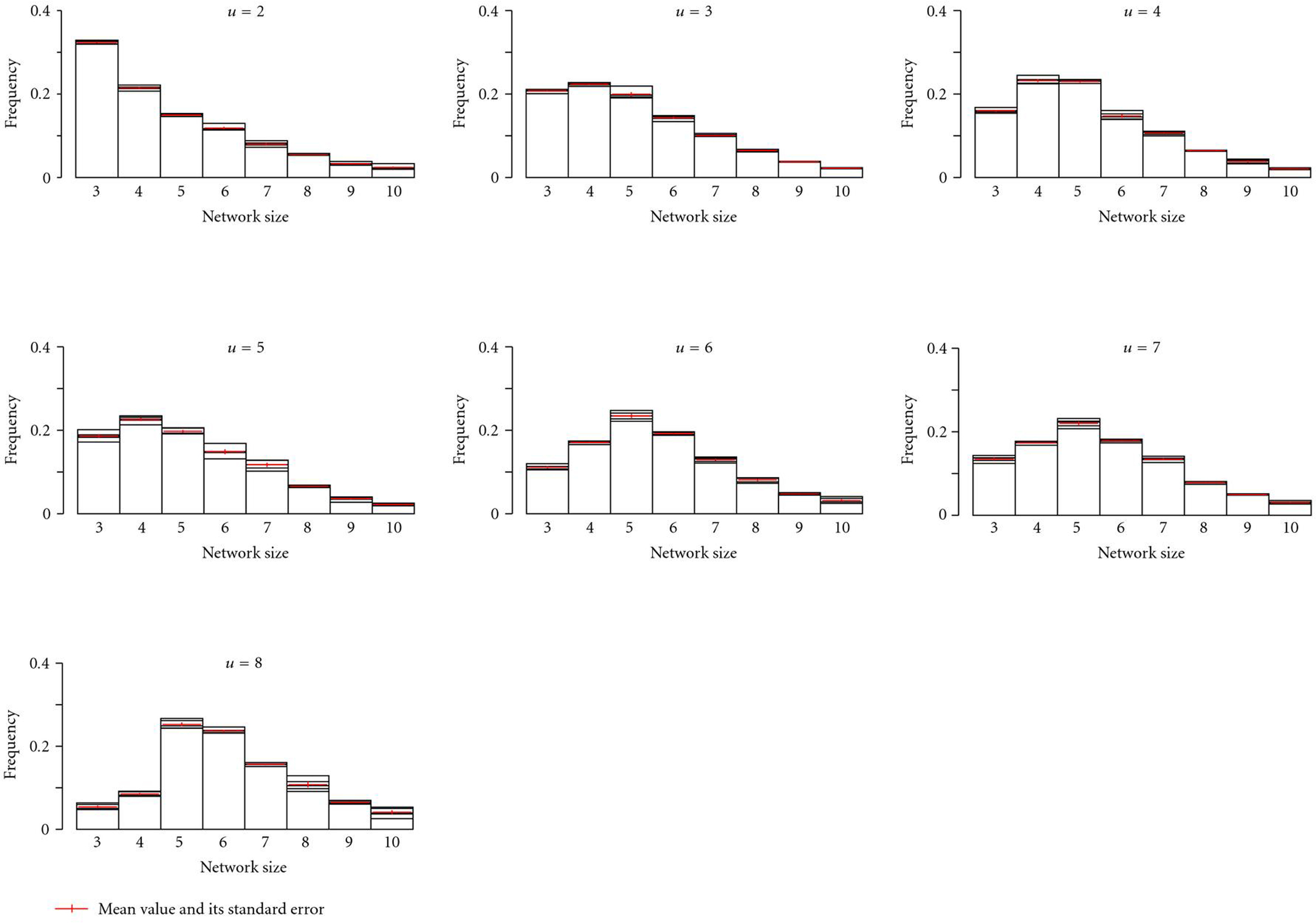
To accomplish adaptability, all living organisms are constructed of regulatory networks on different levels which are capable to differentially respond to a variety of environmental inputs. Structure of regulatory networks determines their phenotypical plasticity, that is, the degree of detail and appropriateness of regulatory replies to environmental or developmental challenges. This regulatory network structure is encoded within the genotype. Our conceptual simulation study investigates how network structure constrains the evolution of networks and their adaptive abilities. The focus is on the structural parameter network size. We show that small regulatory networks adapt fast, but not as good as larger networks in the longer perspective. Selection leads to an optimal network size dependent on heterogeneity of the environment and time pressure of adaptation. Optimal mutation rates are higher for smaller networks. We put special emphasis on discussing our simulation results on the background of functional observations from experimental and evolutionary biology.
为实现适应性,所有生物均由不同层次的调控网络构成,这些网络能够对各种环境输入做出不同反应。调控网络的结构决定了它们的表型可塑性,即对环境或发育挑战的调控反应的详细程度和适当程度。这种调控网络结构编码在基因型中。我们的概念性模拟研究探讨了网络结构如何限制网络的进化及其适应能力。重点是结构参数网络大小。我们表明,小型调控网络适应速度快,但从长远来看不如大型网络。选择导致取决于环境异质性和适应时间压力的最优网络大小。较小网络的最优突变率更高。我们特别强调在实验生物学和进化生物学功能观察的背景下讨论我们的模拟结果。