Department of Medicine, Osher Center for Integrative Medicine, University of California, San Francisco VAMC, 111-A1 4150 Clement Street, San Francisco, CA 94121, USA.
J Autism Dev Disord. 2009 Aug;39(8):1145-54. doi: 10.1007/s10803-009-0724-5. Epub 2009 Mar 31.
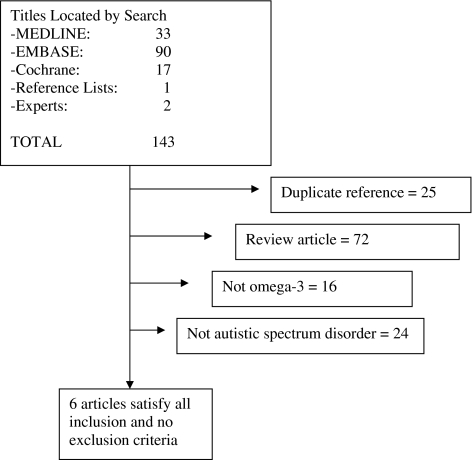
We conducted a systematic review to determine the safety and efficacy of omega-3 fatty acids for autistic spectrum disorder (ASD). Articles were identified by a search of MEDLINE, EMBASE, and the Cochrane Database using the terms autism or autistic and omega-3 fatty acids. The search identified 143 potential articles and six satisfied all inclusion criteria. One small randomized controlled trial (n = 13) noted non-significant improvements in hyperactivity and stereotypy. The remaining five studies were small (n = 30, 22, 19, 9, and 1) with four reporting improvements in a wide range of outcomes including language and learning skills, parental observations of general health and behavior, a clinician-administered symptom scale, and clinical observations of anxiety. Due to the limitations of evidence from uncontrolled studies and the presence of only one small randomized controlled trial, there is currently insufficient scientific evidence to determine if omega-3 fatty acids are safe or effective for ASD.
我们进行了一项系统综述,以确定ω-3 脂肪酸治疗自闭症谱系障碍(ASD)的安全性和疗效。通过在 MEDLINE、EMBASE 和 Cochrane 数据库中使用“自闭症或孤独症”和“ω-3 脂肪酸”这两个术语进行检索,确定了 143 篇潜在文章,其中 6 篇符合所有纳入标准。一项小型随机对照试验(n = 13)指出,多动和刻板行为有非显著改善。其余 5 项研究规模较小(n = 30、22、19、9 和 1),其中 4 项报告了广泛的结果改善,包括语言和学习技能、父母对一般健康和行为的观察、临床医生管理的症状量表以及焦虑的临床观察。由于来自非对照研究的证据存在局限性,且仅有一项小型随机对照试验,目前尚无足够的科学证据来确定 ω-3 脂肪酸是否安全或有效治疗 ASD。